Medical AI specialist Deepnoid announced on the 3rd that it will unveil research results on AI-based lung nodule diagnosis technology at the '2024 North American Radiology Society (RSNA 2024)' held in Chicago, USA.
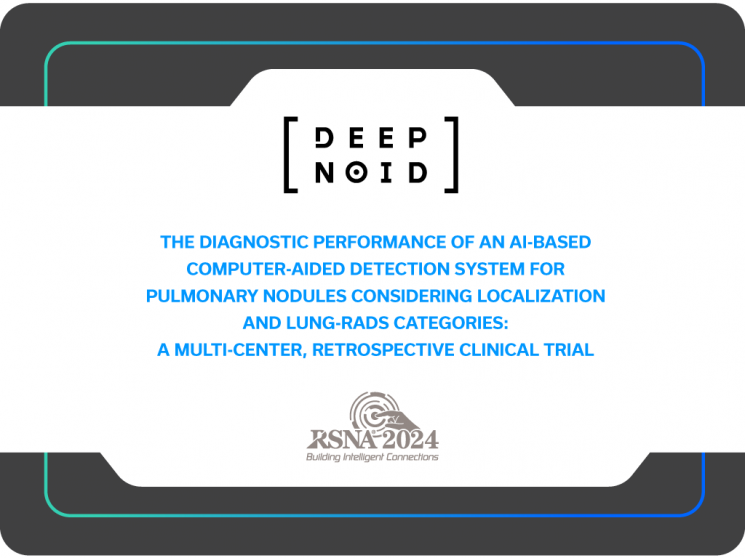
At RSNA, Deepnoid will showcase the excellent diagnostic performance of DEEP:LUNG through an abstract titled "Diagnostic Performance of AI-based CAD System Considering Localization of Lung Nodules and Lung-RADS Categories."
The clinical study evaluated the diagnostic performance of DEEP:LUNG using 455 low-dose chest computed tomography (LDCT) data collected from outpatient and emergency room visits at Pusan National University Hospital, Yangsan Pusan National University Hospital, and Hwasun Chonnam National University Hospital from January 2019 to July 2023. The evaluation included tissue, size, malignancy classification of lung nodules, Lung-RADS categorization, and nodule localization.
When using DEEP:LUNG, key evaluation metrics showed high accuracy with a sensitivity of 91.38%, specificity of 93.08%, and malignancy classification AUROC of 89.62%. AUROC is an indicator used to evaluate the performance of classification models, with a score above 85% considered quite good.
Stable performance was also demonstrated in sensitivity and specificity across Lung-RADS categories. In measuring the size of solid nodules and ground-glass opacity nodules, DEEP:LUNG maintained high precision with error margins within 2mm and 3mm, respectively.
Deepnoid CEO Woo-sik Choi said, "Through this research, we were able to prove that AI can provide significant assistance to medical professionals in the diagnosis and malignancy classification of lung nodules." He added, "Next year, we plan to expand the application of AI solutions to the chest area along with brain disease diagnosis solutions." He continued, "Our next goal is to provide more comprehensive AI diagnostic support tools to the medical field."
© The Asia Business Daily(www.asiae.co.kr). All rights reserved.

















