French Prime Minister adopts social security finance bill by invoking constitutional clause
The French government has pulled out the card of 'parliamentary passing' to process next year's budget bill. The opposition party immediately announced plans to file a motion of no confidence against the government. As the political situation plunged into chaos, the French financial market fluctuated.
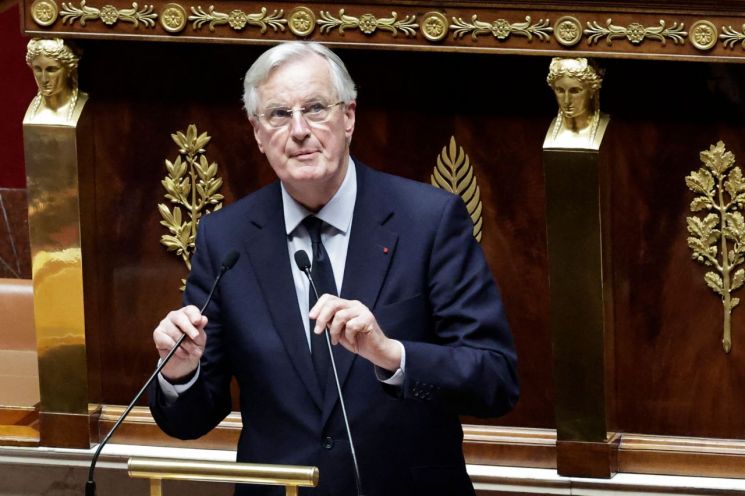
On the afternoon of the 2nd (local time), Prime Minister Michel Barnier made a sudden appearance at the National Assembly, where the Social Security Finance Bill was being reviewed, and declared that the government would take responsibility by invoking a constitutional provision to adopt the Social Security Finance Bill. Article 49, Paragraph 3 of the French Constitution allows the government, when it deems the situation urgent, to pass a bill approved by the Council of Ministers without a parliamentary vote under the prime minister's responsibility.
Prime Minister Barnier said, "The French people will never forgive us if we prioritize private interests over the nation's future," adding, "This is why I am invoking the government's responsibility for the entire bill based on Article 49, Paragraph 3 of the Constitution." He further stated, "Now we have reached a moment of truth where everyone must face their responsibilities," and added, "I will also face my responsibilities."
The Barnier government had earlier submitted next year's budget plan to reduce the fiscal deficit, expected to be 6.1% of this year's gross domestic product (GDP), to 5% next year by cutting government spending and raising taxes. However, the left-wing coalition and the far-right factions, major political forces in the National Assembly, have opposed the government’s budget plan, citing reasons such as decreased consumer purchasing power, worsening social inequality, and increased burdens on businesses.
Until the morning of the same day, Prime Minister Barnier had made some concessions by withdrawing certain tax increase proposals and social security reduction plans from the original budget. Nevertheless, when the far-right National Rally tried to enforce additional demands, it is analyzed that the government invoked the constitutional provision to signal that no further compromise would be made.
The opposition warned that they would file a motion of no confidence against the government. Mathilde Panot, the floor leader of the far-left party La France Insoumise (LFI), criticized, "Barnier will be recorded in history as the prime minister with the shortest term." Marine Le Pen, the de facto leader of the National Rally and floor leader in the National Assembly, expressed her intention to vote in favor of the no-confidence motion regardless of who files it.
The no-confidence motion is expected to pass smoothly. It requires a majority vote of the total members of the National Assembly to be approved. Although the total number of members is 577, two seats are currently vacant, so the quorum for approval is 288. Given the current composition of the National Assembly, the combined seats of the left-wing coalition, the National Rally, and allied forces exceed 300. If the no-confidence motion passes, the Barnier government must immediately resign. Since the establishment of the French Fifth Republic, the last time a government was dissolved due to a parliamentary no-confidence vote was in 1962 under Prime Minister Georges Pompidou.
As the French government faced the risk of collapse that day, the euro exchange rate in the French foreign exchange market plunged 1.01% to $1.0470 per euro compared to the previous trading day, and against the pound sterling, it fell 0.21% to ?0.8287 per euro. The CAC40, France's representative stock index, also dropped as much as 1.2% in early trading due to the possibility of government collapse.
Investor sentiment toward French government bonds was also pressured, with the 10-year government bond yield rising to 2.923%. The 10-year bond spread between France and Germany increased by 8 basis points to 88 basis points. The bond yield difference between Germany, the largest economy in the Eurozone (20 countries using the euro), and neighboring countries is used as a key indicator of economic imbalance. Experts express concerns that if the no-confidence motion materializes and the cabinet resigns, it will lead to a decline in France's credibility in international financial markets, resulting in credit rating downgrades, rising government bond yields, and a decrease in foreign investment, among other economic problems.
Antoine Armand, Minister of Finance and Economy, urged cooperation from the political sphere that is obstructing the government, saying at a press conference on the 30th of last month, "At this critical time, I call on everyone to fulfill their responsibilities beyond party lines for the national interest."
© The Asia Business Daily(www.asiae.co.kr). All rights reserved.
![Clutching a Stolen Dior Bag, Saying "I Hate Being Poor but Real"... The Grotesque Con of a "Human Knockoff" [Slate]](https://cwcontent.asiae.co.kr/asiaresize/183/2026021902243444107_1771435474.jpg)
















