Average Income 970,000 KRW with Monthly Rent Expense of 240,000 KRW
Heating Boiler Cost Burden 89.9% Not Used
City Councilor Park Mijeong, 'Discussion on Seeking Support Measures'
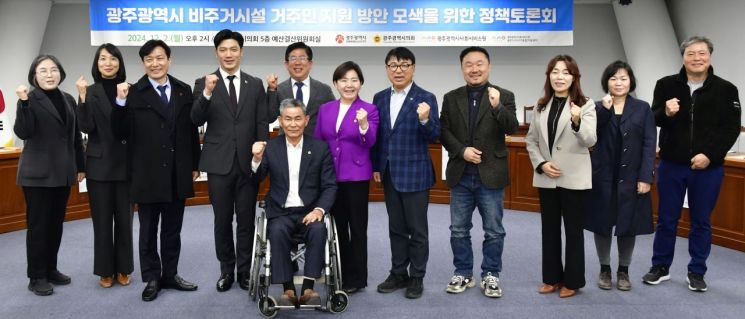 On the 2nd, Park Mi-jeong, a member of the Gwangju City Council, held a policy forum titled "Exploring Support Measures for Residents of Non-Residential Facilities in Gwangju" in the Budget and Accounts Special Committee Room on the 5th floor of the City Council building. Photo by Gwangju City Council
The number of residents living in jjokbang (small rooms) in Gwangju reaches 936, and there are claims that urgent improvements in living conditions are needed along with the provision of welfare services such as the establishment of jjokbit Counseling Centers.
On the 2nd, Park Mi-jung, a member of the Gwangju City Council (Democratic Party, Dong-gu 2), held a policy forum titled "Exploring Support Measures for Residents of Non-Residential Facilities in Gwangju" at the Budget and Accounts Special Committee Room on the 5th floor of the City Council building. The event was jointly hosted by the Gwangju City Council, Gwangju City, Gwangju Social Service Agency, and Gwangju Dasiseogi Comprehensive Support Center.
The jjokbang in the Gwangju area are old non-residential facilities such as motels, inns, and goshiwon (small dormitory rooms), and the exact status of residents has not been accurately identified until now.
At the forum, Lee Sun-mi, Policy Research Director of the Gwangju Social Service Agency, delivered a keynote presentation on the topic of "Living Conditions of Residents in Non-Residential Facilities in Gwangju."
Through a survey, Director Lee confirmed 936 residents living in non-residential facilities among housing benefit recipients. The number of jjokbang residents by autonomous district was ▲Buk-gu 480 (50.7%) ▲Dong-gu 265 (31.3%) ▲Seo-gu 114 (11.6%) ▲Nam-gu 45 (3.8%) ▲Gwangsan-gu 32 (2.6%). By age group, 34.4% were in their 50s, 28.8% in their 60s, and 11.8% aged 70 or older. Due to health reasons and others, 65.9% were not working.
The types of residences were 38% goshiwon, 32.2% motels, and 29.8% inns or guesthouses. Most had bathroom and bathing facilities, but 47.4% lacked kitchens, indicating an urgent need for improvement in living conditions. Although more than 80% had air conditioners or heating boilers, 91.3% and 89.9% respectively did not use them.
They wished to live in rental housing but cited difficulties in securing deposits and monthly rent burdens as reasons for not applying. Additionally, 30.6% were unaware of the system. Most residents were single-person households receiving livelihood or housing benefits, with an average monthly income of 976,000 KRW, of which an average of 246,000 KRW was spent on rent.
In particular, it was found that due to low income, residents experienced material deprivation such as unpaid rent or utility bills, lack of hospital fees and heating/cooling costs, and difficulty purchasing food. 63.9% had no family to contact, and the biggest stressor was economic problems at 45.4%. Over the past year, 18.5% had even contemplated suicide.
Director Lee proposed solutions including ▲expansion of jjokbit Counseling Centers ▲establishment of a case management system through networks of related local organizations ▲guarantee of housing rights through housing upgrades ▲job support ▲medical support ▲food support ▲regular counseling sessions.
Following this, in-depth discussions were held with Park Mi-jung as chairperson, joined by Jang Min-chul, director of Daegu Jjokbang Counseling Center, Kim Ji-eun, professor at Chonnam National University, Kim Jun-hee, senior researcher at the Korea Urban Research Institute, and Park Young-sook, team leader of the Living Security Division in Gwangju’s Care Policy Department.
Councilor Park stated, “The survey confirmed the status of jjokbang residents and identified their living conditions and welfare needs. The provision of welfare services such as the establishment of jjokbit Counseling Centers is urgent,” adding, “I hope today’s forum serves as an opportunity to discuss the various issues faced by jjokbang residents and to seek practical solutions.”
© The Asia Business Daily(www.asiae.co.kr). All rights reserved.

















