With "Apologize and Process Reduced Budget"
Opposition Raises Possibility of Negotiation with Determined Stance
The passage of next year's budget bill has been engulfed in a fog of uncertainty. On the 2nd, the legal deadline for the 2025 budget bill, the People Power Party and the Democratic Party of Korea failed to narrow their differences over the Democratic Party-led reduction amendments. The People Power Party reiterated that negotiations are impossible unless the Democratic Party apologizes for and withdraws the reduction proposals. The Democratic Party stood firm, stating that there would be no concessions on the budget bill and confronted the People Power Party.
On the same day, at the Supreme Council meeting, People Power Party floor leader Choo Kyung-ho said, "The Democratic Party should apologize to the people, the government, and the ruling party for the forced passage in the Budget and Accounts Committee and withdraw the reduced budget proposal," emphasizing, "If the forced passage in the Budget and Accounts Committee is used as leverage to intimidate the ruling party into accepting unreasonable opposition budget increase demands, such tricks should be abandoned altogether."
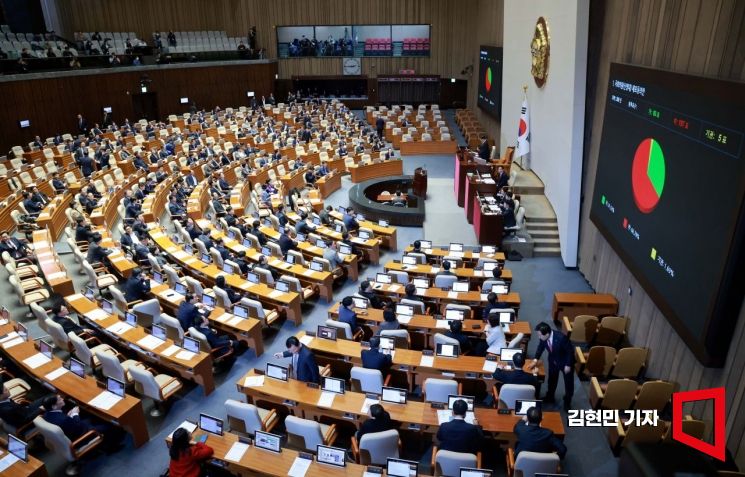 On the 28th, at the plenary session held in the National Assembly, the motion to arrest Shin Young-dae, a member of the Democratic Party of Korea, who was indicted on charges of manipulating primary election polls and bribery, was rejected with 93 votes in favor, 297 against, and 5 abstentions out of 300 members present. Photo by Kim Hyun-min
The ruling party's high-handed stance on the budget appears to be partly based on the judgment that by showing an image of not yielding to opposition pressure, criticism may arise in constituencies due to the exclusion of Democratic Party lawmakers' increased budgets for local projects. Specifically, budgets for regional and national projects such as the Honam High-Speed Railway, Wirye Line road network construction projects, and the 'Great Whale Project' for the development of the East Sea oil and gas fields were significantly cut.
The Democratic Party has left the door open for further negotiations if the ruling party proposes amendments to the budget bill. During the budget review process, the Democratic Party was unable to increase the budget related to 'local currency' due to opposition from the government and ruling party. If the ruling party proposes amendments, it is expected that negotiations could include increasing key opposition budgets together. The Democratic Party stated that it did its best to secure livelihood budgets by cutting unnecessary budgets such as the government's special activity expenses and special security expenses.
The opposition's strong stance is interpreted as an effort to reclaim the National Assembly's budget review authority, which has been ineffective so far, to lay the groundwork for next year's supplementary budget (Chugyeong) formulation, and to shake President Yoon Seok-yeol, whose approval ratings are at a low point.
The key going forward will likely be the decision of National Assembly Speaker Woo Won-shik and the negotiation attitudes of both ruling and opposition parties. If Speaker Woo judges that there is room for negotiation between the parties, he may demand negotiations regardless of the legal deadline and postpone the budget bill's submission. Heo Young, the Democratic Party's Budget and Accounts Committee secretary, said, "Since the 10th is the last day of the regular session, there could be a proposal to set this date as the deadline to allow sufficient negotiation time for both parties to negotiate and process the bill." Whether both parties will show a more flexible attitude even if additional negotiations open remains to be seen. If the ruling party does not propose amendments, the Democratic Party-led reduced budget bill is likely to pass the plenary session. In this case, further reductions led by the opposition party may also occur.
Democratic Party leader Lee Jae-myung emphasized livelihood issues and urged the ruling party to negotiate on the budget bill. At the Supreme Council meeting held in Daegu that day, Lee said, "Economic growth has stopped, and domestic demand is stagnant," adding, "At times like this, the government's active fiscal policy is absolutely necessary."
© The Asia Business Daily(www.asiae.co.kr). All rights reserved.

















