Severe Congestion in Major Cities... Traffic Jams Occur in 293 Locations
Lowest Public Transit Usage... Annual Losses of 2.8 Trillion Won Due to Traffic Jams
Severe traffic congestion in Kumamoto Prefecture, Japan, where the world's largest foundry (semiconductor contract manufacturing) company Taiwan's TSMC is located, is causing an annual economic loss of 300 billion yen (2.8 trillion won). TSMC has demanded the resolution of traffic congestion as a condition for building its third semiconductor factory, raising calls within Japan for measures to address the issue.
Japanese online economic media Mercal recently reported that Kumamoto City in Kumamoto Prefecture has the worst traffic congestion among all designated cities nationwide (large cities with populations over 500,000), and analyzed that this could negatively impact TSMC's factory expansion.
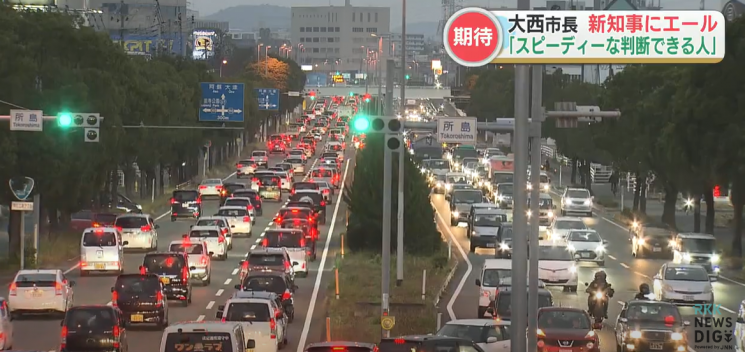 The cityscape of Kumamoto experiencing traffic congestion during the evening commute. Photo by TBS Japan.
There are 293 locations in Kumamoto Prefecture where congestion occurs, with about 60% concentrated in the central Kumamoto City. This is because the establishment of TSMC's factory has led to an influx of new residents into Kumamoto Prefecture and increased traffic volume. In Kikuyo-cho, Kumamoto Prefecture, where the TSMC factory is located, traffic congestion has become much worse than before.
The Ministry of Land, Infrastructure, Transport and Tourism surveyed the number of major congestion points and average vehicle speeds in the central areas of 20 designated cities, finding that Kumamoto City ranked first in the number of major congestion points and last in average vehicle speed. This means it has the most congestion points nationwide and the slowest driving speeds in its central area due to heavy traffic jams.
TSMC warned that traffic congestion could hinder its future factory expansion plans. On September 9, Liu Jingqing, Chairman of Taiwan's National Development Council, pointed out that traffic congestion in Kumamoto Prefecture could be an obstacle to TSMC's entry related to the third factory. He added, "The construction of TSMC's first factory in Kumamoto was efficiently carried out through cooperation among local governments, the Japanese government, and related companies. We expect Kumamoto Prefecture to resolve the traffic congestion issue as well," appealing for countermeasures.
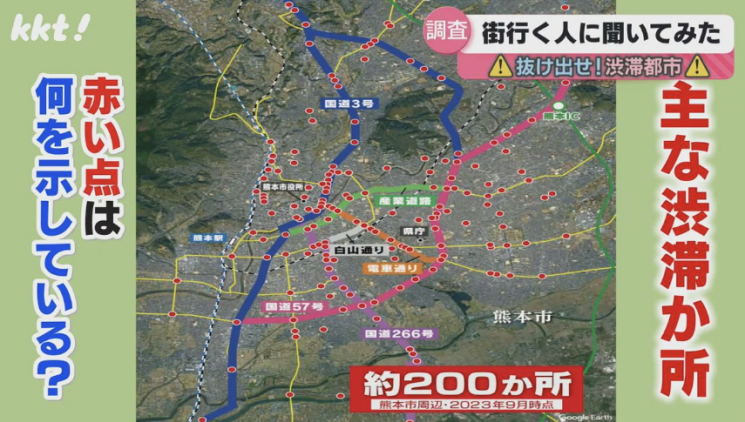 A map marking major locations of traffic congestion in Kumamoto city with red dots. It was found to be over 200 places. KTT (Kumamoto Kenmin TV).
According to estimates by Kumamoto Prefecture, economic losses due to traffic congestion amount to 170,000 yen (1.58 million won) per person annually for Kumamoto residents and 240,000 yen (2.24 million won) annually for Kumamoto City residents. The total annual loss reaches approximately 298 billion yen (2.778 trillion won). Severe traffic jams during commuting hours are likely to lead to an outflow of young people. In fact, the population moving from Kumamoto City to nearby Fukuoka City, which offers convenience in transportation and shopping, is gradually increasing. Mercal pointed out, "There may be no other city besides Kumamoto City where traffic congestion is cited as a factor for population outflow."
This traffic congestion is also influenced by Kumamoto's 'My Car' culture. In the area where TSMC is located, the proportion of people using private cars rather than public transportation is overwhelmingly high. The Ministry of Land, Infrastructure, Transport and Tourism surveyed public transportation usage rates during outings in 16 designated cities and found that Kumamoto City ranked lowest with 4.9% on weekdays. On holidays, the usage rate dropped further to 2.6%.
Kumamoto has defined traffic congestion countermeasures as its most important issue and set goals to "reduce car traffic volume by 10% and double public transportation usage rates."
Although the government is actively promoting measures such as improving public transportation, expanding roads, and increasing telecommuting, voices are emerging that changing the private car culture is the fundamental solution. Mercal added, "Traffic congestion is not just a waste of time but a serious problem that hinders urban development," and "The success or failure of Kumamoto's reforms will be the key to its future development."
© The Asia Business Daily(www.asiae.co.kr). All rights reserved.
![Clutching a Stolen Dior Bag, Saying "I Hate Being Poor but Real"... The Grotesque Con of a "Human Knockoff" [Slate]](https://cwcontent.asiae.co.kr/asiaresize/183/2026021902243444107_1771435474.jpg)

















