Democratic Party Agrees to Postpone for Additional System Improvements
Han Dong-hoon: "Cryptocurrency, a Tool of Hope for Youth"
Creates Tax Blind Spots... Also Compared to the US
The National Assembly has agreed to postpone taxation on cryptocurrency investment income for two years. Following last month's abolition of the financial investment income tax (FIIT), the postponement of cryptocurrency taxation has drawn criticism that the National Assembly is hindering the establishment of a taxation infrastructure and undermining tax justice.
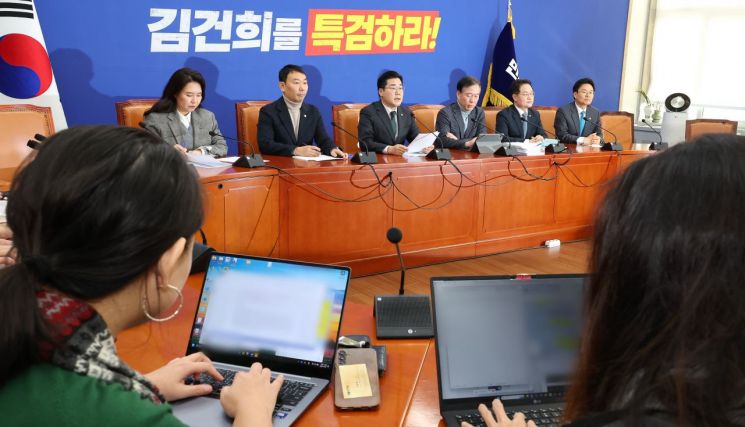 Democratic Party of Korea Floor Leader Park Chan-dae (fourth from the right) is speaking at a press briefing held at the National Assembly on the morning of the 1st. Photo by Yonhap News
On the 1st, Park Chan-dae, floor leader of the Democratic Party of Korea, stated at a press conference at the National Assembly in Yeouido, Seoul, "We agree with the government's amendment to the Income Tax Act to postpone taxation on cryptocurrency investment income for two years," adding, "After deep discussions, we thought it was time for additional institutional adjustments." As a result, cryptocurrency taxation has been postponed twice, following 2022. This discussion on postponing taxation began with the government and ruling party taking the initiative. The Ministry of Economy and Finance approved the 2024 tax law amendment in July, which included a two-year postponement of cryptocurrency taxation. The People Power Party used the postponement of cryptocurrency taxation as leverage to pressure the opposition party. On the 25th of last month, Han Dong-hoon, leader of the People Power Party, argued at the Supreme Council meeting, "Cryptocurrency should be recognized as a new asset formation and a new tool of hope for young people."
This postponement of cryptocurrency taxation closely resembles the process of abolishing the FIIT. Like the FIIT, cryptocurrency taxation was set to be implemented in January next year according to a law already passed by the National Assembly. However, the government and ruling party pressured the opposition party, citing market downturns and the difficulty for general investors to build assets. Within the Democratic Party, voices emerged suggesting that just as they failed to block the FIIT, the postponement of cryptocurrency taxation was an inevitable step.
Although both ruling and opposition parties cited institutional deficiencies as the reason for postponing cryptocurrency taxation, in reality, it appears they gave up on taxation due to tax resistance. Ahead of the cryptocurrency taxation, investors showed resistance to taxation. On the 20th of last month, a petition titled "Request to Postpone Coin Taxation until January 1, 2025" was posted on the National Assembly's public consent petition site. The author of the post stated, "It is like stock investment, but taxing only one side causes fairness issues," and "Taxation without proper laws and supplements is not right." The number of supporters for the post exceeded 50,000 within a day, and it was referred to the relevant standing committee.
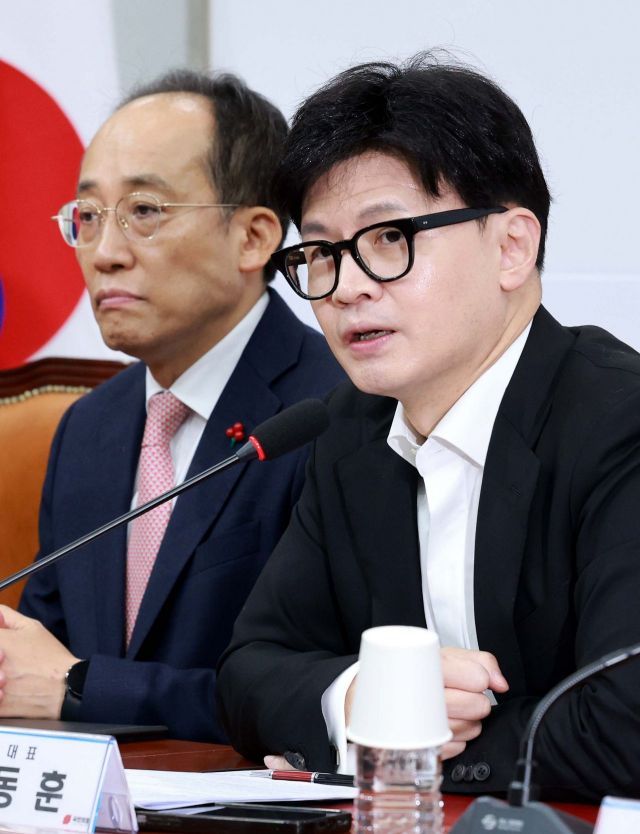 Handonghun, leader of the People Power Party, is speaking at the Supreme Council meeting held at the National Assembly on the 2nd. Photo by Kim Hyunmin
However, experts criticize the National Assembly for setting a bad precedent. They point out that avoiding cryptocurrency taxation due to tax resistance only creates a tax blind spot. This is also compared to the United States. The U.S. first introduced cryptocurrency taxation standards in 2014 and supplemented the system in 2019 and 2020. In 2021, it mandated reporting of profits and transaction details for cryptocurrency trades exceeding $600 annually, eliminating blind spots. Hong Ki-hoon, a professor in the Department of Business Administration at Hongik University, said, "To catch overseas cryptocurrency transactions, it is necessary to identify Korean individuals or corporate accounts abroad, but in the current situation where domestic cryptocurrency transactions are not taxed, it is not easy," adding, "The taxation infrastructure for overseas cryptocurrency transactions is inevitably incomplete."
There are also criticisms that the National Assembly is undermining tax justice itself. The report "Digital Asset Taxation Systems in Major Countries," published by the Korea Institute of Public Finance in October, pointed out, "South Korea does not tax all virtual asset income due to insufficient taxation infrastructure, which is very unusual compared to international trends." Kim Woo-chul, a professor of taxation at the University of Seoul, said, "This postponement of cryptocurrency taxation is a consequence of the abolition of the FIIT," adding, "Tax laws and tax justice should not easily collapse under tax resistance. This will now cause other side effects."
© The Asia Business Daily(www.asiae.co.kr). All rights reserved.


















