Government Consultative Body Established to Study Sanctions Impact
Learning About Dollar Assets and Supply Chain Concerns
Since the outbreak of the Russia-Ukraine war, there has been analysis suggesting that China is supporting the Russian economy while seeking ways to circumvent Western sanctions. This is interpreted as practice for evasion methods in preparation for similar sanctions by the West in the event of a future conflict with Taiwan.
On the 1st (local time), The Wall Street Journal (WSJ) reported that China established an inter-agency government consultative body after Russia's invasion of Ukraine to study the impact of sanctions and regularly produce reports.
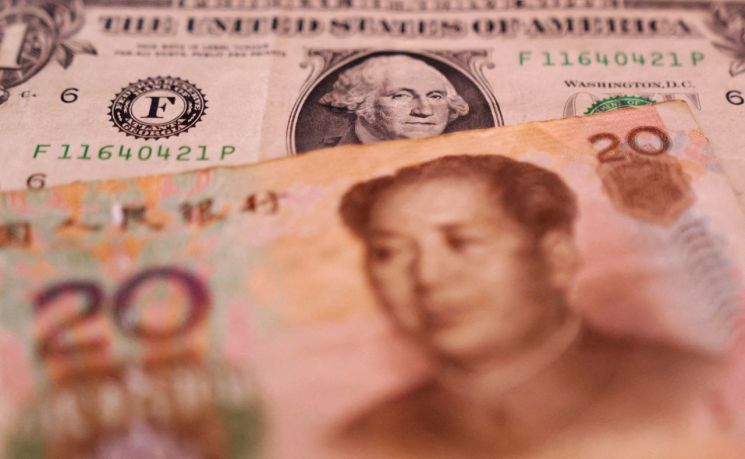
According to sources, this is to research ways to evade similar sanctions that the West might impose on China in the event of a conflict with Taiwan. To this end, Chinese officials regularly visited Moscow, Russia, to meet with the Central Bank, Ministry of Finance, and others.
WSJ stated, "China's research symbolizes a new era of economic warfare, where the boundaries between economic policy and geopolitical strategy are increasingly blurred," adding, "This trend is likely to intensify during Donald Trump's potential second term." The establishment of the consultative body also demonstrates the depth of Sino-Russian cooperation and shows that China's economic support for Russia is not a one-way street.
Alexander Gabuev, head of the Carnegie Moscow Center's Russia and Eurasia Program, said, "For China, Russia serves as a sandbox to understand how sanctions work and how they are managed."
However, senior Chinese government officials drew a line, stating that the consultative body does not imply that China is preparing for an invasion of Taiwan.
Sino-Russian relations have become closer since the Ukraine war. Bilateral trade reached $240 billion last year, driven by Russian oil sales. According to Autostat, about 60% of new cars sold in Russia are Chinese-made. However, WSJ pointed out that while China accounts for one-third of Russia's total trade, Russia represents a small portion of China's trade, making it difficult for Russia to support the Chinese economy in return.
The United States has already imposed sanctions on China, including restrictions on advanced semiconductor exports, but if China and Taiwan engage in full-scale conflict, it could lead to a different scale of economic warfare. According to a report released last year by the Atlantic Council and the Rhodium Group, if the West imposes full-scale financial sanctions on China, China's financial system could collapse, trade could halt, and China's overseas bank assets and reserves of $3.7 trillion (approximately 5,176 trillion won) would be at risk. China is particularly concerned about its foreign exchange reserves exceeding $3.3 trillion (approximately 4,616 trillion won).
Experts say China has learned the necessity of preparation from Russia's experience. Before the Ukraine invasion, Russia diversified its foreign exchange reserves and gained time to protect its economy through de-dollarization. When the West tried to expel major Russian banks from the SWIFT financial network and impose a price cap on oil, Russia responded by strengthening relations with China, Iran, and North Korea. In particular, this secured routes to avoid disruptions in global supply chains.
As China exerts greater influence in the global economy, the costs of sanctions are expected to be much higher. According to the Atlantic Council and the Rhodium Group, at least $3 trillion (approximately 4,197 trillion won) in trade and financial flows could be disrupted. This is equivalent to the annual gross domestic product (GDP) of France.
© The Asia Business Daily(www.asiae.co.kr). All rights reserved.

















