Japan's Eisai and US Biogen Jointly Develop 'Rekembi'
Biweekly Intravenous Injection Removes Causative Substance
The most notable drug recently in South Korea was the obesity treatment drug 'Wegovy.' However, an even more eagerly anticipated drug was the dementia treatment. The Alzheimer's treatment drug 'Leqembi' (generic name: lecanemab), jointly developed by the Japanese pharmaceutical company Eisai and the American biotech company Biogen, has been launched in South Korea.
According to the pharmaceutical industry on the 1st, Eisai's Korean subsidiary, Eisai Korea, announced the domestic launch of Leqembi. Leqembi is a treatment that works by removing amyloid beta (Aβ), one of the main causative substances of Alzheimer's disease. In May, it was approved by the Ministry of Food and Drug Safety as a treatment for adults with mild cognitive impairment or mild Alzheimer's disease caused by Alzheimer's. It is the fourth country in the world to approve it after the United States, Japan, and China.
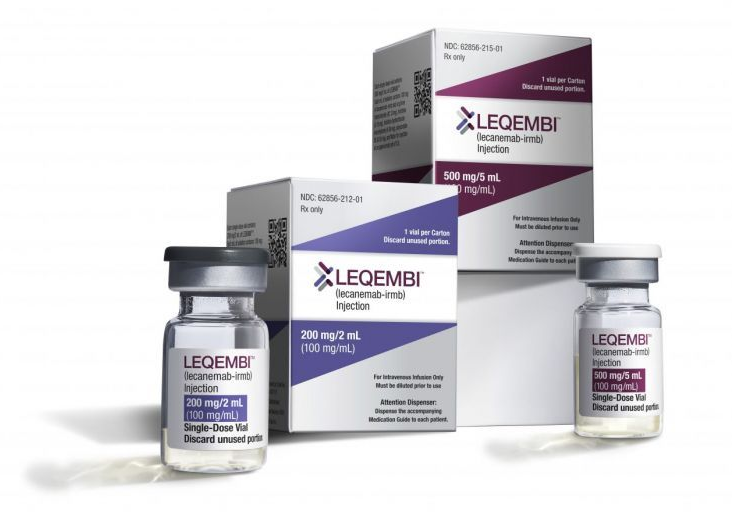
Until now, there has been no specific cure for Alzheimer's disease, and only symptom-relieving drugs have been used. In 2021, Aduhelm, the predecessor of Leqembi, received conditional approval from the U.S. Food and Drug Administration (FDA) but was withdrawn due to controversies over efficacy and safety. Leqembi is administered via intravenous injection once every two weeks and works by preventing the binding of beta-amyloid proteins dissolved in the cerebrospinal fluid in a thread-like form.
Eisai Korea announced that the results of the Phase 3 clinical trial (CLARITY AD) showed that Leqembi delayed the progression of Alzheimer's by about 27%. Among the participating patients, in the group with low tau (TAU) protein levels, 59% (35 out of 41 patients), which is more than half, showed improvement or maintenance of the disease after three years of Leqembi treatment. Tau protein is a factor affecting cognitive decline in Alzheimer's patients, and low tau levels indicate relatively early-stage patients.
The issue is that administration of this drug may cause amyloid-related imaging abnormalities (ARIA) side effects. Brain edema, brain effusion, and microbleeding are examples of ARIA. Additionally, targeting only beta-amyloid has limitations in fully restoring patients' cognitive function.
Meanwhile, according to the 'Status of Dementia in South Korea 2022' published by the Central Dementia Center, the estimated number of dementia patients in South Korea last year was about 1 million. This number is steadily increasing every year, projected to reach 1.42 million by 2030, 2.26 million by 2040, and nearly 3.15 million by 2050. It is known that 70% of all dementia cases are caused by Alzheimer's disease.
© The Asia Business Daily(www.asiae.co.kr). All rights reserved.
!["The Woman Who Threw Herself into the Water Clutching a Stolen Dior Bag"...A Grotesque Success Story That Shakes the Korean Psyche [Slate]](https://cwcontent.asiae.co.kr/asiaresize/183/2026021902243444107_1771435474.jpg)
















