June 25 KOSDAQ Listing at IPO Price of 11,500 KRW
Expectations for Autonomous Driving Regulation Easing under President-elect Trump
Stock Price Up 78% This Month
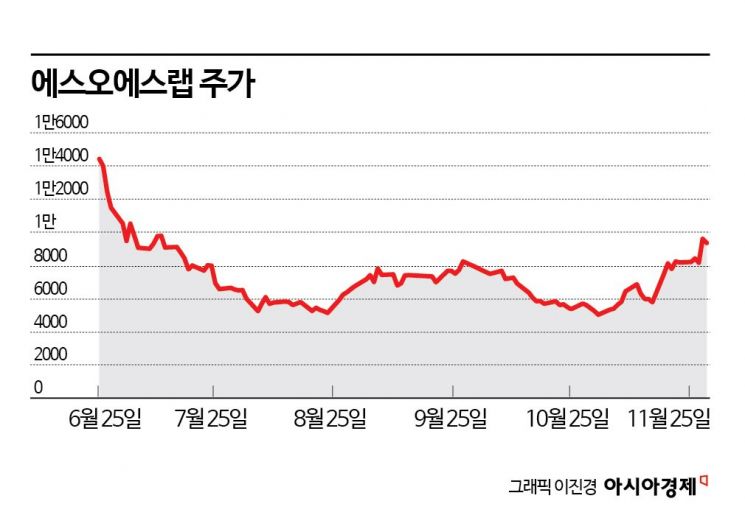
As expectations grow that U.S. President-elect Donald Trump will ease regulations on autonomous driving, domestic related stocks are rising. LiDAR development company SOS Lab, which had seen sluggish stock performance since its listing on the KOSDAQ market on June 25, has also continued a strong rebound trend this month.
According to the financial investment industry on the 2nd, SOS Lab's stock price has risen 78.5% this month. Considering that the KOSDAQ index fell 8.7% during the same period, the market-relative return reaches 87.2 percentage points (P). Individual investors led the stock price increase with a cumulative net purchase of 8.2 billion KRW. The average purchase price for individuals is 8,470 KRW, and based on the current price of 9,370 KRW, the estimated return exceeds 10%.
The LiDAR developed by SOS Lab is a technology that uses a light source to measure distance and position, collecting distance data from surrounding objects to construct three-dimensional spatial information. It can identify the location, size, movement speed, and trajectory of specific objects. Recently, as LiDAR has begun to be applied to autonomous driving technology, its application areas are expanding beyond vehicles to include robots, drones, and more.
SOS Lab was listed on the KOSDAQ market with a public offering price of 11,500 KRW. Although the stock price rose to as high as 21,100 KRW on the day of listing, it fell below 5,000 KRW within two months. Afterward, low-price buying interest flowed in, and the stock price recovered to around 9,000 KRW but dropped back to the 5,000 KRW level last month. Concerns over overhang (potential sell-off volume) hampered the stock. This was due to the sale of shares held by venture financing invested before the listing.
The sluggish stock price began to rebound as prospects for easing autonomous driving regulations in the U.S. emerged. Go Min-seong, a researcher at NH Investment & Securities, said, "After the second Trump administration takes office, there is a high possibility that a policy will pass to expand the annual number of autonomous vehicles allowed on the road from the current 2,500 to 100,000." He added, "If a deregulation policy is established, business opportunities for autonomous driving-related companies will increase significantly."
Choi Seung-hwan, a researcher at Shinhan Investment Corp., explained, "It usually took 2 to 3 years to secure customers and start mass production in the past." He continued, "The mass production timing for automotive and robotics customers who have undergone sample testing from last year to this year is approaching." He added, "Sales are expected to occur first in the robotics and infrastructure sectors," and "From 2026, mass production sales related to autonomous driving will begin in earnest."
Some in the financial investment industry expect SOS Lab to supply LiDAR for the multipurpose mobile robot 'MobED' to be released by Hyundai Motor Group's Robotics Lab. MobED is expected to be equipped with two LiDAR units. If performance is proven through MobED, SOS Lab could also supply LiDAR to Boston Dynamics robots, a world-renowned robot developer acquired by Hyundai Motor.
© The Asia Business Daily(www.asiae.co.kr). All rights reserved.

















