230 Dead in Last Month's Daehong Flood Disaster
Many Commuters Die Due to Authorities' Delayed Response
Recently, while office workers in South Korea experienced a "commuting hell" due to nationwide heavy snowfall, the Spanish government, which suffered massive casualties from severe flooding at the end of last month, introduced 'climate paid leave.'
On the 28th (local time), AFP reported that the Spanish government approved 'climate leave,' allowing workers to take up to four days of paid leave when natural disasters or severe weather anomalies make it difficult for them to commute. Regarding this measure, Yolanda Diaz, Spain's Minister of Labor, told the public broadcaster RTVE, "It is to ensure that no worker is put at risk," adding, "When emergency authorities issue a risk alert, workers should refrain from going to work."
 Near the main route heading to Valencia, Spain, cars are piled up due to a major flood. Photo by Reuters Yonhap News
Accordingly, workers have the right to receive up to four days of paid leave if they are unable to access their workplace or use roads due to travel advisories or restrictions issued by authorities. This is intended to discourage workers from commuting during climate emergencies like last month's floods.
The Spanish government also emphasized that employers must not disadvantage workers who apply for climate paid leave. On the 29th of last month, sudden heavy rains centered around the Valencia region in southeastern Spain caused a total of 230 deaths. Many of these fatalities occurred during commutes due to the government's delayed response, which led to severe criticism and backlash. To prevent similar incidents, the Spanish government has introduced various measures, including urban redevelopment plans incorporating flood control, and has approved billions of euros in aid for flood victims.
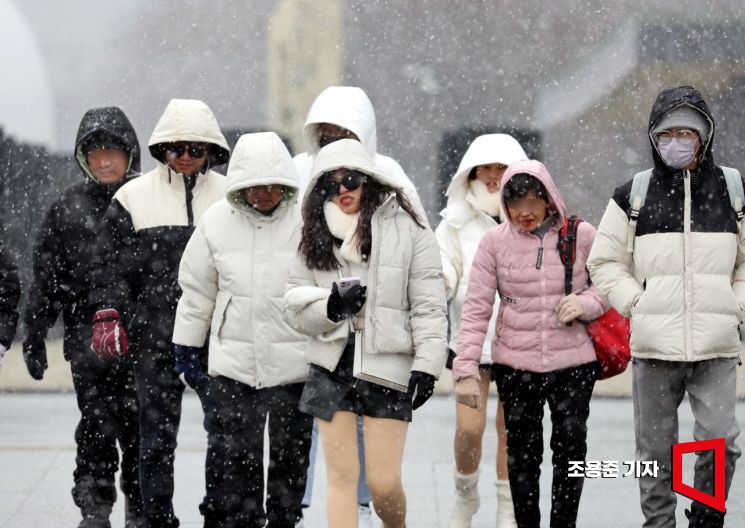 On the 17th, when heavy snow began to fall in Seoul, tourists and citizens were moving while being covered in snow near Gwanghwamun Sejong-daero in Jongno, Seoul.
Meanwhile, in South Korea, from the 26th to the 28th, Seoul experienced the heaviest snowfall in 117 years for November, causing commuting chaos. Notably, in Suwon, Gyeonggi Province, a citizen commuting on skis attracted attention. Unlike cars moving slowly like turtles on snowy roads, this man was seen skiing swiftly along the road. He was later identified as a current physical education teacher and former national ski athlete. He explained that although schools were closed, teachers had to come to work, and he thought skiing would be faster than taking the bus.
In December last year, a man skiing on snowy roads was also spotted in Jeju. At that time, a heavy snow warning was issued across Jeju, paralyzing traffic. The man, dressed in a padded jumper and equipped with ski gear, was seen moving through the streets. When a citizen shouted, "It's too dangerous. Come onto the sidewalk. You might get hurt," the man ignored the warning and calmly passed through the snowy road. Previously, in 2018, a driving school instructor in Jeju city also skied about 12 km to commute when heavy snowfall made public transportation difficult to use.
A survey conducted in July by the civic group Workplace Bullying 119, targeting 1,000 office workers, found that 6 out of 10 workers (61.4%) had experienced commuting on time as usual even during natural disasters such as typhoons, heatwaves, heavy snow, or earthquakes. Notably, 15.9% of workers reported either personally experiencing or witnessing colleagues being harassed or disadvantaged for being late during natural disaster situations.
Regarding these results, Workplace Bullying 119 emphasized, "As damage from natural disasters caused by abnormal climate becomes more frequent, it is urgently necessary to establish regulations within current labor laws, such as the Labor Standards Act, that specify standards and methods for handling absences due to natural disaster situations."
© The Asia Business Daily(www.asiae.co.kr). All rights reserved.