Presidential Office and Prosecutor-Police Special Activity Funds Fully Cut, Half of Government Contingency Funds Reduced
Ruling Party: "A Punitive Cut to Shield Lee Jae-myung"
The Democratic Party of Korea unilaterally passed next year's budget bill, which only reflected cuts without any increases, at the National Assembly's Special Committee on Budget and Accounts on the 29th. This is the first time in constitutional history that the opposition party has passed a budget bill alone.
The budget bill passed by the Budget and Accounts Committee was reduced by 4.1 trillion won from the government's original proposal of 677.4 trillion won. Special activity expenses of the Presidential Secretariat and the National Security Office (8.251 billion won), prosecution's specific task expenses (50.691 billion won) and special activity expenses (8.09 billion won), Board of Audit and Inspection's special expenses (4.5 billion won) and special activity expenses (1.5 billion won), and police special activity expenses (3.16 billion won) were all fully cut.
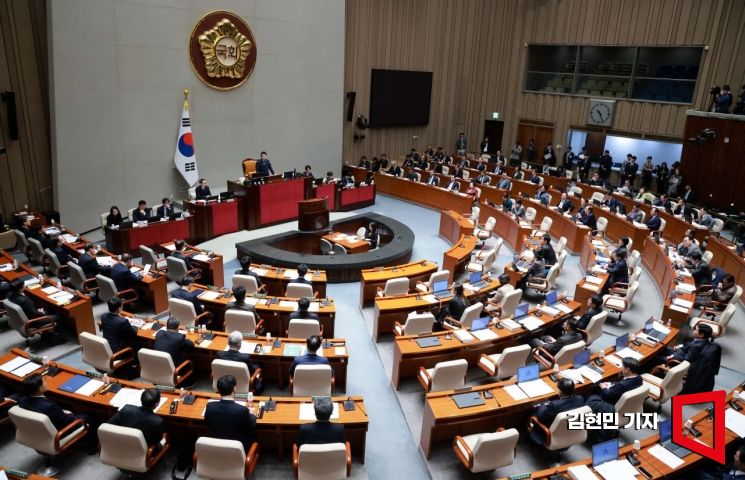 Budget and Accounts Committee Chair Park Jung is presiding over the full meeting of the Special Committee on Budget and Accounts held at the National Assembly on the 29th. Photo by Kim Hyun-min
The government's contingency fund, originally 4.8 trillion won, was cut by 2.4 trillion won, and the budget for national bond interest repayment was also reduced by 500 billion won. The contingency fund refers to an amount pre-allocated within a certain limit to cover unpredictable expenditures outside the budget.
The 'Great Whale Project' budget, which was 50.5 billion won in the government proposal, was cut to 49.7 billion won; the Yongsan Park development project budget, originally 41.6 billion won, was reduced to 22.9 billion won; and the public-private partnership advanced nuclear reactor export infrastructure (R&D) budget, initially 7 billion won, was cut to 6.3 billion won.
The budget for the nationwide mental investment support, which the opposition party labeled as the 'Kim Geon-hee budget,' was also cut by 7.4 billion won from the government's 50.8 billion won proposal.
According to the Constitution, the National Assembly must obtain government consent to increase the budget or create new budget items, but cuts can be made without government approval.
Accordingly, the Democratic Party gave up on increasing the 2 trillion won regional currency (local love gift certificates) budget, which was newly created but not in the government's original proposal. Regional currency is referred to as the 'Lee Jae-myung budget.'
Increases in the 'livelihood budget' agreed upon by both ruling and opposition parties in the relevant standing committees were also not reflected. In the standing committees, the health insurance enrollment support budget was increased by 1.6 trillion won, the renewable energy financial support project budget by 200 billion won, the budget for business closure and career change support due to the end of dog meat consumption by 40 billion won, and the Honam high-speed railway construction budget by 27.7 billion won.
Democratic Party lawmaker Jang Kyung-tae said at the meeting, "The ruling party gave up the livelihood budget to preserve the prosecution's special activity expenses," adding, "We cut the special activity expenses that the prosecution failed to properly justify and conducted the review faithfully as guaranteed by the Constitution."
People Power Party budget committee members held a press conference at the National Assembly Communication Office, criticizing, "This is a retaliatory cut solely to shield Democratic Party leader Lee Jae-myung," and said, "The Democratic Party itself has proven that even the budget, the bastion of people's livelihood, is under Lee Jae-myung, leaving a dark history."
They continued, "The livelihood budget that the Democratic Party said it would increase while talking about people's livelihood was not reflected by even one won in the Democratic Party's unilateral processing," and stated, "We clearly declare that all responsibility for the public's anger lies with the Democratic Party."
The reduced budget bill can, in principle, be submitted to the plenary session on the 2nd of next month. Supplementary budget-related bills such as the Income Tax Act, Inheritance and Gift Tax Act, and Restriction of Special Taxation Act are automatically referred.
However, the People Power Party believes that the likelihood of the budget bill being passed at the plenary session on the 2nd is low.
This is because Speaker Woo Won-shik may feel burdened to submit a budget bill without bipartisan agreement, and opposition lawmakers from local constituencies are expected to oppose the budget bill that does not reflect increases in local budgets.
Democratic Party Budget and Accounts Committee minority whip Heo Young said to reporters after the plenary meeting, "This (budget) bill will be submitted to the plenary session and will be processed within the legal deadline," emphasizing this point.
© The Asia Business Daily(www.asiae.co.kr). All rights reserved.

















