Introduction to Social and Science Subjects from 2027
Excluding Special Education Life English and Information Communication
"Comprehensive Consideration of Expert Opinions in Educational Field"
The Ministry of Education has officially announced a 'speed adjustment' for the introduction of AI digital textbooks, reflecting concerns from the academic community. The Korean language and technology & home economics (sil-gwa) subjects, which were scheduled for introduction in 2026, have been excluded from application, and the introduction in social studies and science subjects for elementary and middle schools has been postponed by one year.
On the afternoon of the 29th, Lee Ju-ho, Deputy Prime Minister for Social Affairs and Minister of Education, held a briefing at the Government Seoul Office and announced the 'AI Digital Textbook Review Results and Introduction Roadmap Adjustment Plan' containing these details. Minister Lee said, "Now, ahead of the introduction of AI digital textbooks, it is time to wisely use digital technology to awaken the sleeping classrooms," adding, "Although there will be various difficulties for teachers as this is the first introduction, I hope everyone will unite during this golden time to transform classrooms and schools, and the Ministry of Education will spare no support."
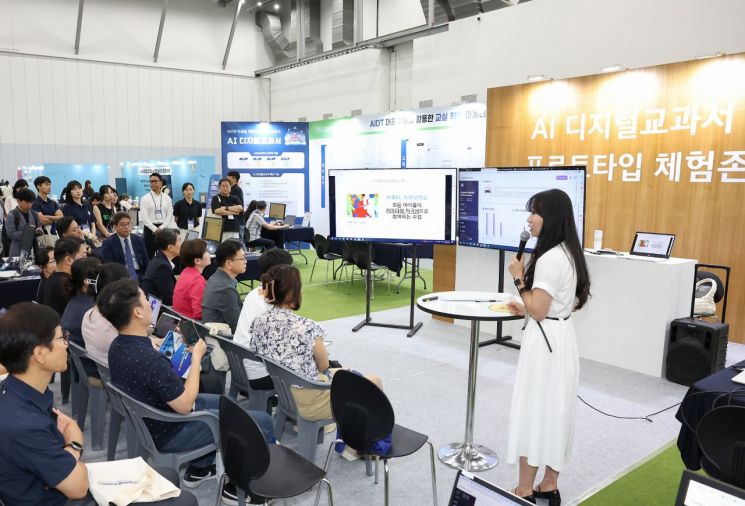
On the same day at midnight, the Ministry of Education published the final results of the AI digital textbook review in the official gazette. A total of 76 types of AI digital textbooks produced by 12 applicants passed. A Ministry of Education official stated, "In the review, the review committee, composed of experts and field teachers, thoroughly verified whether the content was organized to enable effective personalized learning according to the curriculum through content and technical reviews based on the review criteria."
The AI digital textbook introduction roadmap has been adjusted, with some subjects excluded from the application target. The focus will be on demonstrating classroom changes by applying AI digital textbooks in English, mathematics, and information subjects in 2025. The Ministry explained that this decision was made after comprehensively considering opinions from the educational field, experts, and the policy conditions of metropolitan and provincial offices of education.
Although AI digital textbooks were originally planned to be introduced in Korean language and technology & home economics (sil-gwa) subjects in elementary, middle, and high schools in 2026, it was ultimately decided not to introduce them. Earlier, the National Association of Metropolitan and Provincial Superintendents of Education proposed in October that AI digital textbooks be introduced as originally planned in 2025, but adjustments were necessary for subjects applied after 2026, reflecting voices from the school field. Minister Lee also mentioned at the National Assembly audit on October 24, "For AI digital textbook subjects after 2026, we will prepare adjustment plans through expert review and consultation with metropolitan and provincial offices of education."
Similarly, the introduction of AI digital textbooks in social studies and science subjects planned for elementary and middle schools in 2026 has been postponed by one year to 2027, with completion of introduction by 2028. For high schools, since the introduction was originally scheduled for 2028, the schedule will be maintained as is. In special education, life English and information & communication subjects, which were scheduled for introduction in 2027 and 2028 respectively, have been excluded from the application target.
The Ministry of Education stated that it is steadily supporting the creation of an environment for utilizing AI digital textbooks, including infrastructure and teacher capacity building. In the first half of this year, 10,000 leading teachers for classroom revolution were trained, and in cooperation with metropolitan and provincial offices of education, teacher training for 150,000 teachers is underway in the second half of the year.
In particular, starting next month, training will be provided to support schools in selecting which approved textbooks are educationally suitable. After schools select textbooks, practical training on student-centered lesson design using the selected textbooks will be provided to support focused research and design on 'how teachers can effectively utilize AI digital textbooks.'
The Ministry explained that the digital infrastructure is also complete. For the grades applying AI digital textbooks next year?elementary grades 3 and 4, middle school grade 1, and high school grade 1?devices are fully equipped, and together with education offices, devices and networks in schools are being inspected and improved by February next year.
The Ministry emphasized that AI digital textbooks can stimulate students' learning interest and provide content tailored to their level. An interim analysis of the effectiveness of AI courseware classes was conducted on 1,049 students from schools designated as digital leading and research schools from September last year to this year. The average score in the 'use of learning strategies' area increased from 3.55 to 3.86, and in the 'self-regulation' area, the average rose from 3.59 to 3.71.
The AI digital textbooks that passed the review are scheduled to be distributed to schools starting next month. Schools will decide which textbooks to adopt and use them in the field from the first semester of next year.
© The Asia Business Daily(www.asiae.co.kr). All rights reserved.
![Clutching a Stolen Dior Bag, Saying "I Hate Being Poor but Real"... The Grotesque Con of a "Human Knockoff" [Slate]](https://cwcontent.asiae.co.kr/asiaresize/183/2026021902243444107_1771435474.jpg)
















