In the 21st and 22nd National Assembly,
both ruling and opposition parties rushed to propose
9 bills including 'synthetic nicotine cigarettes'
Government concludes 'synthetic nicotine more harmful than tobacco'
Concerns over small business damage and big company monopoly
Shift to public hearing amid worries over increased heated tobacco consumption
The National Assembly has entered a period of deliberation after deciding to hold a public hearing to gather opinions from stakeholders including the government, academia, and industry on whether liquid cigarettes containing synthetic nicotine should be regulated under the Tobacco Business Act.
Although the government recently submitted a research report indicating that synthetic nicotine solutions contain more harmful substances (carcinogenic and reproductive toxicity, etc.) than natural nicotine derived from tobacco leaves, concerns have also been raised about the damage to small business owners selling liquid nicotine-containing e-cigarettes and cases of monopolization by large corporations. Therefore, the decision has been postponed to listen to various opinions.
According to the National Assembly on the 28th, the 1st Economic and Fiscal Subcommittee of the Planning and Finance Committee discussed the amendment to the Tobacco Business Act at the National Assembly the previous afternoon and decided to hold a public hearing.
Article 2 of the current Tobacco Business Act defines tobacco as "products manufactured by using the leaves of tobacco (煙草) as all or part of the raw material, suitable for smoking, sucking, inhaling as vapor, chewing, or smelling." Because of this, natural nicotine liquid-type e-cigarettes made using tobacco leaves as raw materials are classified as tobacco and are legally regulated, whereas synthetic nicotine liquid-type e-cigarettes are not subject to legal regulation. Synthetic nicotine is classified as an industrial product, so tobacco taxes and levies are not imposed.
◆Ruling and opposition parties reach consensus on amending the Tobacco Business Act following the 21st National Assembly
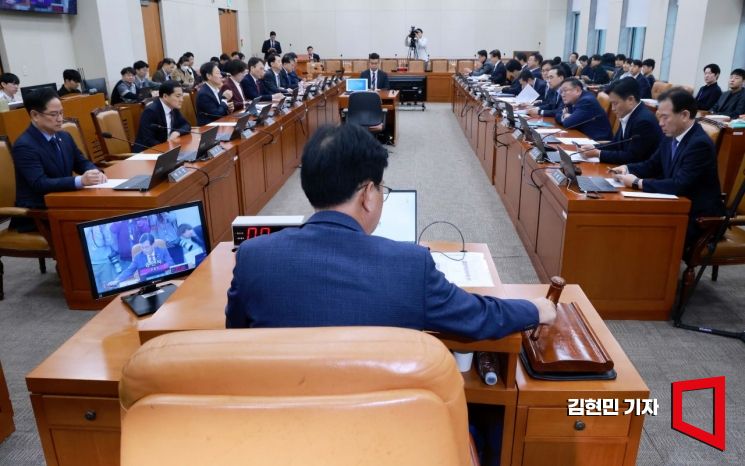 On the 14th, at the Planning and Finance Committee plenary meeting held in the National Assembly, Chairman Song Eon-seok is striking the gavel. Photo by Kim Hyun-min
Following the 21st National Assembly, in the 22nd National Assembly, bills have been continuously proposed by both ruling and opposition parties to include synthetic nicotine as tobacco under the Tobacco Business Act.
Previously, Democratic Party lawmakers Choi Hye-young and Jeong Chun-sook each introduced bills in July 2020 to regulate synthetic nicotine under the Tobacco Business Act.
At that time, lawmakers Choi and Jeong pointed out that while sales and distribution of tobacco products made from natural nicotine derived from stems and roots rather than leaves, as well as synthetic nicotine, were increasing, these products were excluded from individual consumption tax imposition and warning labels, calling for a revision of the definition of tobacco and a prohibition on selling non-tobacco products for smoking purposes.
From the People Power Party, lawmaker Ryu Seong-geol introduced a Tobacco Business Act amendment in March last year to regulate new types of tobacco containing natural nicotine derived from stems and roots rather than tobacco leaves. Although this did not regulate synthetic nicotine, it expressed agreement on the need to broaden the scope of tobacco.
In the 22nd National Assembly, opinions advocating stricter regulation of synthetic nicotine have become more active. Of the 771 tons of nicotine solution for liquid-type e-cigarettes imported and distributed in 2023, 216 tons were synthetic nicotine, nearly double the 121 tons imported and distributed in 2021, raising concerns about potential harm. According to the National Assembly, the excise and other levies not imposed on synthetic nicotine tobacco amount to 3.4 trillion KRW over four years.
People Power Party lawmaker Park Seong-hoon submitted an amendment to the Tobacco Business Act in July, arguing that there is no legal regulation on liquid-type e-cigarettes using synthetic nicotine as raw material, and that sales facilities for these products have been established near elementary, middle, and high schools, calling for regulation at the same level as tobacco. Additionally, lawmakers Kim Tae-nyeon, Kim Seon-min, Nam In-soon, Han Ji-a, Jeon Jin-sook, Choi Eun-seok, Jo Eun-hee, and Song Eon-seok from the People Power Party, Democratic Party, and the Innovation Party have submitted bills to broadly define tobacco under the Tobacco Business Act regardless of party affiliation. Furthermore, Song Eon-seok, chairman of the Planning and Finance Committee, which oversees the bill, also introduced the same bill.
"Liquid nicotine is more harmful to health than natural nicotine," government research results also announced
An official from the Ministry of Health and Welfare appeared at the fiscal subcommittee reviewing the Tobacco Business Act amendment the previous day and submitted final results indicating a high likelihood of health harm from synthetic nicotine contained in 46 types of liquid cigarettes.
According to the final research results, analysis of residual amounts of 69 harmful substances showed that 12,509 mg/L were detected in 45 items in natural nicotine solutions, whereas 23,902 mg/L were detected in 41 items in synthetic nicotine solutions. The total amount of harmful substances detected was higher in synthetic nicotine than in natural nicotine. Alkaloids had higher residual amounts in synthetic nicotine solutions, and contrary to claims by e-cigarette sellers, tobacco-specific nitrosamines (TSNAs) were detected in synthetic nicotine as well. Among these, carcinogenic NNN and NNK precursors were found at high concentrations.
The research report stated, "The claim that synthetic nicotine is a pure substance is not true," and recommended that, as in countries such as the United States, the United Kingdom, and Canada, synthetic nicotine and tobacco nicotine should be managed without distinction, emphasizing the need for uniform regulation. The Ministry of Economy and Finance also conveyed its opinion to the Planning and Finance Committee that synthetic nicotine should be regulated as tobacco under the Tobacco Business Act.
'Small businesses die and large corporations monopolize'... Ruling and opposition parties shift to 'opinion gathering' through public hearings
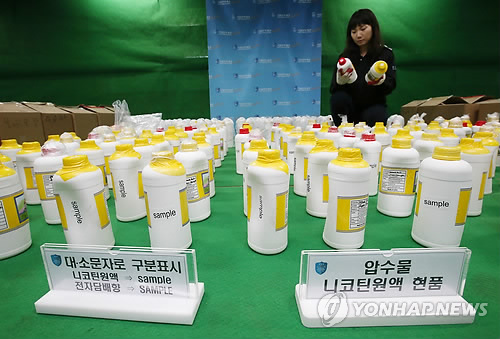 Nicotine concentrate. Photo by Yonhap News Agency
Although lawmakers from both parties have proposed nine bills over about six months since the opening of the 22nd National Assembly, they have not immediately submitted them to the plenary session due to concerns about the economic impact on retail store owners. Since the production cost of synthetic nicotine is higher than that of nicotine from tobacco leaves, if liquid-type e-cigarettes made with synthetic nicotine are included in the definition of tobacco, prices would rise due to various taxes, potentially harming small retailers. In particular, industry demands to consider the risk of market monopolization by large tobacco companies such as BAT and Rothmans, which have launched synthetic nicotine e-cigarettes domestically, were also reviewed.
Concerns were also reflected that the use of liquid-type e-cigarettes as smoking cessation aids might divert users and increase consumption of heated tobacco products. In fact, the UK's Public Health England has issued guidance stating that liquid-type e-cigarettes are less harmful than cigarettes and can help with smoking cessation. The New Zealand Ministry of Health also promotes that liquid-type e-cigarettes can aid quitting smoking and are less harmful than cigarettes.
The Korea Electronic Liquid Safety Association, composed of stakeholders, maintains the position that "about 98% of synthetic nicotine sold on the market is fake," and that "the National Assembly should scrap the amendment to include synthetic nicotine as tobacco and first investigate the ugly criminal reality of illegal fake synthetic nicotine businesses that evade taxes and harm public health."
In response, Democratic Party lawmaker Jeong Tae-ho, the opposition whip of the Planning and Finance Committee, proposed holding a public hearing, and Democratic Party lawmaker Jin Sung-jun suggested convening a hearing with government, industry, and academic representatives. Lawmaker Jeong said, "Distributors and sellers of synthetic nicotine distinguish between fake synthetic nicotine and harmless synthetic nicotine," calling for a process to gather opinions. People Power Party lawmaker Park Dae-chul pointed out that there are about 4,000 small business stores selling synthetic nicotine and said, "If these small business owners fall within the legal category, measures should be put in place to address their damages." Song Eon-seok, chairman who originally introduced the Tobacco Business Act amendment, also agreed with the concerns of lawmakers from both parties and shifted to holding a public hearing to collect diverse opinions.
© The Asia Business Daily(www.asiae.co.kr). All rights reserved.

















