'Passage of Amendment Increasing "Companion Order" for Nonattendance at Hearings'
The National Assembly plenary session passed a revision to the standing special prosecutor rules that exclude the ruling party from investigations involving the president or their family. A bill allowing the issuance of a summons order for non-attendance at hearings was also approved, led by the opposition party.
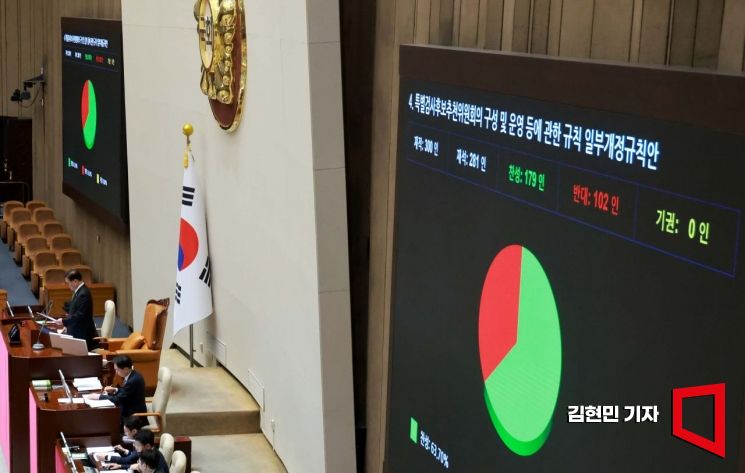 On the 28th, the partial amendment to the rules concerning the composition and operation of the Special Prosecutor Candidate Recommendation Committee was passed at the National Assembly plenary session. Photo by Kim Hyun-min
On the 28th, the National Assembly held a plenary session and voted on the "Partial Amendment Rules on the Composition and Operation of the Special Prosecutor Candidate Recommendation Committee" (Standing Special Prosecutor Bill), passing it with 179 votes in favor, 102 against, out of 281 members present. The "Partial Amendment Act on Testimony and Appraisal in the National Assembly" (Testimony and Appraisal Act) was also voted on and passed with 171 votes in favor, 96 against, and 2 abstentions out of 269 members present. Although the ruling party cast opposing votes, the bills were passed under the leadership of the opposition party.
The Standing Special Prosecutor Bill centers on excluding the ruling party’s two recommended members from the seven-member Standing Special Prosecutor Candidate Recommendation Committee when investigations involve the president or their family. Although the Special Prosecutor Act concerning First Lady Kim Geon-hee (Kim Geon-hee Special Prosecutor Act) passed the National Assembly plenary session three times, President Yoon Seok-yeol repeatedly exercised his veto power, leading the opposition to prepare this alternative. Since the rule revision is not subject to veto, it will be implemented immediately upon passage in the plenary session.
The Democratic Party emphasized the necessity of the Standing Special Prosecutor Bill to investigate allegations surrounding First Lady Kim. Kim Yong-min, a member of the Democratic Party of Korea, stated before the vote, "(The Standing Special Prosecutor Bill) is to appoint a special prosecutor who can conduct investigations of the president, their spouse, and family more fairly and neutrally," adding, "President Yoon, who has vetoed a special prosecutor for himself and his spouse three times, is trampling on the spirit of our country's constitution."
On the other hand, the ruling party opposed the Standing Special Prosecutor Bill, claiming it was for political conflict. Joo Jin-woo, a member of the People Power Party, said before the vote, "In short, the Standing Special Prosecutor Bill means the Democratic Party wants to pick and choose special prosecutors to investigate as they please," and added, "If the bill passes, it will become a lawless state where the ruling party’s prosecution office and the opposition’s standing special prosecutor clash over every case and conduct mutual raids."
The Testimony and Appraisal Act is also a bill with significant differences between the ruling and opposition parties. Kang Myung-gu of the People Power Party said, "Forcibly summoning a person is a frightening matter," and added, "(The summons order system) should be exercised very restrictively." Meanwhile, Min Hyung-bae of the Democratic Party said, "I really don’t understand why People Power Party members oppose this bill," and pointed out, "This Testimony and Appraisal Act is about fully establishing the National Assembly representing the sovereign citizens and upholding the spirit of the constitution."
© The Asia Business Daily(www.asiae.co.kr). All rights reserved.

![Clutching a Stolen Dior Bag, Saying "I Hate Being Poor but Real"... The Grotesque Con of a "Human Knockoff" [Slate]](https://cwcontent.asiae.co.kr/asiaresize/183/2026021902243444107_1771435474.jpg)















