Bank of Korea Cuts Base Rate Twice Consecutively Amid Economic Slowdown Concerns
Growth Forecast for Next Year at 1.9%, Below Potential Growth Rate
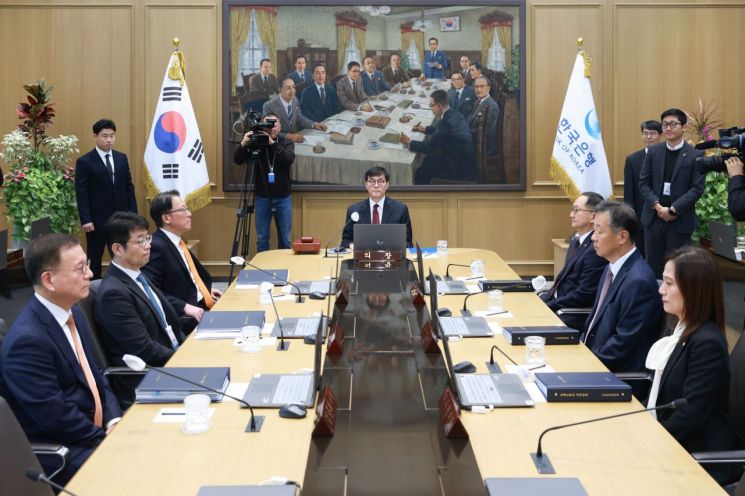 The Bank of Korea's Monetary Policy Committee (MPC) announced on the morning of the 28th at the Bank of Korea headquarters in Jung-gu, Seoul, that it has decided to set the base interest rate at 3.00% per annum. This is a 0.25 percentage point decrease from the previous 3.25%. Lee Chang-yong, Governor of the Bank of Korea (center), is presiding over the meeting held that day.
The Bank of Korea has cut its benchmark interest rate twice in a row. This is interpreted as a rapid rate cut to stimulate the economy amid growing concerns about economic sluggishness. The economic growth forecast for next year has been revised downward from the previous 2.1% to 1.9%, which is below the potential growth rate (2.0%).
The Monetary Policy Board (MPB) of the Bank of Korea announced on the morning of the 28th at the Bank of Korea headquarters in Jung-gu, Seoul, that it had set the benchmark interest rate at 3.00% per annum, down 0.25 percentage points from the previous 3.25%.
The MPB had lowered the benchmark interest rate by 0.25 percentage points from 3.50% to 3.25% on the 11th of last month, marking a pivot (monetary policy shift) for the first time in 3 years and 2 months. While the market expected the Bank of Korea to hold rates steady this month to observe the effects of the previous cut, the Bank chose to cut rates twice consecutively.
The Bank of Korea’s unexpected rate cut is interpreted as a response to the recent very poor economic conditions in South Korea. The country’s economic growth rate for the third quarter was 0.1%, significantly below the expected 0.5%. The slowdown in export growth of key items such as semiconductors, automobiles, and secondary batteries, which had supported the economy, is the cause.
The problem is that this trend is likely to continue into next year. Experts believe that if the tariff policies of the second Trump administration are fully implemented next year, they will significantly reduce South Korea’s exports and economic growth rate.
The Korea Institute for Industrial Economics and Trade, a government research institute, estimated that if the universal tariffs (10-20%) promised by President Trump are actually imposed, South Korea’s exports to the U.S. could decrease by up to 14% (about $9.3 billion). This would lower South Korea’s economic growth rate by 0.2 percentage points. The Hyundai Research Institute analyzed that if the U.S. wages a tariff war not only with China but with all countries worldwide, South Korea’s economic growth rate could decrease by as much as 1.1 percentage points in the worst case.
The Bank of Korea’s downward revision of next year’s economic growth forecast was also cited as a reason for the rate cut on this day. In its revised economic outlook, the Bank lowered the forecast for next year’s economic growth from 2.1% to 1.9%. The growth forecast for this year was also revised down from 2.4% to 2.2%.
Private research institutions that predict next year’s economic growth will fall short of the Bank of Korea’s 1.9% forecast are increasing. Goldman Sachs forecast South Korea’s economic growth at 1.8% next year. Kwon Guhoon, senior economist at Goldman Sachs, said, “The tariff policies of the second Trump administration will be a downside risk for the Korean economy,” adding, “Export weakness has already started in the second half of this year, and investment is likely to decrease accordingly.”
Morgan Stanley also projected South Korea’s growth rate at 1.7% next year. Morgan Stanley cited domestic demand weakness and Trump’s tariff policies as negative factors. Other major investment banks (IBs) such as Nomura Securities, JP Morgan, Barclays, and Citi also lowered their growth forecasts for South Korea next year to the high 1% range.
Professor Son Jongchil of the Department of Economics at Hankuk University of Foreign Studies said, “Corporate investment is shrinking, and the pace of benchmark rate cuts is slower than initially expected, so next year’s economy does not look easy,” adding, “Without government intervention such as bond issuance, it will be difficult for next year’s economic growth rate to exceed 2.0%.”
Park Jungwoo, economist at Nomura Securities, evaluated the rate cut as “a benchmark interest rate cut to mitigate downside risks to next year’s growth amid growing concerns about exports following the U.S. presidential election.”
© The Asia Business Daily(www.asiae.co.kr). All rights reserved.
![From Bar Hostess to Organ Seller to High Society... The Grotesque Con of a "Human Counterfeit" [Slate]](https://cwcontent.asiae.co.kr/asiaresize/183/2026021902243444107_1771435474.jpg)
















