Christian Contact Leads to 'Life Imprisonment Without Parole' Punishment
Vatican Foundation Report Highlights 'Religious Persecution' in North Korea
Kim Il-sung Calls Religion "Opium"... Persecution Under Juche Ideology
After the 'large-scale forced repatriation' that took place in China last October, claims have emerged that North Korean authorities sent defectors who had been exposed to Christianity to political prison camps. Concerns have been raised that harsh punishments equivalent to life imprisonment without parole are being carried out simply because they did not worship the sole ideology of the 'Suryong' and held religious beliefs.
The Vatican foundation 'Aid to the Church in Need (ACN)' recently published a report stating, "Among the defectors repatriated from China last year, those found to have had contact with Christians were sent to political prison camps." These camps are unofficial detention facilities called 'management centers.'
The report explained, "The North Korean State Security Department interrogates defectors based on reports provided by Chinese police (Public Security). If the report contains information related to religion, the defectors are sent to the camps without exception, regardless of any explanation they provide." China forcibly repatriated about 500 defectors residing in China immediately after the closing of the Hangzhou Asian Games last October, and such measures were taken against defectors dragged back to North Korea at that time. While ordinary defectors received relatively light punishments, those classified as having had contact with Christians were subjected to harsh punishments equivalent to life imprisonment without parole.
The camps have been notorious since the past. They are known for arbitrary detention, as well as assault, torture, and even executions. However, Park Kwang-ho, director of the North Korean Central Court, claimed at the United Nations Universal Periodic Review (UPR) earlier this month that "there are no political prison camps in the Republic." Nevertheless, he partially acknowledged the authorities' forced measures by stating, "Those 'human garbage' who not only betray but attempt to overthrow the motherland cannot escape judgment."
In North Korea, where the concept of 'human rights' is virtually absent, 'freedom of religion' is also not guaranteed. Looking back at modern history, religion such as Protestantism and Catholicism spread earlier in the northern region of the Korean Peninsula than in the south before liberation. According to data from the General Association of Korean Residents in Japan (Chongryon), as of 2004, the number of Christians in North Korea was 12,000, Catholics 800, Buddhists 10,000, and Cheondoists 15,000.
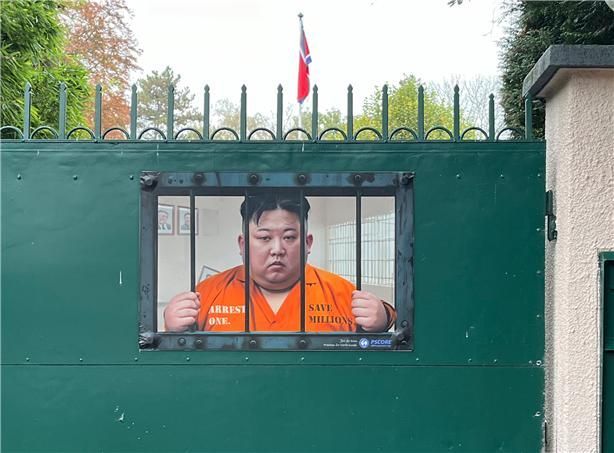 The North Korean human rights organization PSCORE, in collaboration with the Lee Je-seok Advertising Research Institute, created a public service poster protesting North Korea's human rights abuses and attached it to the iron gate of the North Korean mission in Geneva, Switzerland. The poster features North Korean State Affairs Commission Chairman Kim Jong-un wearing a burial shroud, appearing trapped behind bars, along with the English phrase "ARREST ONE, SAVE MILLIONS," conveying the message that if one person is arrested, millions can be liberated. Photo by Lee Je-seok Advertising Research Institute
However, religion in North Korea has been considered underground since shortly after liberation. Chairman Kim Il-sung began persecuting religion by promoting the sole ideology system, viewing religion as an 'unscientific reactionary act' and a target for struggle and eradication. Kim Il-sung famously compared religion to 'opium.' This is because religion posed an obstacle to the worship of the Suryong and allowed residents to organize and interact outside government control.
Subsequently, when inter-Korean dialogue began in 1972, North Korea permitted the activities of religious organizations to create the appearance of 'freedom of religion.' These included various groups such as the Korean Christian Federation, the Korean Buddhist Federation, and the Central Guidance Committee of the Korean Cheondo Church, but they were merely nominal organizations. Most North Korean religious organizations were used as channels for receiving aid from South Korean religious groups during the active inter-Korean exchanges in the 2000s.
The ACN report estimated that, due to severe religious persecution, it is difficult to ascertain exact numbers, but there are approximately 98,000 Christians in North Korea. This accounts for only about 0.38% of the total North Korean population.
© The Asia Business Daily(www.asiae.co.kr). All rights reserved.


















