Facing the so-called 'Trump tariffs' threat, Mexico's President Claudia Sheinbaum spoke again on the 27th (local time) with U.S. President-elect Donald Trump to discuss immigrant suppression and drug interdiction. She expanded communication channels with Trump and reaffirmed Mexico's stance that it would retaliate if a 25% tariff were imposed on Mexico.
President Sheinbaum confirmed the call on social media platform X (formerly Twitter) in the afternoon, saying, "I had a good conversation with Trump." She explained, "We discussed Mexico's strategy on migration and shared that caravans (large groups of migrants) are staying inside Mexico and thus not reaching the northern border," adding, "We also talked about strengthening cooperation on security issues and the domestic campaign underway to prevent fentanyl abuse."
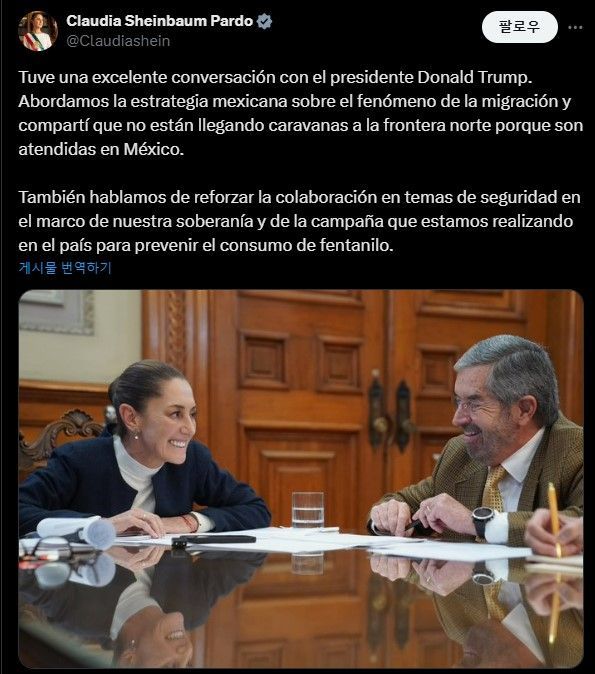
This is the second call between President Sheinbaum and Trump since the U.S. election victory on the 7th. The post was accompanied by a photo showing Mexico's Foreign Minister Juan Ram?n de la Fuente sitting at a table, smiling during the call.
The second call within just 20 days is analyzed as a response to Trump’s recent criticism that Mexico and Canada are insufficient in handling illegal immigration and drugs, and his announcement that he would sign executive orders on January 20 next year, his inauguration day, to impose 25% tariffs on both countries. In retaliation, Mexico announced it would respond with counter-tariffs. For Mexico, this means warning of retaliatory measures to prevent the realization of Trump’s high tariff threat while accelerating efforts to find common ground through dialogue.
At a press conference that morning, President Sheinbaum also called Trump’s tariff threat "an unacceptable threat" and said she had sent a letter proposing a meeting to Trump. She explained, "I expect to be able to talk with Trump soon," adding, "I believe there will be an opportunity for our government delegation to meet with him at least before January 20, the day of his inauguration." She also said she would use the occasion to convey Mexico’s position.
Marcelo Ebrard, Minister of Economy, who accompanied the president at the press conference, emphasized, "The impact of this measure (tariffs) will mainly affect American consumers," and said, "That is why we say the tariffs are like 'shooting oneself in the foot'." He pointed out that the costs U.S. companies would bear due to tariffs on Mexican imports are "enormous." Citing research based on figures from U.S. automakers such as General Motors (GM), which produces cars in Mexico, he claimed, "About 400,000 jobs in the U.S. would disappear."
According to the Mexican Automotive Association, approximately 3.8 million vehicles are produced annually in Mexico, with 90% of them for export. Of these, 80% are understood to be destined for the United States. By sales revenue, the top three companies are U.S. firms GM, Stellantis, and Ford. This also explains why the stock prices of these American car manufacturers plunged on the New York Stock Exchange following Trump’s tariff announcement.
In an interview with local radio station Radio F?rmula, Minister Ebrard expressed that "what the U.S. president-elect truly wants" is negotiation rather than the actual imposition of tariffs. He said, "It is obvious that if both countries impose tariffs on each other, Mexico would win against the U.S.," and added, "I want to emphasize that the U.S. needs trade with Mexico very much." He continued, "If he (Trump) really wanted to impose tariffs, he would not have announced it two months before taking office," and said, "Since he has already indicated what he wants to discuss, I am optimistic that talks will begin soon."
Gerardo Esquivel, a professor at the National Autonomous University of Mexico (UNAM), also told the British BBC Spanish service (BBC Mundo) that in an interdependent economic model like that of the U.S. and Mexico, "the likelihood of daring to start a tariff war is low," and analyzed that it is "more of a Trump-style message urging Mexico and others to try to find room for negotiation."
© The Asia Business Daily(www.asiae.co.kr). All rights reserved.


















