KCCI International Trade Committee Discusses Response to Trump's Second Term
Trade Chief from Trump's First Term Offers Suggestions
Trump Announces Additional Tariffs on Mexico, Canada, and China
"Must Align Interests with the United States"
Kate Calutkevich McLarty, former Executive Director and trade chief under the 'Trump 1.0' administration, described re-elected U.S. President Donald Trump as a "transactional man" who is thorough in "give and take," advising the Korean business community that "active discussions are needed on agendas of interest to the U.S., such as easing barriers for American companies entering the Korean market and increasing the defense cost-sharing burden for U.S. forces stationed in Korea."
On the morning of the 28th, Executive Director McLarty spoke at the podium during the 9th International Trade Committee meeting of the Korea Chamber of Commerce and Industry (KCCI) held at the Hwakwarn Hall in Jung-gu, Seoul. She said, "With the Republican Party controlling both the White House and Congress, Trump has gained strong authority and momentum," and predicted, "Campaign promises will be swiftly implemented after inauguration, especially the imposition of a 60% tariff on China, which received strong support from American voters, will be promptly initiated." She also noted that "considering the solid Korea-U.S. relationship, the application of universal tariffs on Korea is somewhat skeptical."
At the meeting, which was held with Kim Won-i, the Democratic Party's secretary of the National Assembly's Industry, Trade, Energy, Small and Medium Venture Business Committee, and Kim Geon, the People Power Party's secretary of the Foreign Affairs and Unification Committee, invited, economic circles and experts from academia and research institutes discussed changes in Korea-U.S. trade relations and response strategies for Korean companies following the inauguration of the Trump administration. The meeting was held amid heightened anticipation as the Trump 2.0 administration is set to begin in January next year and has announced additional tariffs on Mexico, Canada, and China, creating a more intense atmosphere.
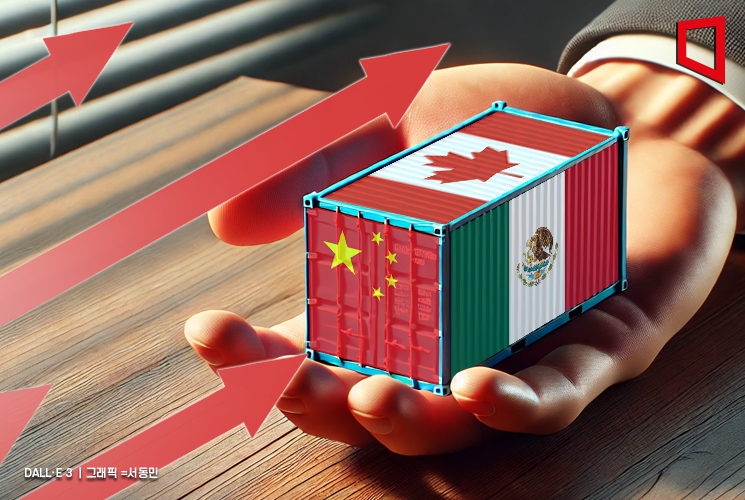
Earlier, on the 25th (local time), President-elect Trump posted on his social media platform 'Truth Social' that on his inauguration day, January 20 next year, he would impose additional tariffs on China, including an extra 10% tariff, and impose 25% tariffs on Mexico and Canada respectively.
In response, experts agreed on the need to selectively accept Trump's recent statements, emphasizing the importance of distinguishing between actions the president can take unilaterally and those he cannot.
Professor Ha Sang-eung of Sogang University's Department of Political Science and International Relations explained the current U.S. government subsidy policies, stating, "It is true that Trump is not favorable toward the Biden administration's achievements such as the CHIPS Act for semiconductor development and the Inflation Reduction Act (IRA), but the president cannot unilaterally change laws passed by Congress, and since many regions benefiting from federal subsidies are Republican constituencies, the practical possibility of repealing these laws is low."
Kim Hyuk-jung, Senior Research Fellow at the Korea Institute for International Economic Policy (KIEP), emphasized clear communication, stating, "We should request that Korean investments in sectors beneficial to the U.S. economy be excluded from universal tariffs and identify cooperative agendas where Korea and the U.S. can achieve mutual success, aligning the interests of both countries."
The KCCI pledged close cooperation among the government, businesses, and the National Assembly. Lee Gye-in, Chair of the KCCI International Trade Committee, said, "If Trump's campaign promises materialize, the global supply chain will inevitably undergo significant changes," adding, "Our companies experienced similar challenges during the first Trump administration, which is a great asset."
He continued, "Even under protectionist circumstances, we successfully responded through expanded investment and diversification of export markets, so there is no need to be discouraged by upcoming changes and uncertainties," and added, "To address trade issues in the second Trump administration, businesses, the National Assembly, and the government will work as one team in close cooperation."
© The Asia Business Daily(www.asiae.co.kr). All rights reserved.
![Clutching a Stolen Dior Bag, Saying "I Hate Being Poor but Real"... The Grotesque Con of a "Human Knockoff" [Slate]](https://cwcontent.asiae.co.kr/asiaresize/183/2026021902243444107_1771435474.jpg)










