Tesla CEO Elon Musk Warns of Population Collapse
Total Fertility Rate Expected to Rebound for the First Time in 9 Years This Year
Elon Musk, CEO of Tesla, warned that "two-thirds of South Korea will disappear" while mentioning the country's total fertility rate.
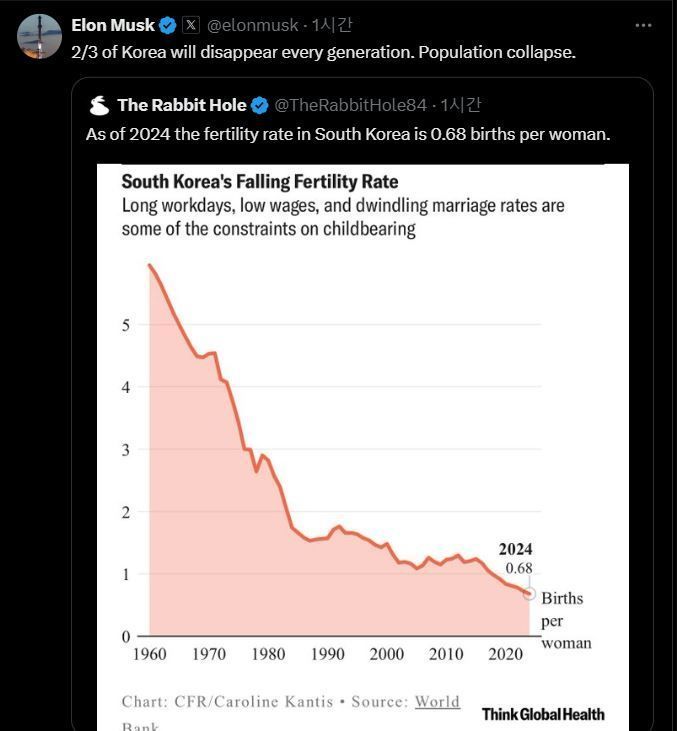
On the 27th (local time), Musk stated on his X (formerly Twitter), "Two-thirds of every generation in South Korea will disappear. Population collapse." Along with this, Musk shared a graphic containing Statistics Korea's projection that South Korea's annual total fertility rate is expected to be 0.68 this year.

This is not the first time Musk has mentioned South Korea's fertility rate. On the 29th of last month, he appeared as a virtual speaker at the Future Investment Initiative (FII) held in Riyadh, Saudi Arabia, and pointed out, "In the short term, artificial intelligence (AI) is the most serious threat, but in the long term, it is the global population collapse." He added, "Based on the current fertility rate, South Korea's population will shrink to about one-third of its current size," and "Europe will also become less than half of its current population." He also mentioned in 2022 that "South Korea, along with Hong Kong, is experiencing the fastest population collapse in the world."
At that time, Musk expressed concern about population collapse, saying, "I have many children, and I encourage others to have children as well." In fact, Musk has five sons with his first wife, writer Justine Wilson, and after divorcing his second wife, he had two sons and one daughter with Canadian singer Grimes, whom he dated. It is also known that he recently had his third child with Shivon Zilis, a female director at Neuralink, the company he runs. Altogether, he has 11 children.
Meanwhile, there is a forecast that the fertility rate will rebound this year for the first time in nine years since 2015. Following the National Assembly Budget Office, the Low Fertility and Aging Society Committee also predicted that the total fertility rate this year will rise to 0.74, higher than last year. If this happens, the total fertility rate will increase for the first time since 2015. This figure is higher than Statistics Korea's projected fertility rate of 0.68 for this year and last year's fertility rate of 0.72.
© The Asia Business Daily(www.asiae.co.kr). All rights reserved.


















