16.5cm at Seoul Meteorological Observatory
Previous Record 12.4cm in 1972
Atmospheric Instability Due to Jeollijeo Low Pressure
With more than 16 cm of snow accumulating in Seoul, the highest November snowfall since modern meteorological observations began in 1907 was recorded for the first time in 117 years.
According to the Korea Meteorological Administration, the daily maximum snowfall in Seoul (based on the Jongno-gu Seoul Meteorological Observatory) as of 10 a.m. on the 27th was 16.5 cm, recorded at 7 a.m. The daily maximum snowfall refers to the greatest amount of snow accumulated during a single day.
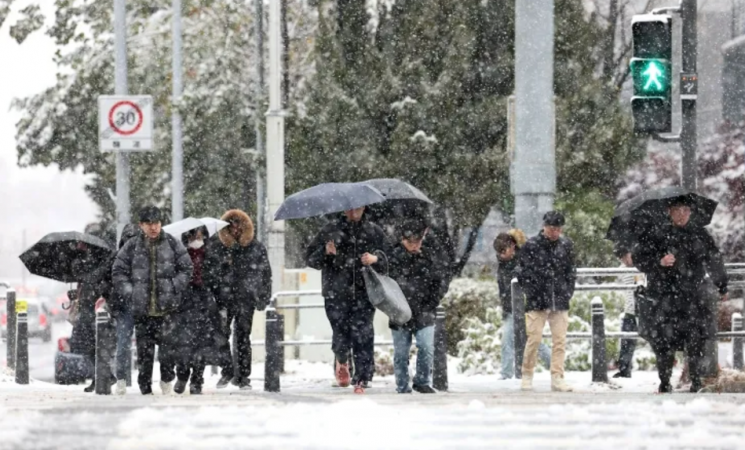 On the morning of the 27th, citizens are walking in the snow at Yeomgok Intersection in Seocho-gu, Seoul. Photo by Yonhap News.
The previous record for the highest daily maximum snowfall in Seoul in November was 12.4 cm on November 28, 1972. This new record exceeds the previous one by about 4 cm. Excluding November, the heaviest snowfall in Seoul was on March 24, 1922, when the daily maximum snowfall reached 31.0 cm.
By district, the daily maximum snowfall in Seoul was 20.6 cm in Seongbuk-gu and 20.4 cm in Gangbuk-gu as of 7 a.m. Other districts with snowfall exceeding 10 cm include ▲Seodaemun-gu (17.2 cm) ▲Dobong-gu (16.4 cm) ▲Eunpyeong-gu (16.0 cm) ▲Mapo-gu (14.1 cm) ▲Gwanak-gu (12.2 cm) ▲Dongdaemun-gu (12.0 cm) ▲Nowon-gu (11.4 cm).
The unusual heavy snowfall in Seoul is analyzed to be due to the influence of a blocking low-pressure system located north of the Korean Peninsula. A blocking low-pressure system forms when the jet stream in the upper atmosphere, which normally blocks cold Arctic air, partially splits. It carries cold Arctic air, making temperatures very low and the atmosphere unstable.
Although snowfall may temporarily ease in some areas, snow clouds from the West Sea are expected to continue bringing snow until the morning of the 28th. Precipitation is forecast to last until the afternoon of the 28th in the central and southern inland and mountainous areas of Gangwon Province and inland Gyeongbuk, until late at night on the 28th in southern Gyeonggi Province, and until late at night on the 29th in Chungcheong, Honam, and Jeju regions.
As cold air flows in from the northwest, temperatures will drop sharply. The minimum temperature on the morning of the 28th is forecast to be minus 5 degrees Celsius, with daytime highs ranging from 3 to 12 degrees Celsius. On the 29th, temperatures are expected to fall to as low as minus 8 degrees Celsius.
The Korea Meteorological Administration urged, "With strong winds making the wind chill even colder, please take care of your health, especially as rapid temperature changes can weaken immunity."
© The Asia Business Daily(www.asiae.co.kr). All rights reserved.

















