Kim Myung-joo, Inaugural Director, "Active International Cooperation"
Deepfake Response Technology Discussed
UK Has 130 Personnel... Revealing Limitations in Workforce and More
Kim Myung-joo, Director of the Artificial Intelligence (AI) Safety Research Institute, stated, "We will ensure that there are no obstacles when Korean AI companies go global," adding, "We will be a collaborative institution, not a regulatory agency."
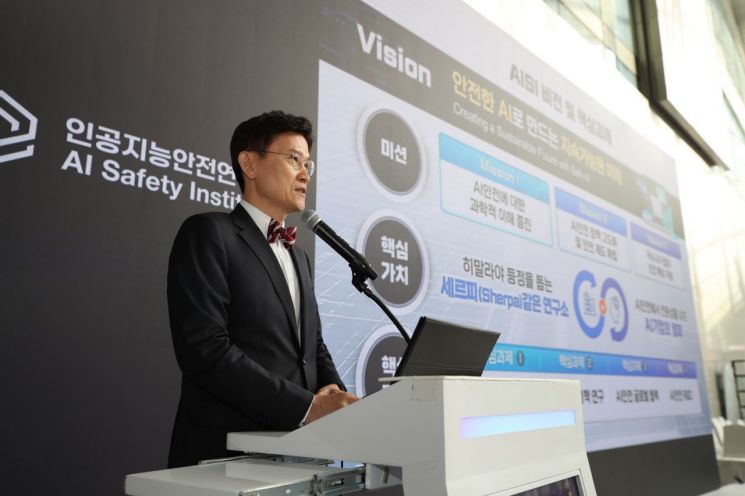 Kim Myung-joo, Director of the AI Safety Research Institute, is explaining the institute's vision and role at the opening ceremony held on the 27th. Photo by Ministry of Science and ICT
After the opening ceremony of the AI Safety Research Institute at the Global R&D Center in Pangyo, Gyeonggi Province on the 27th, Director Kim told reporters, "We will discuss standards related to AI safety through international cooperation and present our opinions where possible."
He also expressed his hope that "the AI Basic Act will pass the National Assembly, and that it will be compatible with the European Union (EU) AI Act in the future."
Director Kim recently attended the launch ceremony of the "International AI Safety Research Institute Network" held in San Francisco, USA, taking the first step toward global solidarity. This network consists of 10 countries including the USA, EU, Canada, France, Singapore, and Japan.
According to Director Kim, the chair country of the network was designated as the USA, and the vice-chair country will be decided at the AI Safety Summit to be held in Paris, France, in February next year.
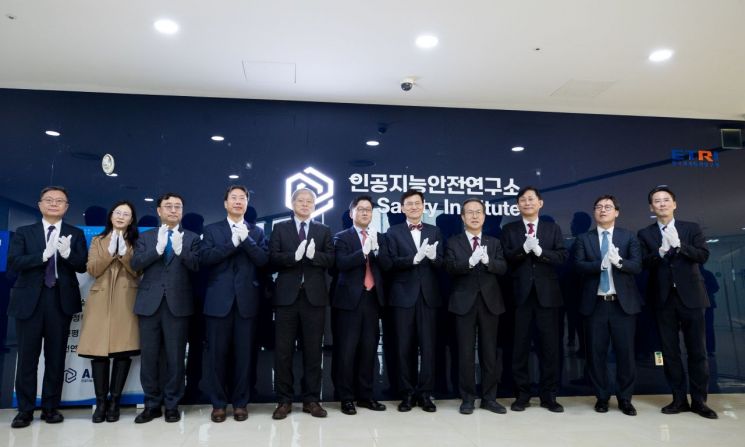 On the 27th, attendees are taking a commemorative photo at the opening ceremony of the AI Safety Research Institute held at the Global R&D Center in Bundang-gu, Seongnam-si, Gyeonggi-do. (From the fourth person from the left) Janghyuk Choi, Vice Chairman of the Personal Information Protection Commission; Jaeho Yeom, Vice Chairman of the National Artificial Intelligence Committee; Gwangjun Ryu, Director of the Science and Technology Innovation Bureau at the Ministry of Science and ICT; Myungju Kim, Director of the AI Safety Research Institute. Provided by the Ministry of Science and ICT
Korea has promised to sign memorandums of understanding (MOUs) with five countries: the United Kingdom, the USA, Canada, Singapore, and Japan, and plans to activate exchanges of technology, personnel, and policies among countries.
The current risks AI faces include ▲technical limitations (malfunctions, hallucinations, bias) ▲loss of control (autonomous replication, AI weapon systems, superintelligence) ▲human misuse (harmful information, cyber hacking, deepfakes).
Director Kim said, "Internationally, we discussed the risks of deepfakes and synthetic generated content, and exchanged technologies that prove AI-generated content such as watermarking and labeling," adding, "Since Korea has already allocated a budget for deepfake countermeasures next year, AI safety evaluations on this will be conducted."
On the same day, the "AI Safety Consortium," involving 24 domestic companies and institutions from industry, academia, and research, was launched with the AI Safety Research Institute as the hub. Director Kim explained about the consortium, "Each company and university presented what they can contribute," and added, "We will share solutions to ensure that safety regulations do not become obstacles."
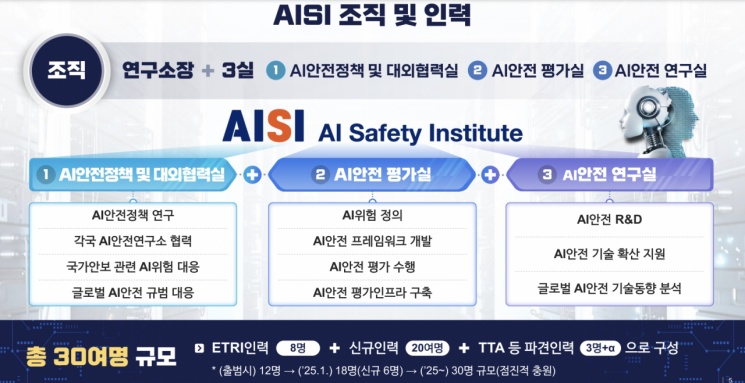
However, since the AI Safety Research Institute was established as an affiliate of ETRI, some limitations have emerged. It is evaluated that there is a shortage of personnel to strengthen international cooperation and provide thorough support for AI safety. Currently, eight ETRI personnel are dispatched, and the number is planned to be increased to 18 by January next year, eventually operating with about 30 staff members.
In the case of the United Kingdom, the AI Safety Research Institute was already established last year, with a total staff of about 130. Their salaries are reportedly as high as 200 million KRW annually, making it easier to secure excellent talent.
© The Asia Business Daily(www.asiae.co.kr). All rights reserved.
![Clutching a Stolen Dior Bag, Saying "I Hate Being Poor but Real"... The Grotesque Con of a "Human Knockoff" [Slate]](https://cwcontent.asiae.co.kr/asiaresize/183/2026021902243444107_1771435474.jpg)


















