Regulation Intensifies Following Research on Harmful Substances
National Assembly's Liquid E-Cigarette Regulation Bill Expected to Pass Within the Year
A research project by the Ministry of Health and Welfare has revealed that synthetic nicotine, which accounts for the majority of liquid-type electronic cigarettes, poses high health risks and therefore requires regulation. The e-cigarette industry has long claimed that synthetic nicotine solution is 'pure nicotine' refined through purification and thus less harmful than natural nicotine solution, but the study found that synthetic nicotine solution also contains numerous harmful substances.
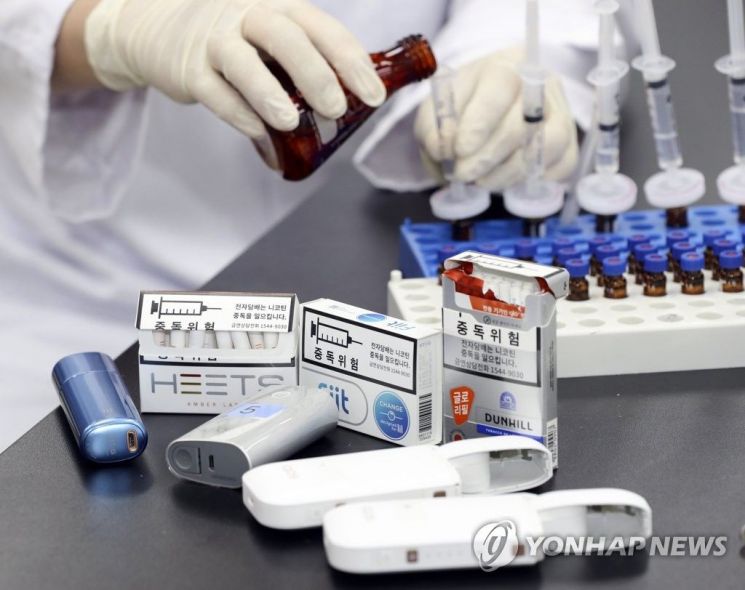
Accordingly, the Ministry of Economy and Finance has decided that it is appropriate to include synthetic nicotine under the definition of tobacco in the Tobacco Business Act for regulatory purposes. Currently, synthetic nicotine is not classified as 'tobacco,' so tobacco taxes and levies are not imposed. Additionally, regulations such as warning label requirements, advertising restrictions, and online sales limitations do not apply, and selling to minors is not punishable.
According to the final research results submitted by the Ministry of Health and Welfare to Park Seong-hoon, a member of the National Assembly’s Planning and Finance Committee from the People Power Party, on the 27th, a significant number of harmful substances causing carcinogenicity and reproductive toxicity were found in synthetic nicotine solution.
Previous preliminary studies detected various harmful components in liquid-type e-cigarettes, but it was unclear whether the source of these harmful substances was the nicotine solution itself or additives and solvents. This study clarified the harmfulness of the nicotine solution.
Analysis of the residual amounts of 69 harmful substances showed that 12,509 mg per liter were detected in 45 items in natural nicotine solution, while 23,902 mg per liter were detected in 41 items in synthetic nicotine solution. Simply put, the total amount of harmful substances detected was higher in synthetic nicotine than in natural nicotine.
Alkaloids were found in higher residual amounts in synthetic nicotine solution. Tobacco-specific nitrosamines (TSNAs) were also detected in synthetic nicotine, with particularly high concentrations of carcinogenic nitrosamines such as NNN and nicotine-derived nitrosamine ketone (NNK) precursors.
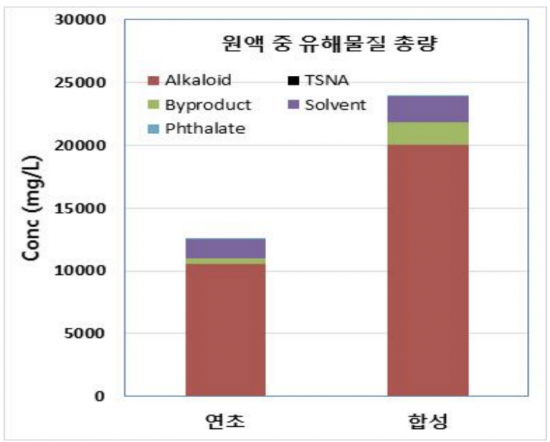
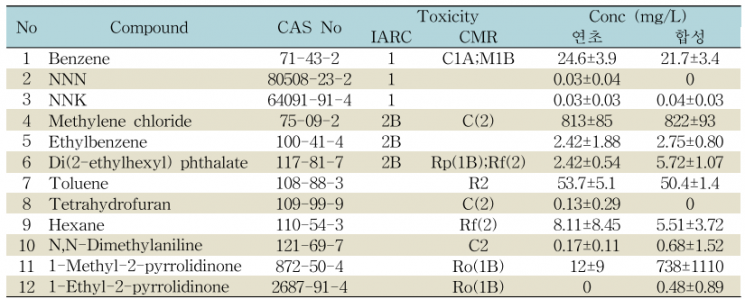 Comparison of Detected Concentrations of IARC-Designated Carcinogens and EU CMR Hazardous Substances in Raw Tobacco and Synthetic Nicotine Solutions
The detection of many harmful substances in synthetic nicotine solution appears to be due to the use of various reactants and organic solvents during the nicotine synthesis process. The research report pointed out that, given the presence of numerous harmful substances in synthetic nicotine solution, "synthetic nicotine should be regulated in the same way as tobacco nicotine."
It emphasized, in particular, that "the claim that synthetic nicotine is a 'pure' substance is not true," and stated that "it is desirable to manage synthetic nicotine and tobacco nicotine without distinction, as is done in countries such as the United States, the United Kingdom, and Canada."
Attention is focused on whether discussions on related bills in the National Assembly will gain momentum now that the government has decided to regulate synthetic nicotine.
The Ministry of Economy and Finance recently conveyed to the National Assembly’s Planning and Finance Committee that, considering the revealed harmfulness of synthetic nicotine and foreign cases, it is appropriate to include synthetic nicotine under 'tobacco' in the Tobacco Business Act for regulatory purposes. Currently, 'tobacco' under the Tobacco Business Act only covers products manufactured using 'tobacco leaves' as raw materials. If synthetic nicotine is classified as 'tobacco,' it will automatically become subject to taxation under the Individual Consumption Tax Act.
The Ministry of Health and Welfare also stated to the National Assembly that most liquid-type e-cigarettes currently sold domestically are excluded from related regulations because they do not fall under tobacco in the Tobacco Business Act, so the definition of tobacco should be expanded to include nicotine from the perspective of preventing smoking among youth and non-smokers. E-cigarettes are divided into liquid-type and heated tobacco types, with the liquid-type rapidly spreading among youth.
In the 22nd National Assembly, a total of 10 bills have been proposed to expand the definition of tobacco in order to regulate synthetic nicotine. However, some members of the Planning and Finance Committee have expressed the opinion that a public hearing should be held before full discussions begin, so there is a possibility that the bills may be delayed beyond this year.
© The Asia Business Daily(www.asiae.co.kr). All rights reserved.
![Clutching a Stolen Dior Bag, Saying "I Hate Being Poor but Real"... The Grotesque Con of a "Human Knockoff" [Slate]](https://cwcontent.asiae.co.kr/asiaresize/183/2026021902243444107_1771435474.jpg)


















