Gyeonggi-do Regional Cooperation Research Center, Sungkyunkwan University ICT Talent Development Project Group and 12 Others Supported
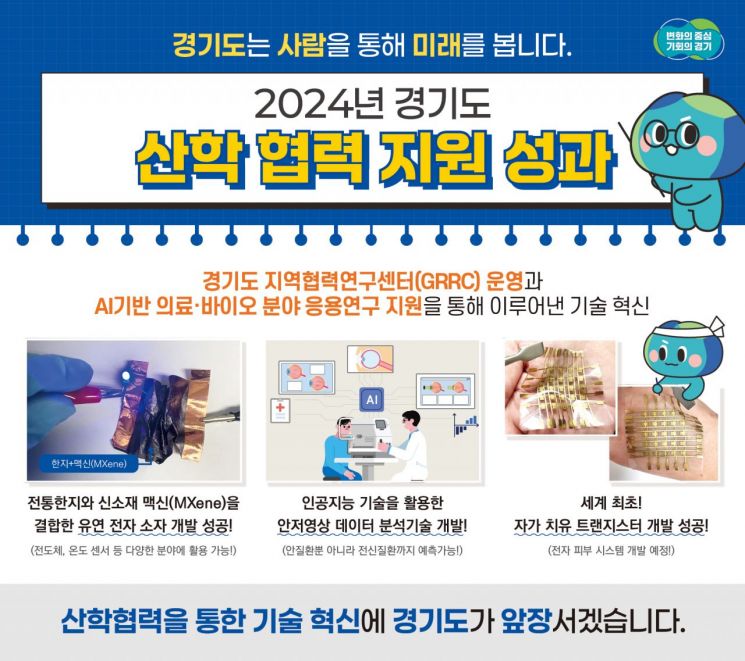
Development of Flexible Paper Device Technology Combining Traditional Hanji and New Material MXene
World's First Self-Healing Transistor Developed... Expected Application in Electronic Skin Devices
The industry-academia cooperation project promoted by Gyeonggi Province to discover future growth engines and provide opportunities to small and medium-sized enterprises (SMEs) in the province lacking research and development infrastructure is gaining attention by achieving remarkable results this year in the fields of artificial intelligence (AI), new materials, and medical technology.
Kim Dong-yeon, Governor of Gyeonggi Province, declared that the core and budget goals of the 8th term of Gyeonggi Province’s administration will be people-centered, under the concept of ‘Humonomics,’ and that investments will be made for sustainable growth. Gyeonggi Province is promoting various support projects to revitalize the economy and discover future growth engines.
Among these, the province supports joint research and development activities at 11 centers within the province, including Sungkyunkwan University, through the Gyeonggi Regional Research Center (GRRC) project. Among the 11 centers, nurturing centers receive 500 million KRW annually for six years, and after evaluation, they are converted into performance utilization centers, which receive an additional 130 million KRW annually for three years. In this process, technology transfer and commercialization support for local companies, as well as training of R&D professionals for regional industrial development, are provided.
Currently, the nurturing centers include six locations: △ Korea Polytechnic University Multi-Material Processing Technology Innovation Research Center △ Hanyang University Hydrogen Energy Full-Cycle Core Material Research Center △ Korea Aerospace University Advanced Mobility Convergence Technology Research Center △ Sungkyunkwan University Next-Generation Semiconductor Materials and Process Research Center △ Ajou University Aging-Related Intractable Disease Response Technology Research Center △ Kyung Hee University Global Next-Generation Semiconductor Research Center.
The performance utilization centers include five locations: △ Sungkyunkwan University Convergent Sensor Material Process Platform △ Kyonggi University Intelligent Information Convergence Manufacturing Research Center △ Korea Aerospace University Audio-Visual Spatial Convergence Technology Research Center △ Gachon University Artificial Intelligence Healthcare Research Center △ Kyung Hee University Global Pharmaceutical Material Development Research Center.
In October, Professor Kim Han-ki’s team from the Department of New Materials Engineering at Sungkyunkwan University succeeded in developing an innovative flexible electronic device by combining traditional Hanji paper and the next-generation new material MXene.
This research utilized the excellent durability and flexibility of Hanji while coating the cellulose surface with MXene, a two-dimensional nano new material. Notably, the research team applied a spray coating method to overcome the limitations of existing solution coating processes, securing technology applicable in various industrial fields such as heating elements, conductors, electromagnetic wave shielding materials, and temperature sensors.
There were also notable achievements in the medical field. The Sungkyunkwan University ICT Talent Development Project Group (Director Chu Hyun-seung) developed fundus image data analysis technology using artificial intelligence in August.
This technology analyzes deep internal eye image information based on deep learning to diagnose 10 eye diseases and measure 15 physical parameters with 98% accuracy. It is especially capable of predicting not only eye diseases such as diabetic retinopathy, macular degeneration, and glaucoma but also systemic diseases including cardiovascular disease, diabetes, and chronic kidney disease, making it an innovative technology in preventive medicine.
The project group has completed two domestic patent applications and plans to collaborate with local hospitals to complete a more comprehensive diagnostic platform.
In May, Professor Oh Jin-young’s research team from the Department of Chemical Engineering at Kyung Hee University succeeded in developing the world’s first self-healing transistor.
The research team used nanofilm technology to enable all electronic components constituting the transistor?conductors, semiconductors, and insulators?to restore electrical properties even if damaged. This significantly increases the potential for the transistor to become a core component of electronic skin, a wearable device attached to the skin, and the team plans to develop an electronic skin system.
Additionally, several research teams have achieved advanced technology development results, including Professor Kim Young-hoon’s team from the Department of New Materials Engineering at Sungkyunkwan University, which developed new AI-based signal processing technology using nanomaterials, and Professor Lee Hong-seop’s team from the Department of Information and Electronic New Materials Engineering at Kyung Hee University, which developed lithium-ion memristor devices to accelerate next-generation AI semiconductor development.
From July last year to June this year, the Gyeonggi GRRC project recorded achievements including 38 SCI-level papers, training of 49 specialized master’s and doctoral researchers, 11 patent registrations, 16 technology transfers, and 20 commercializations. In particular, analysis of participating companies’ sales showed that for every 10 million KRW of provincial funding, 870 million KRW in sales were generated along with the creation of 2.7 jobs.
Gyeonggi Province plans to continue providing support so that these research achievements can be utilized in actual industrial sites. Especially for AI-based medical and bio application research, an additional 450 million KRW of provincial funding will be provided over three years until 2026. Through this, the province expects to strengthen the technological competitiveness of local SMEs and foster an innovative industrial ecosystem.
Kim Tae-geun, Director of Digital Innovation at Gyeonggi Province, said, “These research achievements are excellent examples of technological innovation through industry-academia cooperation,” and added, “Gyeonggi Province will continue to spare no support to ensure meaningful research outcomes are continuously produced through the Regional Cooperation Research Center support project.”
© The Asia Business Daily(www.asiae.co.kr). All rights reserved.
!["The Woman Who Threw Herself into the Water Clutching a Stolen Dior Bag"...A Grotesque Success Story That Shakes the Korean Psyche [Slate]](https://cwcontent.asiae.co.kr/asiaresize/183/2026021902243444107_1771435474.jpg)
















