[K-Construction, A New Leap] Korea Expressway Corporation
Diversified Business Bearing Fruit... Operating 24 Projects in 15 Countries
Turkey Highway Project as a Foothold for European Expansion
Targeting 1 Trillion KRW in Overseas Orders by Next Year
Korea Expressway Corporation has actively ventured into overseas markets based on over 50 years of accumulated know-how in domestic road construction and maintenance. Currently, it is carrying out 24 projects in 15 countries across various fields such as road construction supervision and project management, operation and maintenance, and investment development projects (PPP). When it first secured an overseas project in 2005, the annual contract amount was only 421 million KRW, but through diversification of projects, the cumulative contract amount has reached 538.5 billion KRW as of the end of November this year.
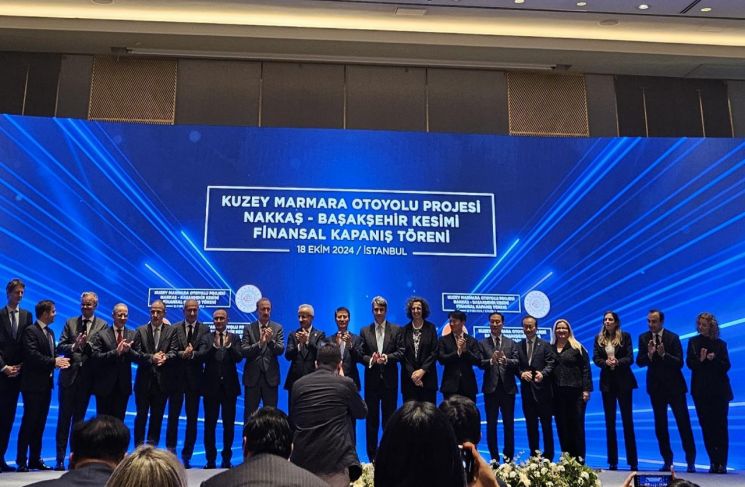 Last month on the 18th, officials are taking a commemorative photo after the Nakas-Basaksehir Road Investment Project Financial Agreement Ceremony held at the Peninsula Hotel in Istanbul, Turkey. / Photo by Korea Expressway Corporation
K-Highway Extending to Europe Begins in T?rkiye
This year, Korea Expressway Corporation seized an important opportunity to apply Korean road traffic technology in T?rkiye, which connects Europe and Central Asia. The Korea-T?rkiye joint consortium, including Korea Expressway Corporation, confirmed the contract for the Nakhas-Ba?ak?ehir Highway investment project in T?rkiye through a financial agreement ceremony last month. The total project cost is approximately 2.1 trillion KRW, marking the largest overseas road investment project Korea Expressway Corporation has participated in to date.
The Nakhas-Ba?ak?ehir Highway is the final eighth section of the Northern Marmara Highway, a key project of the Turkish government. The Northern Marmara Highway construction project is a large-scale bypass network project aimed at expanding the highway network near Istanbul, connecting Asia and Europe, and alleviating traffic congestion. It consists of eight sections, with sections 1 to 7 completed and operational from 2016 to 2020. The Nakhas-Ba?ak?ehir Highway will be constructed as a 31.3 km long, 4 to 8-lane highway. After approximately 2 years and 4 months of construction, it will be operated by the private sector for 15 years and 6 months before being transferred to the Turkish government.
Korea Expressway Corporation evaluated this contract as a significant turning point in its future growth strategy. By participating in the largest overseas investment project to date, it has reset the direction of its future overseas business. As a joint investor, it collaborated with local Turkish companies to reduce project risks and laid the foundation to take a leading role in subsequent projects. The government announced in February this year the need to shift from overseas construction contracts focused on subcontracting to PPP projects, and Korea Expressway Corporation explained that this case perfectly aligns with that strategy. Previously, Korea Expressway Corporation’s overseas projects were mainly subcontract-based, making it difficult to lead projects proactively and resulting in relatively limited ripple effects on other countries or domestic companies.
This project also provided an opportunity to showcase Korea’s highway maintenance technology, accumulated over more than 50 years, to the world. After the completion of the Nakhas-Ba?ak?ehir Highway, Korea Expressway Corporation, Samsung C&T, and the local company Renaissance will jointly manage operation and maintenance. Korea Expressway Corporation plans to dispatch experts during the operation period to transfer Korea’s excellent maintenance know-how and provide management solutions optimized for the local environment. Through this process, it expects to secure operation and management technologies specialized for overseas projects in cooperation with local companies. Notably, concerns raised early in the project about the consortium’s lack of road operation expertise were reportedly resolved by Korea Expressway Corporation’s participation.
Korea Expressway Corporation plans to use this contract as a stepping stone to strengthen technological exchanges with T?rkiye and accelerate its entry into Europe and Central Asia. T?rkiye, in particular, plans to expand its highway network from the current 3,633 km to 20,585 km by 2053 under the '2053 Transportation and Logistics Master Plan.' Korea Expressway Corporation intends to build trust as a true brotherly nation by expanding information exchange and joint projects with the Turkish government to share advanced road technologies.
A Korea Expressway Corporation official said, "This contract is the largest overseas investment project and is expected to serve as a foothold for entry into advanced markets such as Europe," adding, "We will strive to secure overseas expansion opportunities for private companies based on Korea Expressway Corporation’s high credibility and negotiation power, and widely promote excellent K-Highways worldwide."
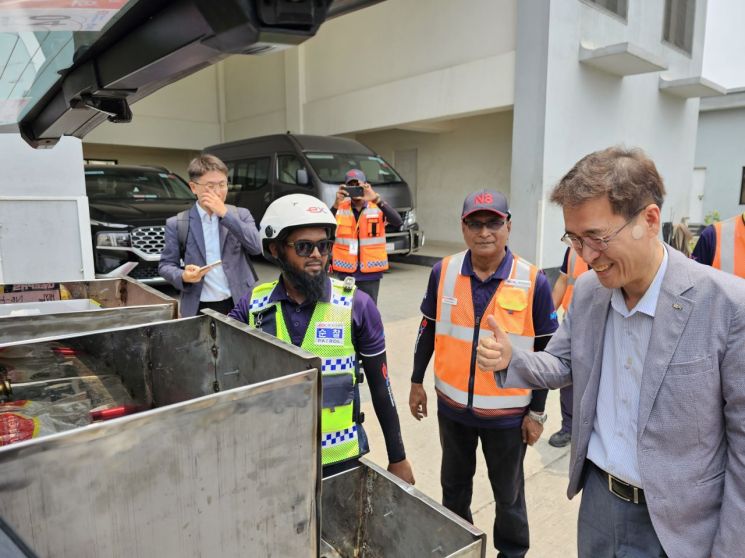 Ham Jin-gyu, President of Korea Expressway Corporation (first on the right), is showing on-site management efforts related to the operation and maintenance project of the Bangladesh N8 Expressway. / Photo by Korea Expressway Corporation
President Ham Jin-gyu: "Goal of 1 Trillion KRW in Overseas Cumulative Contracts"
Korea Expressway Corporation is expanding its overseas territory through business diversification such as operation and maintenance and PPP projects. A representative achievement is the Bangladesh Padma Bridge operation and maintenance project, contracted in 2022. This is the first project where Korea Expressway Corporation took charge of operation and maintenance, with a contract amount of 100.5 billion KRW. By May 2027, it will install a Hi-Pass type toll system and an intelligent traffic management system in the relevant section and perform traffic and maintenance tasks. It is also conducting operation and maintenance of the N8 Highway (55 km), connected to the Padma Bridge. This highway is Bangladesh’s first expressway and was solely contracted by Korea Expressway Corporation.
Since June last year, Korea Expressway Corporation has also started maintenance work on the Almaty Ring Road in Kazakhstan. This is the first PPP project conducted by Korea Expressway Corporation and the Kazakhstan government, aimed at alleviating traffic congestion caused by population growth in Kazakhstan. The project cost is 854 billion KRW, with a contract amount of 161.2 billion KRW. Operation and maintenance will be performed for the next 16 years.
Ham Jin-gyu, president of Korea Expressway Corporation, expressed his determination to focus on market development, including the activation of overseas projects, in his New Year’s address this year. The goal is to achieve 1 trillion KRW in cumulative overseas contract amounts by next year. To this end, he has been continuously communicating by directly inspecting highway project sites such as the Padma Bridge and meeting domestic and foreign stakeholders to sign memorandums of understanding. Recently, he visited the California Department of Transportation and the International Road Federation in the United States to sign agreements to strengthen the corporation’s intelligent transportation system (ITS) technology and human exchanges. President Ham said, "Overseas projects are an important driving force that breathes vitality into our economy," adding, "By cooperating between the private and public sectors, we will overcome the global economic downturn and contribute to the national economy."
© The Asia Business Daily(www.asiae.co.kr). All rights reserved.



















