U.S. President Joe Biden announced on the 26th (local time) that Israel, which has been at war in Lebanon for over a year, and the pro-Iran armed group Hezbollah have agreed to a ceasefire. The ceasefire agreement will take effect at 4 a.m. local time on the following day, the 27th (11 a.m. Korean time on the same day).
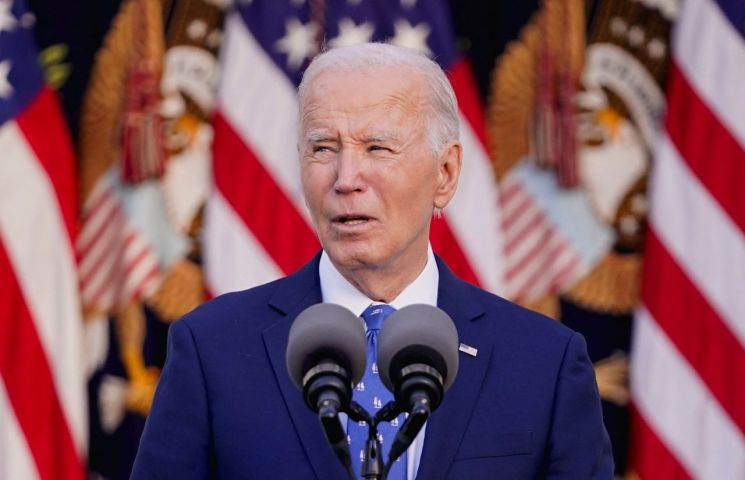
In a speech at the White House Rose Garden on the same day, President Biden said that the Lebanese authorities, who negotiated on behalf of Israel and Hezbollah, accepted the ceasefire agreement, calling it "good news." He explained, "According to the agreement reached today, the war crossing the Lebanon-Israel border will end at 4 a.m. local time tomorrow."
Accordingly, the ceasefire comes about 13 months after Israel was caught off guard by an attack from Hamas in October last year and clashes with Hezbollah began in Lebanon. From the time the Israeli military launched the so-called "Arrow of the North" operation targeting Hezbollah and entered ground combat in Lebanon, it has been about two months.
In his speech, President Biden emphasized, "This is designed for the permanent cessation of hostile acts," adding, "It is unacceptable for Hezbollah and other terrorist groups' remnants to threaten Israel's security." He also explained that under the ceasefire plan, the Israeli military will gradually withdraw troops from Lebanon over the next 60 days, and the Lebanese army and national security forces will be deployed in the border area. He mentioned that U.S. troops will not be stationed in southern Lebanon.
President Biden said, "This agreement marks a new beginning for Lebanon," and predicted it would also help maintain Lebanon's sovereignty. He further emphasized that just as the Lebanese people deserve a future of security and prosperity, so do the people of the (Palestinian) Gaza Strip, stating that efforts to pursue a ceasefire in the Gaza war will continue. He urged, "The people of Gaza have endured hell, and their world has been completely shattered," calling on the Palestinian armed group Hamas to release the remaining hostages and end the war as the only way out.
The Israeli Prime Minister's Office also issued a statement immediately after President Biden's speech, announcing, "The cabinet approved the U.S. proposal for a ceasefire in Lebanon tonight by a majority vote of 10 ministers in favor." Earlier, Israeli Prime Minister Benjamin Netanyahu had announced the ceasefire policy in a video speech, saying, "With the ceasefire in Lebanon, we will be able to focus on the threat from Iran." However, Netanyahu also made it clear that this ceasefire would not affect the war in the Gaza Strip. He cited Hamas's isolation as a reason for the ceasefire in addition to the threat from Iran, stating, "Our pressure on Hamas will intensify, which will help us recover the hostages."
However, there is also opposition within Israel. Itamar Ben-Gvir, Israel's far-right Minister of National Security, criticized the ceasefire agreement as a "historic mistake" on his X (formerly Twitter) account. He argued, "This is not a ceasefire. It is a return to the concept of silence for silence, and we have already seen where this leads," claiming that the war will eventually resume.
ActionAid, a non-governmental organization dedicated to eradicating global poverty, pointed out in a statement that "Do the people of Lebanon have to live in uncertainty until bombs fall on their homes again?" and criticized that this ceasefire is not a long-term solution. They added, "The important point is that there is still no ceasefire close to being reached in the Gaza Strip," and criticized, "Israel continues to carry out mass killings in Gaza."
© The Asia Business Daily(www.asiae.co.kr). All rights reserved.
!["The Woman Who Threw Herself into the Water Clutching a Stolen Dior Bag"...A Grotesque Success Story That Shakes the Korean Psyche [Slate]](https://cwcontent.asiae.co.kr/asiaresize/183/2026021902243444107_1771435474.jpg)
















