An Ecological Park 2.7 Times the Size of a Soccer Field Opens in Siheung Valley at the Foot of Hoamsan Mountain
Enjoy Both Dense Forests and Refreshing Valleys Along a 4km Garden Path
Featuring 100 Charming Gardens, a Barefoot Walking Trail on Loess Soil, Mureogwi Rest Area, Rose Garden, and More
Geumcheon-gu (Mayor Yu Seong-hoon) announced the creation of ‘Omi Ecological Park,’ a 2.7 soccer field-sized (approximately 18,500㎡) park located in the Siheung Valley area at the foot of Hoamsan Mountain (around San 77-1, Siheung 5-dong).
The ‘Omi Ecological Park’ project was promoted as part of the ‘Green SOC Expansion’ initiative to create a ‘Green City Geumcheon’ that coexists and develops with nature.
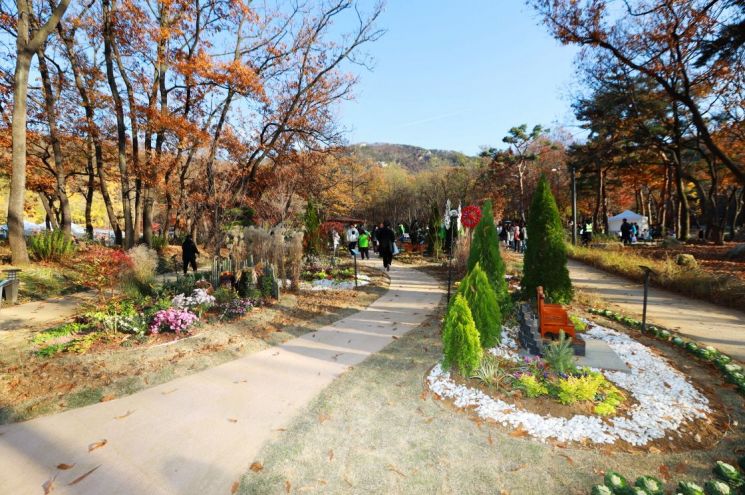
The district invested a total of 4.8 billion KRW to establish 100 attractive gardens called ‘Baeginbaekhyanggiwon,’ a water mouth resting area, a yellow soil path, a rose garden, and more, expanding the living area park space that residents can directly experience.
The park’s name, Omi (五美), was inspired by the core philosophy of the Joseon Dynasty’s King Seongjong-era scholar Kang Huimaeng, known as ‘Osang’ (benevolence, righteousness, propriety, wisdom, and faith). The name was given to enhance the garden’s charm through the five scents that can be experienced in Siheung Valley: forest, flowers, soil, people, and water. Kang Huimaeng spent his later years living in a small house in Geumyang-hyeon, Gyeonggi-do (currently 807-14, Siheung 4-dong, Geumcheon-gu), where he authored the private agricultural book ‘Geumyang Japrok.’
The district previously received great public response by creating the Geumcheon Green Square on the rooftop of a rainwater storage facility near Omi Ecological Park. Accordingly, the district planned to build Omi Ecological Park on the southern site of the square in 2020 and has been proceeding with related procedures.
The ‘Omi Ecological Park Creation Project’ bore fruit after five years through planning, selection in the Ministry of Land, Infrastructure and Transport’s public contest, securing the project site, park design, and construction.
The project funding was secured through a public contest for resident support projects in development-restricted zones, hosted by the Ministry of Land, Infrastructure and Transport. Candidate projects were submitted by 19 autonomous districts in Seoul, and the Ministry selected the final projects. Three districts were ultimately chosen, and Geumcheon-gu received 41% of the total contest project budget (1.6 billion KRW), gaining recognition from the central government for the project’s originality.
The site for Omi Ecological Park was originally an ordinary privately owned land where not even a single chair could be freely installed. The entrance area was disorderly, with illegal wooden shacks, dilapidated farm sheds, and unclaimed graves, and lacked forest recreation infrastructure, making it difficult for residents to enjoy leisure activities.
The land acquisition process was not smooth. There were 15 parcels in total with 12 landowners, and 7 parcels were jointly owned by 7 individuals, making contract agreements challenging. Price negotiations were conducted via international calls with landowners residing in the United States, and final ownership transfer was agreed upon at about half the usual purchase price.
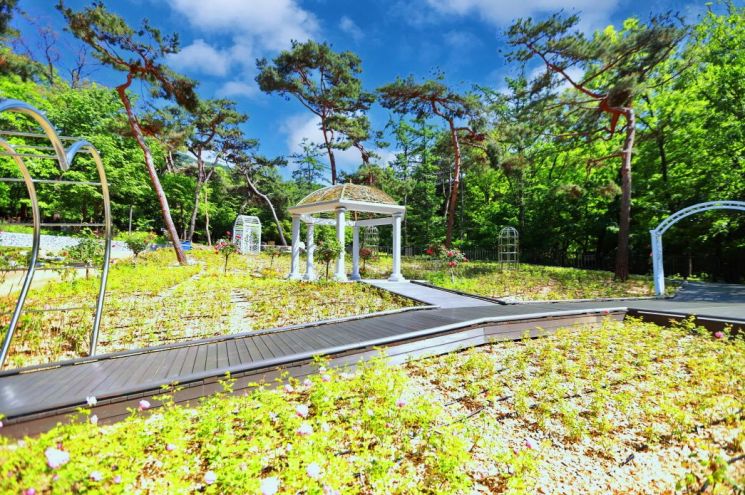
Afterward, through design and about a year of construction, facilities such as ‘Baeginbaekhyanggiwon,’ a garden with one hundred people and one hundred scents, a 100-meter-long ‘Yellow Soil Barefoot Walking Path,’ ‘Water Mouth Resting Area’ where two streams merge, a rose garden symbolizing Venus’s love, a garden healing center, and a fitness area became available. Additionally, the 4 km ‘Garden Path’ within the park connects to the Seoul Dulle-gil trail, offering expansion possibilities.
‘Baeginbaekhyanggiwon’ consists of three types of gardens created by residents, companies, and artists.
For the resident participation garden, a total of 14 teams participated through a public contest: 4 resident teams, 4 student teams, and 6 office worker teams. These teams collaborated with garden artists, conducting workshops and consultations to revise garden plans and directly carried out the construction. The corporate participation garden was created with trees worth 100 million KRW donated by companies based in Geumcheon-gu, and the artist participation garden was established with the involvement of award-winning artists from this year’s Seoul International Garden Expo.
The ‘Yellow Soil Barefoot Walking Path’ is installed near a pine forest, allowing visitors to breathe in phytoncide-rich air and enjoy healing time. The path is composed of yellow soil and loam mixed in an appropriate ratio, enabling users to walk comfortably without feeling muddy. Colorful annual flowers are planted around to enhance the walking experience, and foot washing stations and benches are provided for residents’ convenience.
‘Water Mouth Resting Area’ is a waterfront leisure space reborn through restoration efforts. Siheung Valley was once popular for water play and picnics due to its abundant water flow. With urbanization having interrupted the water flow, the restoration of Siheung Valley now stimulates nostalgia among middle-aged and older residents, allowing them to enjoy dense forests and cool valley water nearby.
Yu Seong-hoon, Mayor of Geumcheon-gu, said, “I am pleased that the Omi Ecological Park project, initiated as part of creating a ‘Green City Geumcheon,’ has borne fruit after five years and can now be presented to residents. Starting with Omi Ecological Park, we will accelerate the expansion of green space capacity within the city so that everyone can enjoy parks close to home.”
© The Asia Business Daily(www.asiae.co.kr). All rights reserved.


















