Royal Palaces and Tombs Center to Invest 7.6 Billion Won in Restoration Project
"Site to Be Actively Used for National Ceremonies"
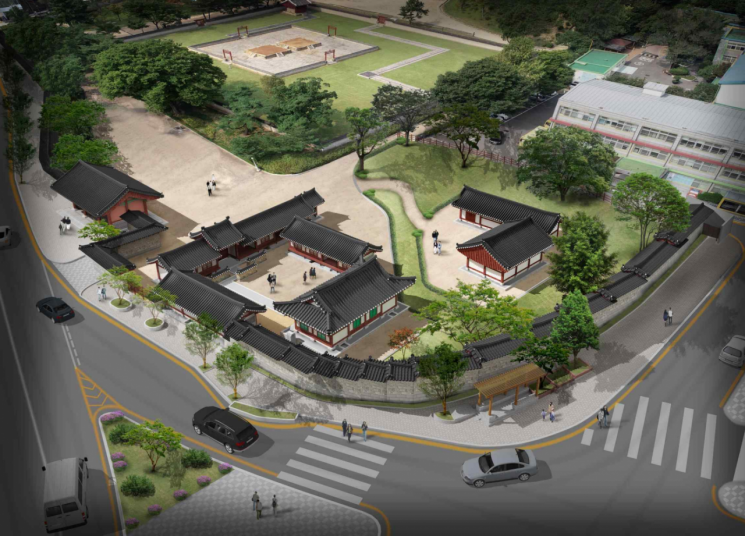
The Royal Palaces and Tombs Center of the National Heritage Administration announced on November 27, 2024, that it will restore the Anhyangcheong area of Sajikdan, which was damaged during the Japanese colonial period, by 2026. The groundbreaking ceremony will be held on this day, marking the commencement of construction.
Sajikdan was a ritual site during the Joseon Dynasty where ceremonies were held to honor the deities of land and grain. It was established in 1395 at its current location in Sajik-dong, following the principle of "Jwajo Usa" (Ancestral Shrine on the Left, Sajik on the Right) as described in the Gokonggi section of the Zhouli. The Zhouli Gokonggi is a supplementary text to the Zhouli, which introduces the governmental system of China's Zhou Dynasty, and "Jwajo Usa" is the principle of constructing the ancestral shrine and Sajik altar outside the city gates to the left and right, respectively.
The buildings and walls of Sajikdan were demolished and damaged during the Japanese colonial period. In 1911, the Sajik rituals were abolished, and in the 1920s, the area was converted into a park.
The National Heritage Administration has been pursuing the restoration project in accordance with the Sajikdan Restoration and Maintenance Plan established in 2014. In 2022, it restored the Jeonsacheong area to the west and reorganized the ritual procession route. Jeonsacheong was the space where preparations for the rituals took place.
The Anhyangcheong area to be restored this time, located to the north, was a place where incense and ritual texts were stored. It consisted of spaces where the king purified himself and refrained from impure acts before religious ceremonies, rooms where ritual attendants stayed (Jipsacheong), storage for ceremonial instruments (Akkigo), storage for tents (Chajanggo), and the central gate quarters (Jungmunchae), which served both as the entrance and as accommodation for the king’s attendants.
The Royal Palaces and Tombs Center will invest approximately 7.6 billion won in the restoration project. An official explained, "The existing Anhyangcheong building will be repaired based on historical research, while the remaining five buildings will be reconstructed, taking into account the current topography and surrounding road conditions."
The official added, "Once the restoration is complete, we plan to actively utilize the site for national events such as the Sajik Daeje, promoting its function as a ritual space and allowing the public to experience its historical significance."
© The Asia Business Daily(www.asiae.co.kr). All rights reserved.

















