Israel Defense Chief Visits UK
Ceasefire with Lebanon Possible...
Strong Opposition to Ceasefire Within Israel
Herzi Halevi, Chief of Staff of the Israel Defense Forces, visited the United Kingdom. Amid the ongoing war between Israel and the Lebanese militant group Hezbollah, the visit of the Israeli military chief to the UK has sparked speculation about the possibility of a ceasefire.
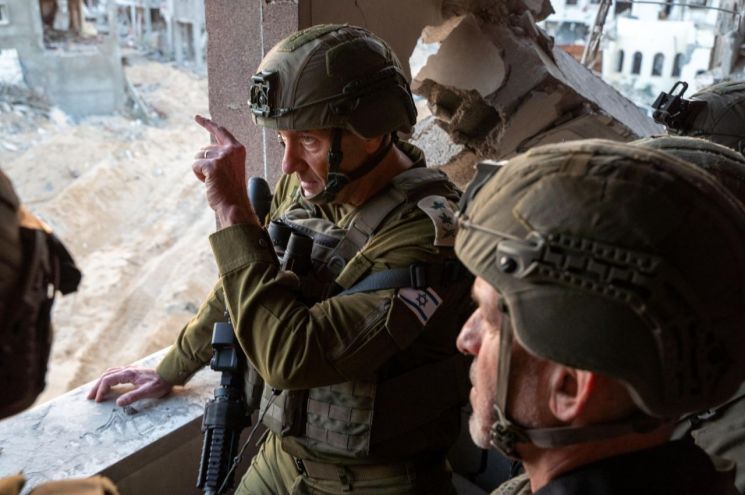 Herzi Halevi, Chief of Staff of the Israel Defense Forces, is giving orders. Photo by Xinhua Yonhap News.
The Times of Israel reported on the 26th (local time) that the Israeli military chief visited the UK amid expectations that a ceasefire agreement between Israel and Lebanon is imminent.
According to the report, Chief of Staff Halevi visited the UK the previous afternoon, met with military leadership from several countries, and then returned home. He explained that "it is unusual for a military chief to visit overseas during wartime."
This visit has led to speculation that a ceasefire with Lebanon is near. The Israeli Security Cabinet is scheduled to hold a meeting at 5:30 PM at the military headquarters in the Kirya area of Tel Aviv to discuss whether to agree to a ceasefire with Lebanon.
Abdullah Bou Habib, Lebanon’s Foreign Minister, said on the same day, "We hope a ceasefire to end the fighting between Israel and Hezbollah will be agreed upon today," adding, "If the Israeli military withdraws from southern Lebanon, the Lebanese army is willing to deploy at least 5,000 troops there."
The previous day, major media outlets in the United States and Israel reported that Israeli Prime Minister Benjamin Netanyahu had approved a ceasefire plan. The ceasefire proposal presented by the US includes a 60-day halt to the war, during which Israel would withdraw from southern Lebanon, and Hezbollah would retreat north of the Litani River.
David Menzar, spokesperson for the Israeli government, stated, "Through an agreement with Lebanon, Israel will maintain operational freedom to conduct defensive activities to eliminate the Hezbollah threat, and residents will be able to safely return to northern Israel."
According to major foreign media, Israeli Defense Minister Yoav Katz met with Jens-Peter Hennis-Plasschaert, the UN Special Coordinator for Lebanon, who was visiting Tel Aviv that day, and said, "If the ceasefire agreement is broken, we will respond with zero tolerance."
Defense Minister Katz added, "If the UN does not act, we will take decisive action. Houses being rebuilt as terrorist bases in southern Lebanon will be destroyed, rearmed organizations will be struck, and threats to our military and civilians will be eradicated."
However, public opinion in Israel still strongly opposes a ceasefire with Lebanon, which could influence the Netanyahu cabinet’s decision. Itamar Ben-Gvir, Israel’s far-right National Security Minister, opposed the ceasefire the previous day, calling it "a historic opportunity to eliminate Hezbollah that we are missing."
Moderate politician Benny Gantz, leader of Israel’s National Unity Party, stated on X (formerly Twitter) that day, "If we withdraw troops now, it will create a disadvantageous dynamic for us and make it easier for Hezbollah to rebuild."
© The Asia Business Daily(www.asiae.co.kr). All rights reserved.

![Clutching a Stolen Dior Bag, Saying "I Hate Being Poor but Real"... The Grotesque Con of a "Human Knockoff" [Slate]](https://cwcontent.asiae.co.kr/asiaresize/183/2026021902243444107_1771435474.jpg)















