Martial Arts, Report Published on 'ASEAN Semiconductor Industry Leap'
"Cooperation Among ASEAN Countries Essential to Reduce Dependence on China"
There is a strong argument that the growth of the ASEAN (Association of Southeast Asian Nations) semiconductor sector is likely to continue even after the inauguration of the second Trump administration in the United States. Semiconductor exports from three ASEAN countries?Malaysia, Singapore, and Vietnam?accounted for 19.5% of global semiconductor exports in 2022.
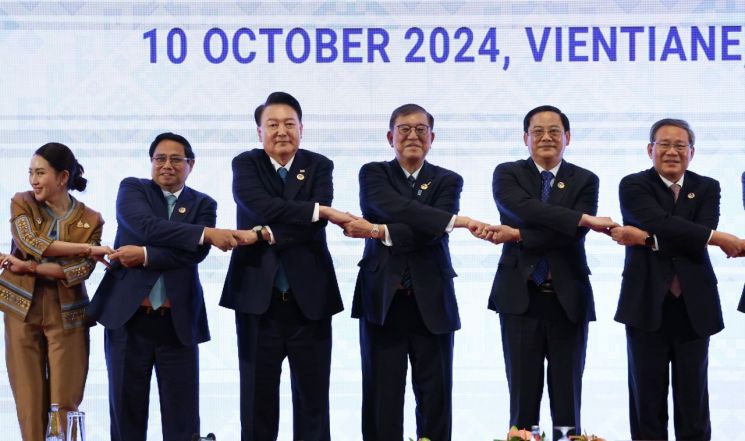 President Yoon Suk-yeol is taking a commemorative photo with ASEAN (Association of Southeast Asian Nations) leaders, including Japanese Prime Minister Ishiba Shigeru, Chinese Premier Li Chang, and Laotian Prime Minister Son Sai Siphandone, at the ASEAN+3 (Korea-China-Japan) Summit held on the 10th of last month (local time) at the National Convention Center (NCC) in Vientiane, Laos.
 From the left: Thai Prime Minister Prayut Chan-o-cha, Vietnamese Prime Minister Pham Minh Chinh, President Yoon, Japanese Prime Minister Ishiba Shigeru, Laotian Prime Minister Son Sai Siphandone, Chinese Premier Li Chang. Photo by Yonhap News.
According to the report "The Leap of the ASEAN Semiconductor Industry," published on the 27th by the Korea International Trade Association's Institute for International Trade and Commerce, ASEAN is emerging as the biggest beneficiary as global semiconductor companies make large-scale investments to establish bases outside China. ASEAN is traditionally strong in the semiconductor packaging sector.
The report highlights Malaysia, Singapore, and Vietnam within ASEAN. Intel has invested in Malaysia, GlobalFoundries in Singapore, and Samsung in Vietnam. As U.S. pressure on China intensifies, the number of Chinese companies entering the ASEAN region is also increasing. The number of Chinese companies in Penang, Malaysia, reportedly rose from 16 to 55.
According to the report, semiconductors are the largest export industry in these three countries. As of 2022, semiconductor exports from these three countries accounted for 19.5% of global semiconductor exports. The average annual export growth rate of semiconductors from 2014 to 2022 was 10.7% in Malaysia and 27.3% in Vietnam, higher than China’s 9.9% and South Korea’s 9.3%.
ASEAN countries are striving to strengthen their positions as semiconductor production hubs based on human resources and geopolitical advantages. Singapore aims to attract foreign investment through innovation in domestic technological capabilities and corporate tax reductions. Malaysia is promoting advanced packaging technology and workforce development through a $100 billion (approximately 140 trillion KRW) investment based on its national semiconductor strategy. Vietnam is also leading efforts to establish a domestic semiconductor ecosystem with the goal of achieving $100 billion in semiconductor industry sales by 2050.
The report states that due to the ASEAN semiconductor industry's focus on back-end processes such as assembly, testing, and packaging, the impact of U.S. sanctions on China, which center on advanced technology and equipment, is limited. In particular, packaging uses general-purpose equipment and relies heavily on individual companies’ know-how, so the sanctions are expected to have little effect. Even if the U.S. strengthens sanctions and encourages domestic production of advanced packaging, cooperation with ASEAN is likely to expand as global demand for advanced packaging surges.
The report suggests that cooperation with ASEAN not only helps reduce dependence on China and diversify supply chains but also strengthens South Korea’s competitiveness in back-end process technology. South Korea’s back-end process competitiveness is relatively weak. As of 2021, the distribution of back-end process facilities was 134 in China, 111 in Taiwan, 95 in ASEAN, 75 in North America, 31 in Japan, and 24 in South Korea. This is why ASEAN is emerging as a partner for advanced packaging. There is also a need for joint workforce development with ASEAN countries to secure labor.
Heo Seul-bi, a researcher at the Korea International Trade Association, said, "ASEAN is a strategic key point for diversifying semiconductor supply chains and a partner for strengthening South Korea’s back-end process capabilities. Since the degree of cooperation with the U.S. and China varies among ASEAN countries, it is important to develop customized cooperation strategies and diversify risks in line with the new U.S. administration’s trade policies."
© The Asia Business Daily(www.asiae.co.kr). All rights reserved.
![A Woman with 50 Million Won Debt Clutches a Stolen Dior Bag and Jumps... A Monster Is Born [Slate]](https://cwcontent.asiae.co.kr/asiaresize/183/2026021902243444107_1771435474.jpg)
















