Proven Synergy from Volpara Acquisition Through Q3 Results
Growth Expectations Rise on AstraZeneca Collaboration News
Stock Price Up 75% This Month
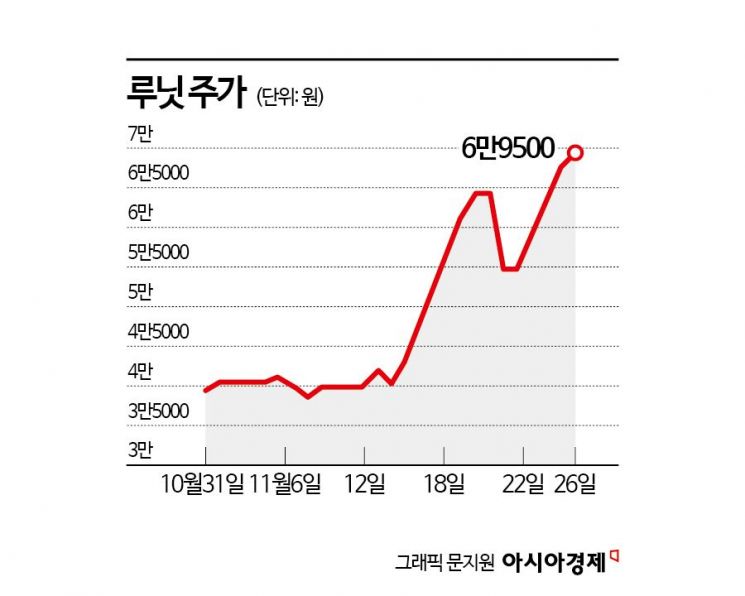
The stock price of Lunit, a leading medical artificial intelligence (AI) company in South Korea, has surged more than 70% since the beginning of this month. This rise is attributed to the proven synergy effect from the acquisition of Volpara Health through the third-quarter earnings, along with the news of a collaboration with the global pharmaceutical company AstraZeneca.
According to the financial investment industry on the 27th, Lunit's stock price rose 74.8% compared to 39,750 KRW at the end of last month. It closed at 69,500 KRW the previous day. During the same period, the KOSDAQ index fell by 6.7%. The return compared to the market reached 81.5 percentage points (P). Domestic institutional investors led the stock price increase by accumulating net purchases worth 104.5 billion KRW.
In the third quarter of this year, Lunit recorded consolidated sales of 16.8 billion KRW and an operating loss of 16.4 billion KRW. Operating revenue increased by 413% compared to the same period last year. On a cumulative basis for the third quarter, sales reached 34.1 billion KRW, up 73% from 19.7 billion KRW in the same period last year. Operating losses doubled to 49.2 billion KRW compared to the same period last year.
Lunit completed the acquisition of Volpara Health in May. It acquired 100% of Volpara's shares for 264.7 billion KRW. The third quarter reflected Volpara's full performance from July to September, resulting in a significant increase in sales. Jiwoo Baek, a researcher at Shinhan Investment Corp., explained, "Volpara recorded sales of 11 billion KRW in the third quarter," adding, "It has a business structure that generates stable monthly sales between 3 billion and 3.5 billion KRW, which helps reduce the volatility of Lunit headquarters' sales."
On the 18th, Lunit signed a strategic collaboration agreement with AstraZeneca to develop an AI-based digital pathology solution targeting non-small cell lung cancer. Researcher Baek said, "This is the first contract with a global pharmaceutical company since the launch of the AI biomarker platform Lunit Scope early last year," and analyzed, "Lunit Scope Genotype Predictor presents the potential to identify patients with EGFR (epidermal growth factor receptor) mutations."
Non-small cell lung cancer accounts for 85% of all lung cancers. The number of patients diagnosed annually is expected to increase from 520,000 in 2020 to 600,000 in 2030. For pharmaceutical companies to prescribe more drugs, it is important to identify more patients.
The collaboration between AstraZeneca and Lunit demonstrates the growth potential of the companion diagnostics market. Companion diagnostics not only help develop new drugs but also become a prerequisite for using newly developed drugs. Since companion diagnostic tests determine the target group for drugs, the diagnostics themselves determine the market size of the drugs.
Seungyeon Han, a researcher at NH Investment & Securities, introduced, "If the main contract with AstraZeneca is signed, there is a possibility to expand the applicable cancer types," adding, "AstraZeneca, a global anticancer drug developer, has a diverse pipeline of anticancer drugs." He emphasized, "Depending on the results with AstraZeneca, there is also the possibility of signing contracts with other global pharmaceutical companies, which is a strength of the AI platform."
© The Asia Business Daily(www.asiae.co.kr). All rights reserved.

















