Commissioner Kwon Jaehan Meets with Director of Pakistan Agricultural Research Council in Seoul
The Rural Development Administration (RDA) and the Pakistan Agricultural Research Council (PARC), which have been promoting the Korean-style disease-free seed potato production system in Pakistan since 2021, have agreed to strengthen agricultural technology cooperation.
On the 26th, RDA Administrator Kwon Jae-han met with Gulam Muhammad Ali, Chairman of PARC, in Yeouido, Seoul, and announced that the two countries agreed to enhance cooperation in agricultural technology.
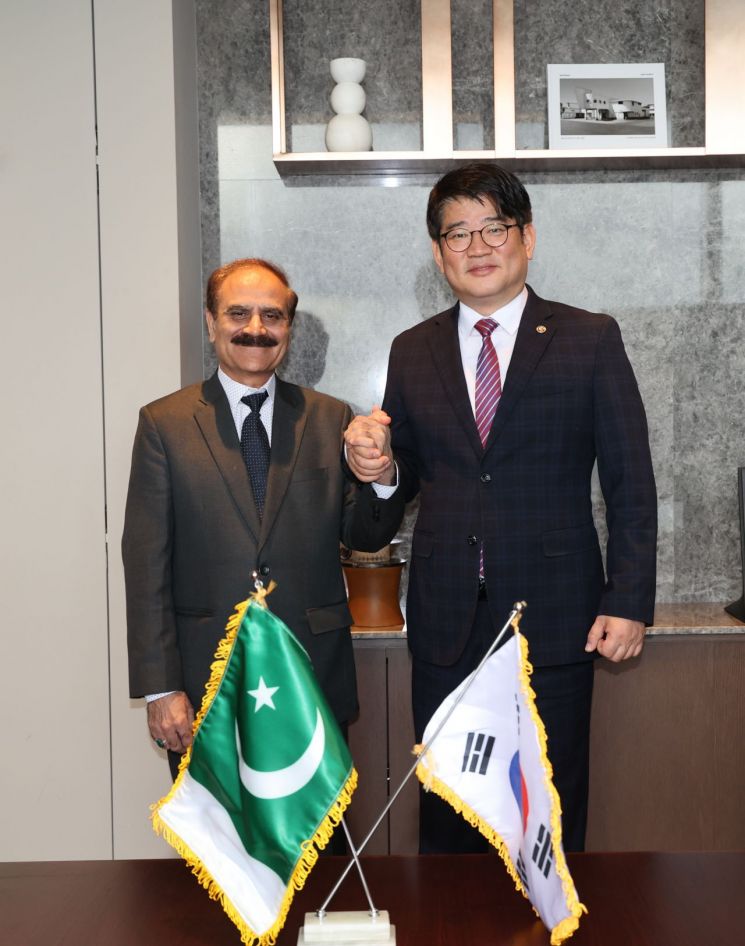 Kwon Jae-han, Administrator of the Rural Development Administration (right), is taking a commemorative photo with Gulam Muhammad Ali, Director of the Pakistan Agricultural Research Council, on the 26th in Yeouido, Seoul.
Administrator Kwon congratulated Chairman Gulam Muhammad Ali, who visited Korea to receive the Presidential Citation for Outstanding Contribution to Official Development Assistance (ODA) on 'Development Cooperation Day,' and discussed solutions for Pakistan's food security and ways to increase the income of small-scale farmers.
Since signing a Memorandum of Understanding (MOU) with PARC in August 2020 and opening the KOPIA Pakistan Center in Islamabad, the two countries have continued cooperation in the agricultural sector. The KOPIA Pakistan Center, jointly operated with PARC, is engaged in various projects such as seed potato production technology, livestock improvement, and feed production technology development.
In particular, since 2021, the Korean-style disease-free seed potato production system has been disseminated to increase Pakistan's self-sufficiency rate in seed potatoes. The Pakistani government highly evaluated the effectiveness of the project and designated it as a national project in 2023, committing $2.5 million over five years. By 2028, when the seed potato production and distribution system is completed, it is expected to supply more than 30% of Pakistan's total seed potato demand.
Administrator Kwon told Chairman Gulam Ali that they would successfully establish the seed potato production and distribution system and ensure the smooth implementation of livestock improvement and advanced feed technology projects starting this year to support Pakistan's food security achievement.
Chairman Gulam Ali expressed gratitude for RDA's significant contribution to Pakistan's agricultural development through the KOPIA project. Furthermore, he actively hoped for the transfer of advanced agricultural technologies such as climate change response and smart agriculture in addition to the ongoing potato and livestock projects. He also added that he hopes there will be more opportunities for Pakistani researchers to learn advanced Korean agricultural technologies to strengthen their capabilities.
The RDA is striving to enhance the national prestige of Korea and build friendly relations by transferring Korea's advanced agricultural technologies to several Asian countries, including Pakistan, to increase farmers' incomes.
Administrator Kwon said, "The core value of agricultural technology ODA projects is to lead agricultural development in developing countries with Korean-style agricultural technology and overcome the global food crisis. Through the K-Rice Belt project, RDA supports the eradication of hunger in Africa, and in Asia, it transfers customized agricultural technologies by country to play a responsible role in solving global food issues."
© The Asia Business Daily(www.asiae.co.kr). All rights reserved.
![User Who Sold Erroneously Deposited Bitcoins to Repay Debt and Fund Entertainment... What Did the Supreme Court Decide in 2021? [Legal Issue Check]](https://cwcontent.asiae.co.kr/asiaresize/183/2026020910431234020_1770601391.png)
















