Democratic Party calls first trial of Public Official Election Act "judicial murder"
Han Dong-hoon says he "finds it hard to accept" Lee Jae-myung's acquittal
Political reactions have been fluctuating depending on the trial results of Lee Jae-myung, leader of the Democratic Party of Korea. When the outcome is favorable, there is respect for the judiciary, but when the verdict is the opposite, there is resistance. Critics point out that the political sphere is creating distrust in the judiciary by itself.
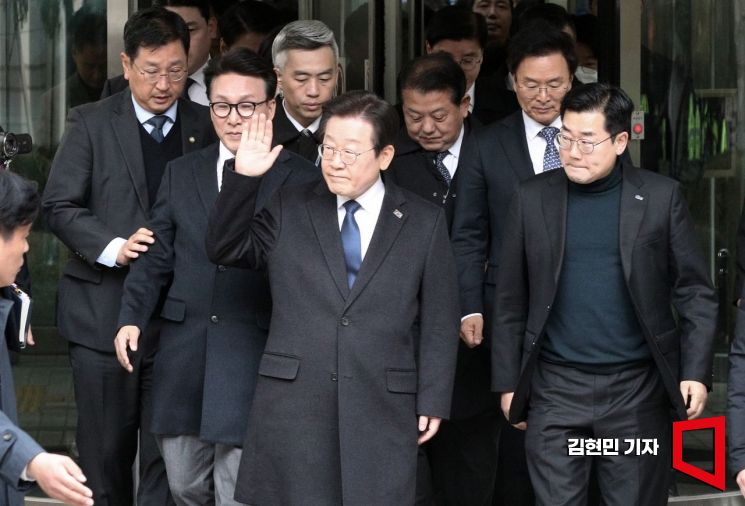 Lee Jae-myung, leader of the Democratic Party of Korea, is leaving the Seoul Central District Court in Seocho-gu, Seoul, after the first trial sentencing hearing for the charge of 'subornation of perjury' held on the 25th. On that day, the first trial court acquitted Lee, who was indicted on charges of subornation of perjury. Photo by Joint Press Corps
The Seoul Central District Court Criminal Division 33 (Chief Judge Kim Dong-hyun) acquitted Lee, who was charged with perjury instruction, on the 25th. The Democratic Party immediately welcomed the verdict. On the 26th, Park Chan-dae, the Democratic Party floor leader, said at a floor strategy meeting held at the National Assembly in Yeouido, Seoul, "This is a victory for truth and justice," adding, "The political prosecution led by Yoon Seok-yeol, which targeted only the opposition party for two and a half years, will soon come to an end." Cho Seung-rae, the Democratic Party chief spokesperson, after a closed-door meeting the previous day, told reporters, "The judiciary has stopped the ruthless oppression of the opposition party by the political prosecution and the judicial assassination attempt against the opposition leader."
This reaction contrasts with the one immediately after Lee was sentenced to one year in prison with a two-year probation for violating the Public Official Election Act in the first trial on the 15th. At that time, the Democratic Party collectively criticized the judiciary. Among the nine members who spoke at the Supreme Council meeting on the 18th, seven, excluding Lee and Song Soon-ho, criticized the judiciary. Floor leader Park said, "The court's ruling is a clear judicial murder," calling it "the worst verdict that will remain a stain in the history of the judiciary." Kim Min-seok, the Democratic Party senior supreme council member, raised his voice, saying, "How could one not question whether the judge, who graduated from Seoul National University Law School, is really qualified?"
The People Power Party also shows inconsistent behavior depending on the judiciary's decisions. Han Dong-hoon, leader of the People Power Party, posted on his social media the day before, saying, "It is difficult to accept the acquittal in the first trial for perjury instruction," but added, "Just as I respected the guilty verdict on the 15th (Public Official Election Act first trial), I respect today's verdict as well. I hope the Democratic Party respects the guilty verdict too." There were no further posts on social media afterward. On the 15th, Han posted three social media messages in one day regarding Lee's guilty verdict. Kim Ki-hyun, a People Power Party lawmaker, said the first trial verdict on the Public Official Election Act was "the people's will winning and the rule of law prevailing," but criticized the recent verdict by saying it "reminds one of an absurd and preposterous sophistry."
Supporters are echoing politicians' reactions and criticizing the judiciary. In Lee's fan cafe, "Jaemyeong's Village," supporters cheered the acquittal and praised Chief Judge Kim. One supporter praised, "Chief Judge Kim is a true patriot who contributed to saving the Republic of Korea." On the other hand, Chief Judge Han Seong-jin, who sentenced Lee guilty in the first trial of the Public Official Election Act, was heavily criticized with terms like "political judge" and "panreki" (a portmanteau of judge and garbage). Similarly, in Han's fan cafe, "With Hoonie," supporters responded with "infinite gratitude to Chief Judge Han," but criticized Chief Judge Kim as a "leftist judge."
Professor Jang Young-soo of Korea University Law School said, "The judiciary is not a sanctuary that should be free from criticism," but added, "The political sphere should logically counter judicial rulings; emotional responses only create distrust in the judiciary."
© The Asia Business Daily(www.asiae.co.kr). All rights reserved.
![User Who Sold Erroneously Deposited Bitcoins to Repay Debt and Fund Entertainment... What Did the Supreme Court Decide in 2021? [Legal Issue Check]](https://cwcontent.asiae.co.kr/asiaresize/183/2026020910431234020_1770601391.png)
















