Draft Master Plan Approved by Seoul City Planning Committee
Transforming into a 'Waterfront-Friendly City' with Easy Access to the Han River
Maximum Height Limited to 250m, Floor Area Ratio Set at 300%
A total of 9,428 households (including 1,792 rental housing units) will be supplied in the Seongsu Strategic Maintenance Zone in Seongdong-gu, Seoul. It is expected to be developed as a waterfront-friendly residential complex with significantly improved access to the Han River.
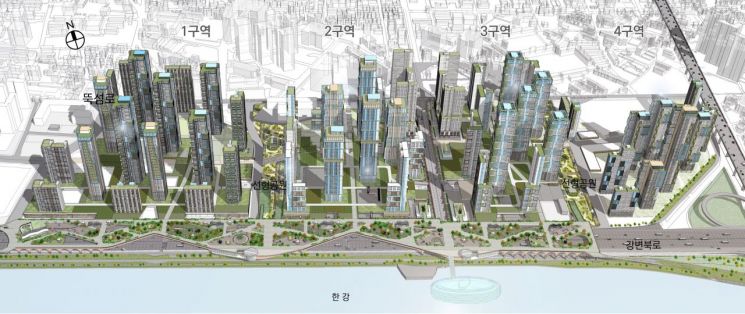 A bird's-eye view of Seongsu Strategic Maintenance District, Seongdong-gu, Seoul. Provided by Seoul City.
On the 25th, the Seoul Metropolitan Government held the ‘12th Urban Planning Committee Maintenance Project Authorization Subcommittee’ and announced on the 26th that it had approved the revised maintenance plan and district unit plan decision for the ‘Seongsu Strategic Maintenance Zone Housing Maintenance-type Redevelopment Project’ containing these details.
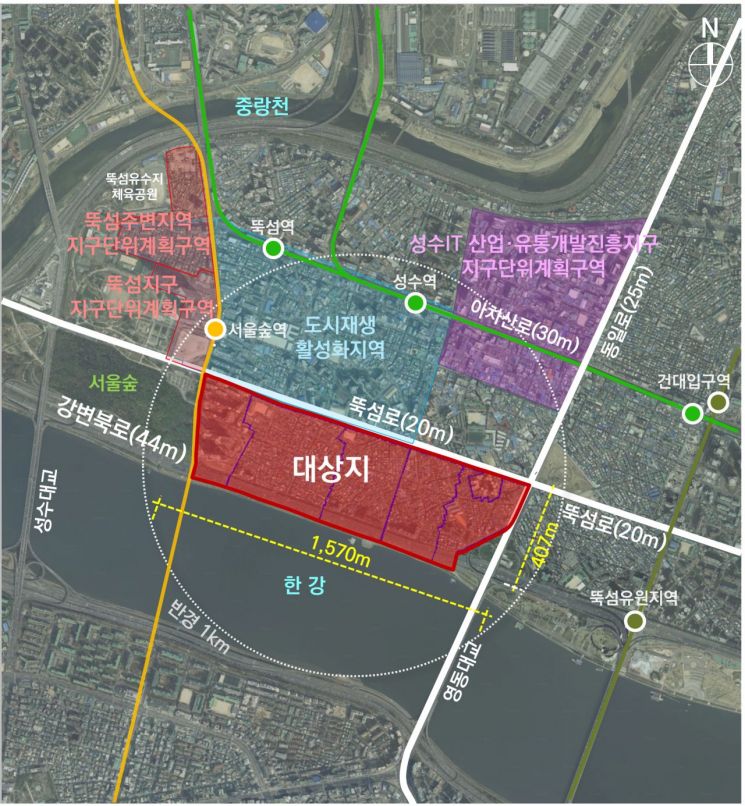
The Seongsu Strategic Maintenance Zone, covering an area of 530,000㎡ along the Han River in Seongsu-dong (around 72-10, Seongsu 1-ga 1-dong), was designated as a strategic maintenance zone in 2009 as part of the ‘Han River Renaissance Plan.’ Subsequently, in 2011, a redevelopment maintenance plan was established and the maintenance zone was decided, but the project faced difficulties for a long time due to local stakeholders’ interests and changes in policies and systems. However, the project began to gain momentum after being selected as a target site for Seoul’s Rapid Integrated Planning in 2021. The city directly established the maintenance plan and district unit plan, coordinated stakeholders’ interests, and prepared a revised maintenance plan that enables smooth project progress in each district.
Through this review, the Seongsu Strategic Maintenance Zone area will be redeveloped into apartments with a maximum height of up to 250m and a floor area ratio of 300% (500% in quasi-residential areas). The project will be carried out in a total of four districts. District 1, which is closest to Seoul Forest and has convenient transportation, will have 3,014 households; District 2, the second largest in area, will have 2,609 households; Districts 3 and 4 will have 2,213 and 1,592 households respectively.
The city plans to enhance project feasibility by expanding the lot area by about 50,000㎡ compared to the existing maintenance plan, reducing the net burden rate by about 8%, and increasing the number of households by more than 14%.
Access to the Han River will also be improved. Two wide linear parks connecting the Seongsu area to the Han River, three-dimensional decks within the complex, and public pedestrian pathways will be secured. Additionally, to compensate for the site’s limitation of being cut off from the Han River by Gangbyeonbuk-ro, a waterfront cultural park approximately 1 km long will be created. It will be designed as a space where various activities such as culture, relaxation, and scenic viewing can be enjoyed.
Furthermore, to sustain the vitality of the Seongsu area, neighborhood living facilities and public facilities will be concentrated along Ttukseom-ro and Seongsu 2-ro to contribute to street activation. From the perspective of the Han River waterfront landscape, a rhythmic wave-shaped skyline will be created. To develop a residential complex open to the Han River, visual corridors within the complex and waterfront and district visual corridors (four axes) have been secured to induce a gradually descending ‘gradation-type landscape.’
Han Byung-yong, Director of the Housing Office of Seoul City, said, “Since residents have waited for a long time, we will actively support the prompt progress of integrated reviews led by the association after the change notification.” He added, “If the Seongsu area’s waterfront covered park is organically connected to the citizens’ living area, it will gain the appearance and competitiveness of an attractive waterfront-friendly city.”
© The Asia Business Daily(www.asiae.co.kr). All rights reserved.
![Clutching a Stolen Dior Bag, Saying "I Hate Being Poor but Real"... The Grotesque Con of a "Human Knockoff" [Slate]](https://cwcontent.asiae.co.kr/asiaresize/183/2026021902243444107_1771435474.jpg)












