Survey Results on the Impact of the US Presidential Election on the Korean Economy According to Mid-sized Enterprises
76.4% of medium-sized enterprises expressed concerns that the launch of Donald Trump's second administration would intensify uncertainty in the Korean economy.
On the 26th, the Korea Federation of Medium-sized Enterprises announced the results of the "Survey on the Impact of the U.S. Presidential Election on the Korean Economy," stating that "there is significant concern about the impact on the Korean economy."
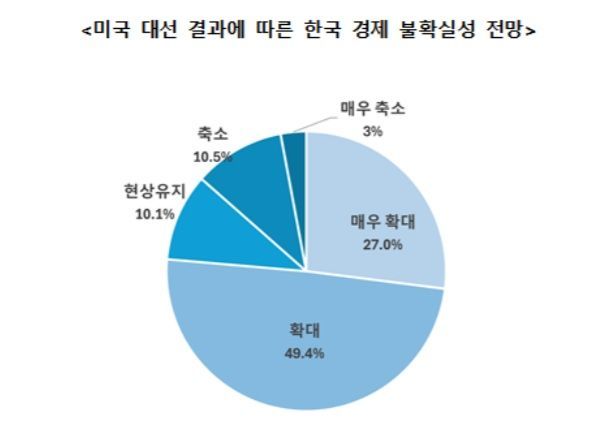
In this survey conducted from the 7th to the 18th targeting 237 medium-sized enterprises, the companies identified factors expanding uncertainty in the Korean economy as "increased corporate burden due to strengthened nationalism (43.9%)," "deterioration of trade balance due to high-intensity tariff policies (35.9%)," and "increased China risk due to strengthened controls on China (13.3%)."
Medium-sized enterprises responded that the impact from Donald Trump's major campaign promise of "tariff policy (39.5%)" would be the greatest. This was followed by trade policy (32.3%), industrial policy (17.3%), environmental policy (7.4%), and tax policy (3.6%).
A representative from the Korea Federation of Medium-sized Enterprises predicted, "If the high universal tariffs of over 10% on general imports and over 60% on China, as declared by Donald Trump, along with reciprocal tariff policies on countries imposing tariffs on U.S. products, are implemented, Korea, with its high trade dependence and characteristics as a small open economy, will face negative effects such as a decline in real GDP."
The top priority government response task following the launch of Trump's second administration was pointed out as "strengthening the competitiveness of core industries from an economic security perspective (20.9%)."
Other key tasks for maintaining and enhancing corporate competitiveness included "establishing policies to protect domestic industries and create new opportunities (17.3%)" and "maintaining real economy soundness at the government level amid exchange rate volatility (16.7%)."
As corporate-level self-help measures to respond to changes in U.S. government policies, "securing liquidity to prepare for exchange rate fluctuations (31.7%)," "diversifying export markets (23.4%)," and "diversifying suppliers of Chinese raw and subsidiary materials (20.4%)" were identified as urgent tasks.
Lee Ho-jun, Executive Vice Chairman of the Korea Federation of Medium-sized Enterprises, said, "The rapid policy changes of Trump's second administration could act as a factor that further exacerbates difficulties in our economy," adding, "We must mobilize all available policy measures to strengthen corporate competitiveness as well as diplomatic responses."
© The Asia Business Daily(www.asiae.co.kr). All rights reserved.
![From Hostess to Organ Seller to High Society... The Grotesque Scam of a "Human Counterfeit" Shaking the Korean Psyche [Slate]](https://cwcontent.asiae.co.kr/asiaresize/183/2026021902243444107_1771435474.jpg)
















