Writing with Ink and Brush Encompasses Traditional Knowledge
Reflects Changing Aesthetic Sensibilities and Sociality Across Eras
"Specific Holders and Holder Groups Not Recognized"
The Cultural Heritage Administration announced on the 26th that it will designate 'Hangeul Calligraphy' as a new category of national intangible heritage. They plan to collect opinions from various sectors for a month and decide on the designation after a review by the Intangible Heritage Committee.
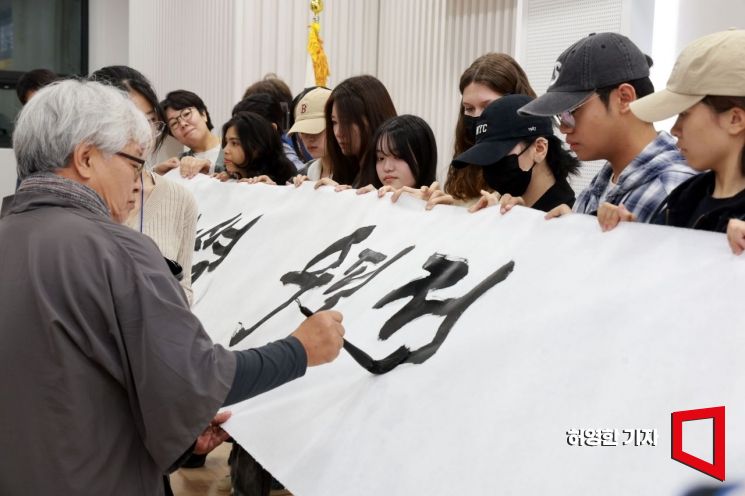 On the occasion of the 578th Hangeul Day, the 30th Foreigners' Hangeul Writing Contest was held on the 8th at the Korean Language Institute of the Language Research and Education Center at Yonsei University. Calligrapher Han Chang-hwan is presenting the writing prompt in brush calligraphy. Photo by Heo Young-han younghan@
Hangeul Calligraphy encompasses the act of writing the Korean unique script, Hangeul, using ink and brush, as well as the traditional knowledge contained therein.
Since the creation and promulgation of Hunminjeongeum in the 15th century, Hangeul has been used on various media such as paper, metal and stone (金石), and textiles. It has been an important means of recording the lives of Koreans.
Hangeul Calligraphy was naturally used in handwritten manuscripts of literary works written in Hangeul as well as in everyday letters exchanged. It has continued to the present day in various scripts and brush techniques, from traditional printed styles (panbonche) and royal court styles (gungche) to personalized handwriting styles (minche). Panbonche refers to the script used in woodblock prints for printing purposes until the mid to late Joseon Dynasty, while gungche is the script used by court ladies when writing with a brush in the royal palace.
Hangeul Calligraphy also functions as an original form of visual art using characters. Through various calligraphy works, it reflects the changing aesthetic sensibilities and social conditions of each era. This artistic meaning and function have recently expanded into the field of stylish lettering art (calligraphy), where elements of character design are emphasized.
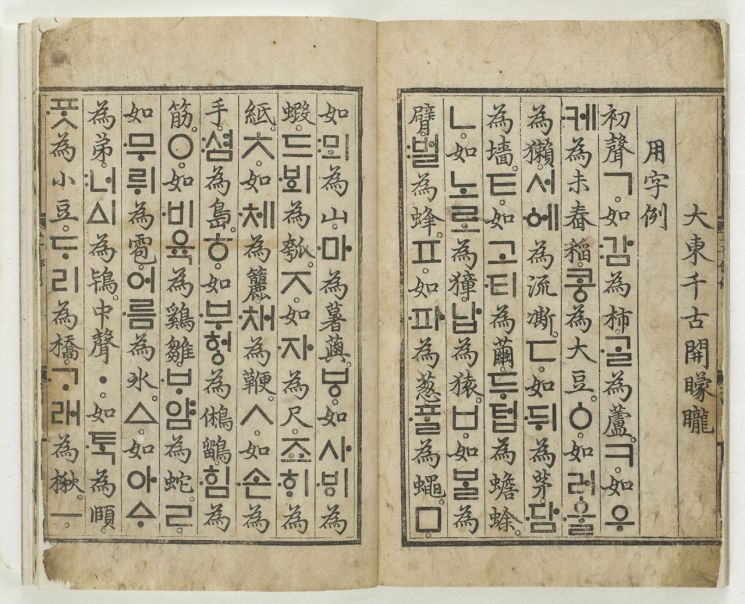
The Cultural Heritage Administration sees sufficient value in designating it as national intangible heritage for four main reasons: ▲It has a long history continuing from the time of Hangeul’s creation to the present ▲It has been used in various records (literary works, practical books for daily life, letters), contributing to research in folklore, Korean language history, food history, cultural history, and script history ▲It uses the uniquely Korean script Hangeul with distinctive brush techniques and refined beauty that distinguish it from neighboring countries ▲It is still transmitted through various educational institutions and is expanding its scope into artistic fields (calligraphy, media works, performances, etc.), contributing to cultural diversity and creativity.
A Cultural Heritage Administration official explained, "Hangeul Calligraphy expresses our unique writing system, Hangeul," adding, "Through its distinctive scripts and brush techniques, it demonstrates representativeness as a traditional Korean culture."
They further stated, "Considering that it is still actively transmitted mainly through educational institutions and related organizations and enjoyed by the entire nation, it was decided to designate it as a community category without recognizing specific holders or holder groups."
© The Asia Business Daily(www.asiae.co.kr). All rights reserved.


















