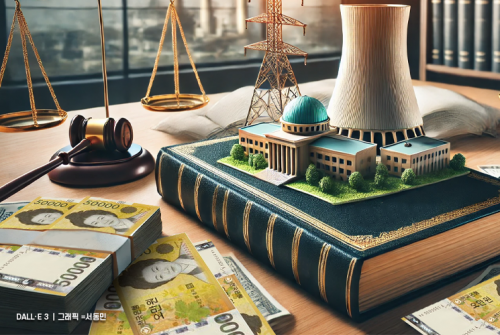
On the 25th, the Korea Nuclear Industry Association issued a statement urging the prompt enactment of the "High-Level Radioactive Waste Management Special Act" (hereinafter referred to as the High-Level Special Act) together with its 422 member companies and 160,000 workers.
The Nuclear Industry Association is the largest nuclear-related organization in Korea, with 422 member companies including Korea Hydro & Nuclear Power, Korea Electric Power Corporation, KEPCO KPS, KEPCO Nuclear Fuel, Doosan Enerbility, Daewoo Engineering & Construction, Samsung C&T, Kumhwa PSC, Woori Technology, Woojin, the Korean Nuclear Society, and the Korean Radioactive Waste Society.
The Nuclear Industry Association explained that the statement was issued based on the recognition that the enactment of the High-Level Special Act should no longer be delayed to ensure the stable operation of nuclear power plants for the effective achievement of carbon neutrality and energy security, as well as for the overseas export of nuclear power plants.
The nuclear industry stated that the reason for the necessity of enacting the High-Level Special Act is that future generations should be able to receive stable electricity from environmentally friendly nuclear power without worrying about high-level radioactive waste, and that it is essential to minimize social conflicts by alleviating the concerns of local residents near nuclear power plant sites.
They also added that the enactment of the High-Level Special Act, which is required by the K-Taxonomy, is essential not only to create jobs through the completion of Shin Hanul Units 1 and 2 and the commencement of Units 3 and 4, but also to further revitalize the domestic nuclear industry ecosystem and successfully export nuclear power plants overseas, such as the selection of the preferred bidder for the new nuclear power plant in the Czech Republic.
No Baek-sik, Vice Chairman of the Korea Nuclear Industry Association, said, "The High-Level Special Act is one of the biggest pending issues in the nuclear industry that must be resolved to establish a safe and responsible management system for high-level radioactive waste, build trust in the nuclear industry, and avoid passing the burden to future generations." He added, "All 422 member companies and 160,000 workers hope that the 22nd National Assembly’s ruling and opposition parties will pass the High-Level Special Act in the spirit of cooperation and consensus."
After issuing the statement, the Korea Nuclear Industry Association visited the National Assembly to directly deliver the statement urging the swift processing of the High-Level Special Act.
On the same day, the Korean Radioactive Waste Society also issued a separate statement urging the passage of the High-Level Special Act.
The society emphasized, "Countries like Finland and Sweden, which introduced nuclear power around the same time as we did, are already operating or preparing to construct high-level radioactive waste disposal facilities, and countries such as France, Switzerland, Canada, Japan, Germany, and the United Kingdom have either selected disposal sites or are steadily proceeding with the site selection process. To minimize unnecessary social conflicts and consistently promote the management of high-level radioactive waste over decades, a special act is absolutely necessary."
Meanwhile, the National Assembly’s Industry, Trade, Energy, Small and Medium Enterprises Committee is scheduled to hold a bill subcommittee meeting on the 26th to introduce the High-Level Radioactive Waste Special Act for the first time. The High-Level Radioactive Waste Special Act was automatically discarded in the 21st National Assembly due to a lack of consensus between the ruling and opposition parties. In the 22nd National Assembly, Kim Seok-ki, Lee In-seon, Kim Seong-won, and Jeong Dong-man from the People Power Party, along with Kim Seong-hwan from the Democratic Party, have reintroduced the High-Level Special Act.
© The Asia Business Daily(www.asiae.co.kr). All rights reserved.

![Clutching a Stolen Dior Bag, Saying "I Hate Being Poor but Real"... The Grotesque Con of a "Human Knockoff" [Slate]](https://cwcontent.asiae.co.kr/asiaresize/183/2026021902243444107_1771435474.jpg)















