Massive M&A Burdens Lotte Group Overall
Expected 'Cash Cow' but Financial Strain Due to Downcycle
To Become a 'Profitable M&A,' Understanding Seller's Psychology Is Key
In a recession, a cautious strategy is necessary even for mergers and acquisitions (M&A) aimed at the future. In recent years, large-scale M&A investments by conglomerates driven by FOMO (fear of missing out) have backfired on their performance and financial structure. While some corporate groups quickly absorbed future technologies through FOMO-driven investments, others misread the business cycle, burdening their affiliates with financial strain and falling into an indefinite slump.
Expected 'Cash Cow' but Facing Down Cycle: 'Money-Losing M&A'
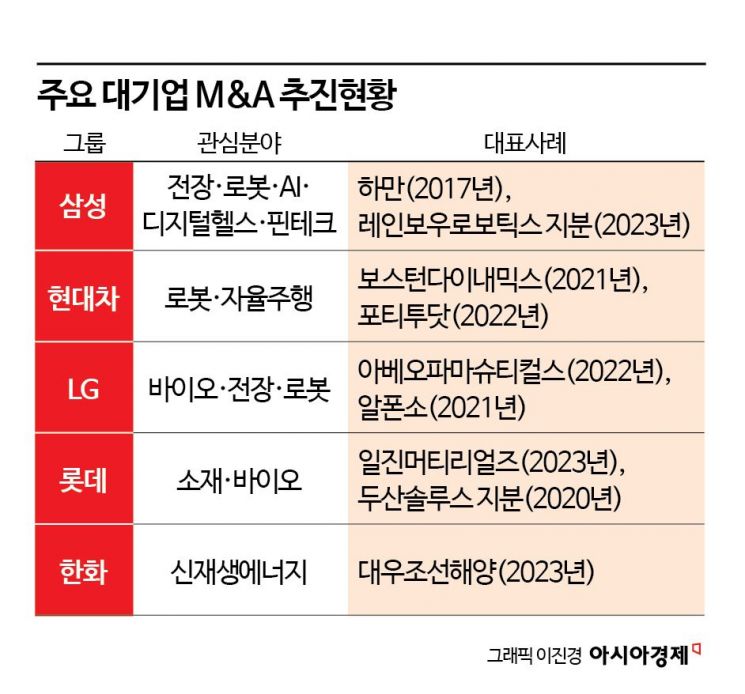
According to the investment banking (IB) industry on the 26th, the aftershocks of Lotte Group's aggressive M&A are affecting the overall financial soundness of the group. The investment in Iljin Materials (now Lotte Energy Materials), acquired by Lotte Chemical last year for 2.7 trillion won, has led to credit rating downgrades of affiliates, burdening Lotte Group's entire financial structure.
The acquisition of Iljin Materials, the world's fourth-largest copper foil manufacturer, was one of the largest M&A deals last year. Copper foil is a film made by thinning copper to less than 100㎛ (1㎛ is one-millionth of a meter) thickness and plays a role in dissipating heat generated in batteries. It attracted market attention alongside the growth of the electric vehicle market. Lotte secured the company after fierce competition with Aditya Birla Group, one of India's top five conglomerates, with Chairman Shin Dong-bin personally involved for future business. Several rights offerings were conducted to raise additional funds.
However, the electric vehicle chasm (temporary demand stagnation) and the upcoming second term of the Trump administration are expected to prolong the downturn in the electric vehicle and battery-related industries. At the end of 2022, when Lotte decided to acquire the company, it posted an operating profit of 84.8 billion won annually, but this dropped to about 11.8 billion won last year. This year, an operating loss of approximately 22 billion won (according to securities firms' forecasts) is expected. Of the 1.3 trillion won in financial sector funds raised during the acquisition, about 700 billion won will mature next year.
An M&A expert said, "Lotte was once renowned for its M&A capabilities, but recent deals seem to have fallen into the FOMO trap. Private equity funds specializing in M&A also refer to economic cycles but tend to avoid industries with large industrial cycles because they are always hard to predict. In Lotte's case, the results of M&A during a down cycle have become starkly apparent."
If Not Investing Now, Future Costs Will Be a Bigger Boomerang... 'Profit-Generating M&A'
M&A driven by FOMO does not only have negative effects on companies. Some M&A investments are expected to pay costs upfront and even generate returns later. Hyundai Motor Group acquired Boston Dynamics in 2021 for 1 trillion won to secure technologies such as robotics and autonomous driving, and in 2022 acquired a stake in 42dot for about 430 billion won. Subsequently, Hyundai Motor Group purchased additional shares in 42dot, investing a total of about 1.5 trillion won. The group invested this large sum to acquire loss-making companies.
Boston Dynamics posted a net loss of 197 billion won in the first year after acquisition, followed by 255 billion won in 2022 and 334.8 billion won last year. Despite continuous losses, the company's corporate value is increasing, and if it succeeds in an initial public offering (IPO), it could be recognized as worth more than the investment. Recently, Boston Dynamics' robot dog 'Spot' was deployed for security duties for then President-elect Donald Trump, marking a successful commercialization in the U.S. Additionally, the release of work videos of the humanoid robot Atlas, which works like a real person, attracted significant international media attention.
42dot, which develops software-defined vehicles (SDV) and autonomous driving technologies, recorded a cumulative loss of over 270 billion won and a deficit of 384 billion won from 2020 to last year. Although it is not a profit-generating business immediately, investments to secure leadership in the autonomous vehicle era are expected to continue. As the core of automobiles shifts to software, owning proprietary SDV technology is anticipated to significantly impact business profitability. Although currently a loss-making company, considering the costs and reduced profitability involved in using SDV systems developed by other companies in the future, this is a justified investment. Despite ongoing losses, the company expanded its investment scale by conducting a rights offering of about 1 trillion won last year.
Investing in High-Value Products... Research and Development Outcomes Are 'Uncertain M&A'
LG Group is challenging cancer drug development through M&A. LG Chem acquired U.S. cancer drug specialist Aveo Pharmaceuticals in 2022 for about 800 billion won. This is a strategy targeting the U.S., the world's largest cancer market. LG Chem is aggressively pursuing research and development (R&D) and pipeline expansion in the cancer drug field. The goal is to prepare for late-stage clinical trials and commercialization directly using Aveo.
The R&D budget for new drug development also increased significantly from 174 billion won in 2020 to about 400 billion won last year. In the third quarter results this year, LG Chem recorded sales of 307.1 billion won and an operating loss of 900 million won in the life sciences division. While major products such as diabetes and vaccines showed strong shipments, increased R&D costs led to a slight loss. LG Chem boldly sold its IT film and diagnostics businesses last year and set a strategy to focus on high-value-added products such as cancer drugs, batteries, and eco-friendly materials. Whether LG Chem can achieve concrete results in the challenging cancer drug field remains uncertain.
A senior official in the investment industry hinted, "When conducting M&A, it is important to see whether there are professional talents internally to operate the company after acquisition. If you buy a company not because of financial necessity but simply because the major shareholder wants to sell, the market often deteriorates two to three years later, so it is crucial to understand the seller's intentions well."
© The Asia Business Daily(www.asiae.co.kr). All rights reserved.

















