The first trial verdict for Lee Jae-myung, leader of the Democratic Party of Korea, on charges of 'suborning perjury' will be announced on the 25th.
Lee, who was already sentenced to a suspended prison term in the first trial on the 15th for violating the Public Official Election Act, will be barred from running for public office for 10 years from the date the sentence is finalized if the first trial sentence is upheld.
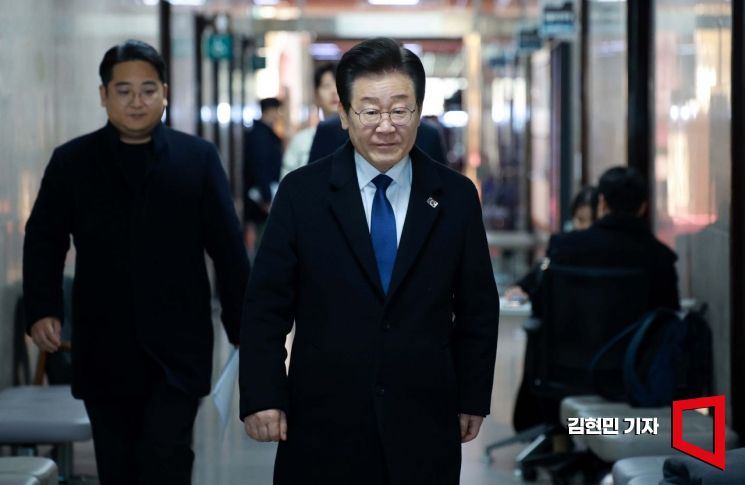 Lee Jae-myung, leader of the Democratic Party of Korea, is heading to the National Assembly on the 25th, the day of the first trial verdict in the perjury coaching charge case.
The 'suborning perjury' case to be sentenced on this day is considered the most likely to result in a guilty verdict among the four trials Lee has been facing, including the recently added indictment for embezzlement of corporate cards in Gyeonggi Province involving about 100 million won in breach of duty.
This is because there is a confession from Kim Jin-sung, who testified as a witness in Lee's criminal trial at Lee's request and committed perjury, as well as an audio recording submitted as evidence in which Lee repeatedly calls Kim and asks him to testify about matters Kim claims not to clearly remember.
In the legal community, considering the court's strict stance on perjury offenders who undermine the national judicial function, there is even speculation that if the court finds Lee guilty, he could be sentenced to actual imprisonment. Previously, the prosecution requested a three-year prison sentence for Lee during the closing arguments.
However, as mentioned by Han Dong-hoon, leader of the People Power Party, the prevailing view is that it is unlikely the court will detain Lee in court without a separate approval for arrest.
The Criminal Division 33 of the Seoul Central District Court (Presiding Judge Kim Dong-hyun) will hold the sentencing hearing for Lee's suborning perjury case starting at 2 p.m. on the 25th.
Lee's Suborning Perjury Charge... Asked Kim Jin-sung to Commit Perjury in 2018
Lee's suborning perjury charge stems from allegations that in December 2018, while on trial for violating the Public Official Election Act (false statement), Lee called Kim Jin-sung, a former secretary to the late Kim Byung-ryang, former mayor of Seongnam, and asked him to appear as a witness in his trial and give false testimony favorable to him.
At that time, Lee was on trial for making false statements during a TV debate for the Gyeonggi Province governor candidate in May 2018, claiming he was falsely accused in the 'impersonation of a prosecutor' incident.
The impersonation of a prosecutor incident involved Lee, who was a lawyer in 2002, conspiring with PD Choi Cheol-ho of KBS's 'Chujeok 60 Minutes' to impersonate a prosecutor while calling Kim Byung-ryang, then mayor of Seongnam, from Lee's office, with Lee providing the name of the prosecutor to impersonate and the questions to ask.
Lee was indicted for impersonating a public official in this case and was fined 1.5 million won by the Supreme Court in 2004.
However, on May 29, 2018, during the '2018 Local Election Gyeonggi Province Governor Candidate KBS Invitational Debate,' Lee stated in response to a rival candidate's question about the impersonation incident, "I was falsely accused because I was next to the PD who was impersonating," and "I never impersonated a prosecutor. I was falsely accused because I was interviewing next to the PD who did it."
The prosecution judged that Lee's statement claiming he was falsely accused in a case where the Supreme Court had already confirmed his guilt constituted false statement publication that could influence the election, and on December 11, 2018, Lee was indicted without detention for false statement publication under the Public Official Election Act. The prosecution's view was that Lee conspired to impersonate a prosecutor by providing the impersonation details to Choi and, despite being criminally punished for it, falsely claimed he was not involved in the impersonation incident.
The court will issue its first ruling on the charge that Lee suborned Kim to commit perjury in that trial.
The prosecution believes that Kim, who was a secretary to the late mayor Kim and, along with Kim In-seop, former CEO of Korea Housing Technology, received money in exchange for facilitating permits related to the Baekhyeon-dong development project and was assisting CEO Jeong Ba-ul in the project, was repeatedly asked by Lee around December 2018 via phone calls to testify that there was an agreement or atmosphere to withdraw a complaint against PD Choi to frame Lee as the main culprit between Kim Byung-ryang and KBS during the impersonation incident. Kim In-seop, known as a close aide to Lee, acted as a lobbyist for Baekhyeon-dong.
At Lee's trial for violating the Public Official Election Act held at the Suwon District Court Seongnam Branch on February 14, 2019, Kim appeared as a witness, took the oath, and testified to the effect that there was such an agreement or atmosphere, even though he did not know or remember if it actually existed, as stated in the prosecution's indictment. Lee was acquitted in that trial, allowing him to retain his position as governor of Gyeonggi Province and run for president.
The prosecution indicted Kim for perjury and Lee for suborning perjury in October last year.
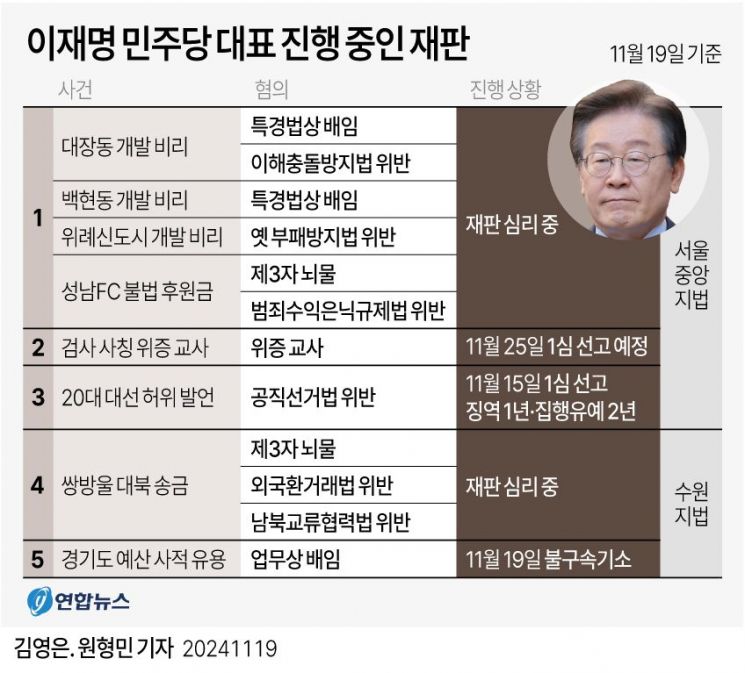
Confession of Kim Jin-sung and Even Audio Recordings
The reason the legal community views the likelihood of Lee's guilt on suborning perjury charges as high is because there is a confession from Kim, who committed perjury at Lee's request in court, and decisive evidence in the form of audio recordings of phone calls between Lee and Kim supporting this.
Kim, who confessed to the crime during prosecution investigation, maintained his position in court that he gave false testimony at Lee's request. At the trial held on February 26, Kim answered "yes" to the prosecutor's question, "Did you give false testimony because you felt pressured by multiple calls from Lee, then governor of Gyeonggi Province and a leading presidential candidate, and due to the pro-Lee public opinion in Seongnam?"
Kim explained his reason for perjury as feeling sympathy for Lee's big ambitions and wanting to help in an urgent situation. He also mentioned the pressure of the request coming from the governor of Gyeonggi Province.
During the trial, the prosecution played a recording in which Lee tells Kim, who said he did not remember, "You can just say you heard that."
The call recordings include Lee telling Kim, "Please tell it as it is," and "I'm not asking you to reconstruct the incident." Lee has argued that these statements indicate he did not ask Kim to give false testimony. However, legal experts suggest that as a lawyer, Lee might have consciously made these remarks considering the possibility of the call being recorded.
Among the calls, Lee's request for Kim to testify in a specific way despite Kim's claim of poor memory is clearly suborning perjury. Moreover, evidence shows Lee sent Kim a brief of arguments before the testimony to practice desired answers to expected questions, making it difficult for Lee to escape the charges.
U Chang-hoon, the presiding judge who dismissed Lee's arrest warrant last September, also stated that the charges in this suborning perjury case appear to be substantiated. Furthermore, Lee's continuous posts on his Facebook claiming innocence and calling the case a 'failed teacher' ahead of the sentencing suggest that Lee himself considers the possibility of guilt in this case to be high.
Supreme Court's 'Subjective Theory' on 'Falsehood' in Perjury
The Supreme Court of Korea adopts the 'subjective theory' rather than the 'objective theory' in determining 'falsehood' in perjury. This means the standard is whether the testimony contradicts the witness's inner memory, not whether it is objectively true or false.
In other words, even if Lee did not explicitly ask Kim to lie, if he asked Kim to testify in a certain way as if he remembered something he actually did not, the crime of suborning perjury is established. Kim, who testified as if he remembered despite not recalling, is also guilty of perjury.
The causal relationship between perjury and its impact on the trial outcome does not affect the establishment of perjury or suborning perjury charges.
Meanwhile, the Supreme Court adopts the 'accomplice dependency theory' regarding accomplices. For Lee to be guilty of suborning perjury as an accomplice, the principal offender Kim must be found guilty of perjury. Since Kim has confessed to perjury in this case, there is no particular issue.
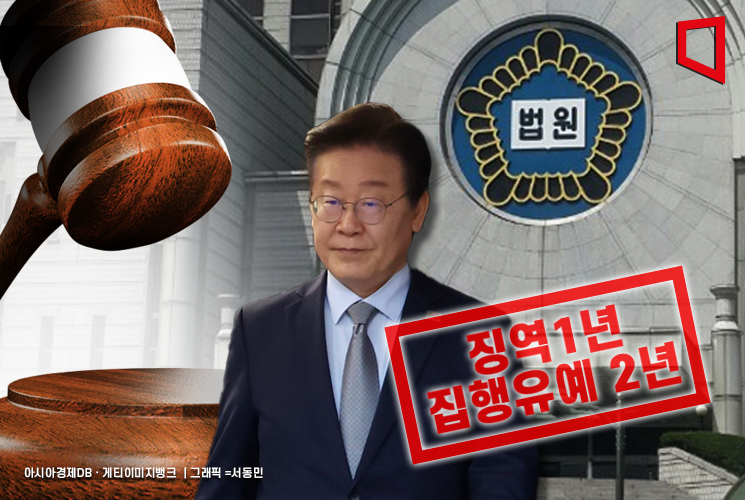 The first trial court sentenced Representative Lee Jae-myung to one year in prison with a two-year probation for violating the Public Official Election Act (false information disclosure).
No Imprisonment Sentence for Suborning Perjury... If Imprisoned, Voting Rights Restricted for 5 or 10 Years After Sentence Completion or Exemption
Article 152(1) of the Criminal Act states, "A witness who has sworn by law and gives false testimony shall be punished by imprisonment for not more than five years or a fine not exceeding 10 million won."
Article 31(1) of the Criminal Act states, "A person who instigates another to commit a crime shall be punished with the same penalty as the principal offender."
Thus, perjury and suborning perjury are punishable only by imprisonment or fines; there is no provision for a jail sentence.
Perjury is a crime protecting the judicial function of the state. Since it obstructs judges from conducting proper trials through false testimony, the judiciary or judges can be considered the victims. Therefore, along with false accusation, it is a crime with a relatively high rate of actual imprisonment compared to other crimes.
In particular, suborning perjury is considered more serious because it causes a person without intent to commit perjury to do so. While destroying one's own criminal evidence is not punishable, causing a third party to destroy evidence is punishable as evidence destruction instigation.
Article 19(2) of the Public Official Election Act states that a person sentenced to imprisonment or higher whose sentence has not been extinguished is disqualified from candidacy.
Since suborning perjury cannot be sentenced to imprisonment, if Lee is sentenced to imprisonment for suborning perjury and the sentence is finalized, his candidacy rights will be restricted until the sentence is extinguished. According to the Act on the Execution and Exemption of Sentences, imprisonment exceeding three years is extinguished after 10 years from sentence completion or exemption, and imprisonment of three years or less after five years.
If multiple sentences restricting candidacy rights are imposed in different trials, the longest restriction period must pass before candidacy rights are restored.
If Lee is acquitted or even fined on this day, he is expected to continue claiming innocence, criticizing the prosecution for 'political investigation' and 'targeted investigation.'
On the other hand, if Lee, who has already been sentenced in the Public Official Election Act violation case and barred from running for office for 10 years, is found guilty again today, the political burden due to judicial risks is expected to increase significantly.
© The Asia Business Daily(www.asiae.co.kr). All rights reserved.
![Clutching a Stolen Dior Bag, Saying "I Hate Being Poor but Real"... The Grotesque Con of a "Human Knockoff" [Slate]](https://cwcontent.asiae.co.kr/asiaresize/183/2026021902243444107_1771435474.jpg)


















