Global IR Event for Participating Companies in Regulatory Sandbox and More
Roundtable Discussion for Commercialization of Cell-Cultured Food
The government has begun exploring collaboration plans with Singapore through regulatory sandbox zones and global innovation zones.
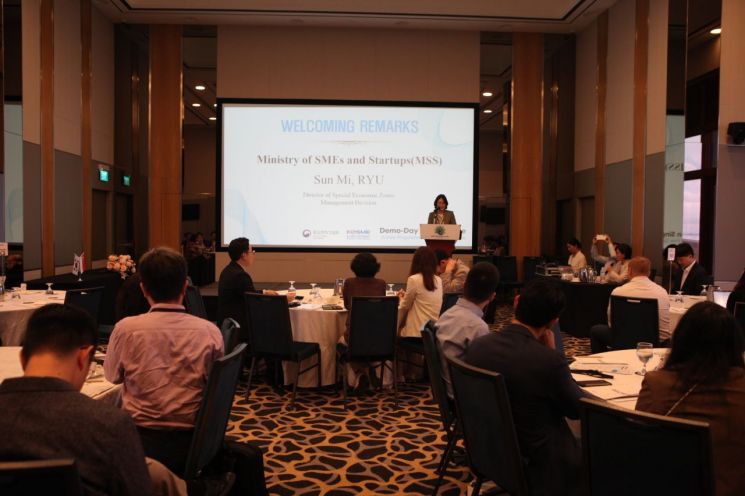 'Regulatory Free Zone and Global Innovation Zone Singapore IR Demo Day' held on the 19th. Provided by the Ministry of SMEs and Startups.
On the 25th, the Ministry of SMEs and Startups announced that it attended the '2024 Singapore International Agri-Food Week,' co-hosted by the Singapore Food Agency and Temasek, Singapore's sovereign wealth fund. The Agri-Food Week was held from the 18th to the 22nd.
First, the government introduced its efforts to secure future food sources through regulatory sandbox zones and met with the Singapore Economic Development Board and Enterprise Singapore to promote strengthened cooperation between innovative companies and demonstration bases of both countries through regulatory sandbox zones and global innovation zones. Additionally, a roundtable was held with experts in future foods, international organizations, and companies from the special zones to share the current status of cell-cultured foods and discuss ways to promote commercialization. Furthermore, a global investor relations (IR) session was conducted targeting Temasek and Singapore venture capitalists (VCs) to showcase promising startups in the cell-cultured food and advanced regenerative sectors within the regulatory sandbox and global innovation zones.
This was the first time a global IR event targeting overseas VCs was held to support the global expansion and scale-up of special zone companies. On the 19th (local time), the 'Regulatory Sandbox and Global Innovation Zone Singapore IR Demo Day' was held, attended by over 20 local VCs, including Singapore investment management firms (K3, Lion X, Qualgro) that will operate global funds funded by Temasek and Korea's Korea Fund of Funds.
The IR, themed on bio and food tech, featured six companies: CEFO, an advanced regenerative medical company developing stem cell differentiation technology-based arthritis cell therapy; Recode, specializing in extracellular vesicle-based brain disease treatment and anti-aging products; Danagreen, a cell-cultured food company using 3D scaffold-based cell culture; Simple Planet, producing powdered cell-cultured protein; Planty Farm, a smart farm company operating ICT-based indoor vertical farms; and 2N, a water purification company with a low-temperature membrane distillation desalination system.
On the 20th, a roundtable was held with Gyeongsangbuk-do Province and Uiseong County to discuss establishing a global cooperation base and commercialization strategies for the 'Gyeongbuk Cell-Cultured Food Regulatory Sandbox,' newly designated in April this year. About 20 participants, including Korean cell-cultured food companies, global firms, international organizations, and academic experts, discussed the challenges necessary for the commercialization of cell-cultured foods. Professor Mark Chong from Singapore Management University stated, "For cell-cultured foods to be chosen by consumers, they must provide direct benefits such as taste, texture, and price."
Additionally, on the 21st, discussions were held with Enterprise Singapore and the Economic Development Board about expanding collaboration between innovative companies and demonstration bases starting with the Gyeongbuk cell-cultured food special zone. A Ministry of SMEs and Startups official said, "Singapore is an important innovation hub for global expansion and scale-up, and South Korea has regulatory sandbox zones and global innovation zones covering various innovative fields such as bio, energy, mobility, and ICT. Through mutual linkage among governments, institutions, and companies of both countries, synergy can be created. In particular, if Singapore, which was the first in the world to approve cell-cultured foods, collaborates with the Gyeongbuk cell-cultured food special zone, it is expected to accelerate the commercialization of cell-cultured foods."
In response, Sharon Tay, Head of Agri-Food at Enterprise Singapore, said, "There is a need to establish a platform that connects Korean and Singaporean SMEs and startups wishing to share and cooperate on SME support policies between Korea and Singapore. We hope that bilateral cooperation for the commercialization of cell-cultured foods will expand through various cooperation models, including joint research on core cell-cultured food technologies between Korean and Singaporean companies and linking Singapore's innovation hubs with South Korea's production bases."
© The Asia Business Daily(www.asiae.co.kr). All rights reserved.

















