The consultative body between the ruling party, opposition, and government showed persistent differences in opinion regarding next year's increase in medical school quotas. However, some common ground was found on expanding medical sector participation in the Presidential Office's Medical Reform Special Committee and on ensuring the autonomy of the Korea Institute of Medical Education and Evaluation (KIMEE).
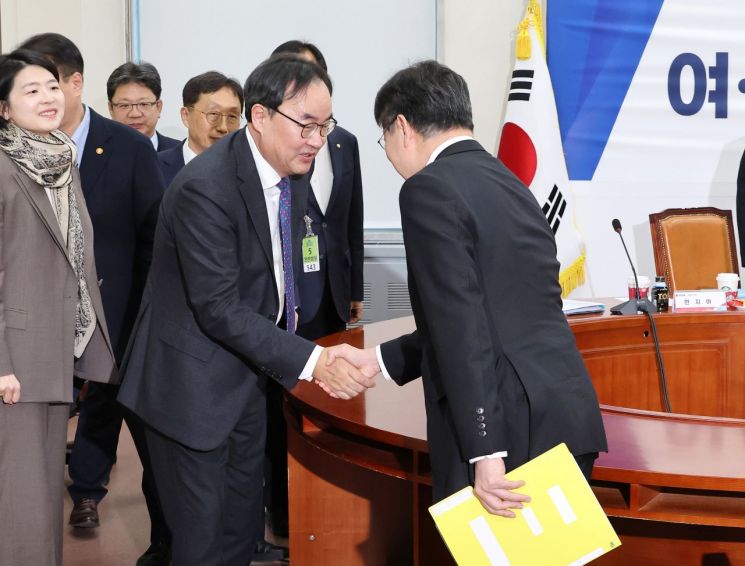 On the afternoon of the 24th, Sung Tae-yoon, Chief of Policy Office at the Presidential Office (right), and Lee Jin-woo, President of the Korean Medical Association, greeted each other at the 3rd meeting of the 'Ruling and Opposition Parliamentary Council' held at the National Assembly. Photo by Yonhap News
Kim Seong-won, a member of the ruling People Power Party who participated in the talks, said at a briefing after the third plenary meeting at the National Assembly in Yeouido, Seoul on the 24th, "The government accepted the medical sector's demand for a structure that can reflect medical sector opinions as much as possible, including plans to expand medical sector participation in the Medical Reform Special Committee." He added, "There has been progress regarding the autonomy guarantee of KIMEE and the revision of enforcement ordinances. We will continue more advanced discussions."
However, no agreement was reached concerning the increase in medical school quotas. Kim explained, "There is still no consensus on the issue of medical school quotas."
On the day, the medical sector submitted four adjustment proposals related to next year's medical school quota increase to the government side. The proposals included limiting the carryover of unfilled early admission slots to regular admissions, reducing the number of waitlisted candidates, granting schools the authority to restrict the selection of applicants with significantly poor academic abilities, and giving schools autonomy over the number of admissions within recruitment guidelines. Additionally, the medical sector proposed discussions on postponing the quota increase until the 2026 academic year and establishing a rational estimation body for quotas.

However, it is reported that the government side expressed that it is practically difficult to accept the adjustment proposals, citing that next year's medical school quotas have already been finalized. The government reiterated its existing stance that the possibility of increasing the 2026 academic year quotas should be discussed by the estimation body.
© The Asia Business Daily(www.asiae.co.kr). All rights reserved.
![Clutching a Stolen Dior Bag, Saying "I Hate Being Poor but Real"... The Grotesque Con of a "Human Knockoff" [Slate]](https://cwcontent.asiae.co.kr/asiaresize/183/2026021902243444107_1771435474.jpg)

















