Sangwook Park, Chief of Science and Technology, "Qualitative Transformation of Basic Research"
Briefing on 'Five Major Reform Directions in Science and Technology for the Second Half'
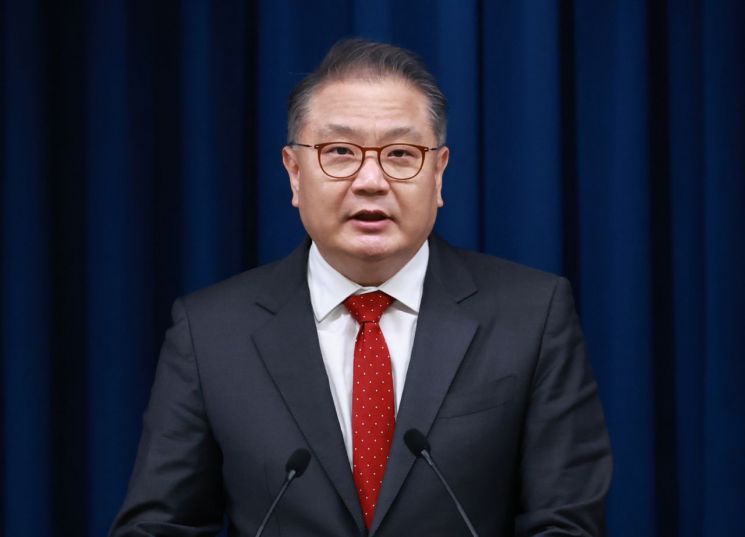 Sangwook Park, Senior Secretary for Science and Technology to the President, is giving a briefing on the five major reform directions in the field of science and technology for the second half of the term at the Presidential Office building in Yongsan, Seoul, on the 24th. Photo by Yonhap News
Park Sang-wook, Senior Secretary for Science and Technology at the Presidential Office, stated on the 24th, "We will break down the barriers between universities and public research institutions, and qualitatively transform basic research into a leading model to upgrade South Korea's national science and technology innovation ecosystem into a leading country model, an advanced country model, and a great power model." In particular, there are plans to foster 'technology commercialization specialized companies' to enable the commercialization of research and development (R&D) technologies from universities and government-funded research institutes in the public sector.
On the afternoon of the same day, Park held a briefing at the Yongsan Presidential Office regarding the 'Five Major Reform Directions in the Science and Technology Sector for the Second Half of the Year,' emphasizing the implementation of five major reforms to overcome weaknesses pointed out by domestic and international experts.
Park explained, "The government-funded research institute system has played an excellent role in conducting national strategic research, but it has been pointed out that the institutes are siloed by their respective fields." He added, "The government has taken measures to dismantle physical, institutional, and cultural barriers among these institutes and launched a top research group this year to introduce a convergent research system where multiple institutes collaborate."
He continued, "To eliminate barriers between departments at the research level, starting next year, we will implement the National Research Laboratory 2.0 (NRL 2.0) project, which supports convergent research at university-affiliated research institutes." He emphasized, "Through the NRL 2.0 project, we will support each research institute with a bundled budget of 100 billion KRW over ten years to nurture world-class university research institutes like the MIT Media Lab."
Park stated, "We will also break down the walls between universities and government-funded research institutes to share research personnel, facilities, and equipment, and allow professors and researchers to hold concurrent positions to jointly cultivate talent." He added, "We will establish a provisional 'National Research Institute Network' where global top research groups from government-funded institutes and national research institutes at universities jointly conduct mission-oriented R&D."
Active Introduction of Market Mechanisms in Technology Transfer and Commercialization
Furthermore, market mechanisms will be actively introduced into the technology transfer and commercialization of R&D outcomes in the public sector.
Park said, "The low performance in technology commercialization relative to research investment has been a representative weakness of South Korea's R&D." Accordingly, he presented a blueprint: "Going forward, we will operate a consultative body among related ministries to revise legislation and governance, and foster private technology commercialization specialized companies that can engage in all technology commercialization-related businesses without restrictions?from IP exploration and development to early scale-up and financial investment?allowing them to compete so that technologies developed by universities and research institutes become legitimate goods or capital."
It is expected that the activation of the technology commercialization market will attract private financial capital, leading to the emergence of unicorn companies originating from the public research sector.
Plans are also in place to improve the basic research support system. Park said, "We will move away from the existing 'researcher lifecycle' support based on the age and career of researchers and transition to a support system aligned with the growth stage of the research itself starting next year." He explained, "This means young researchers can conduct large-scale research depending on their capabilities and topics, and researchers already running large labs can challenge smaller projects exploring new ideas."
For national strategic fields, a new mixed top-down and bottom-up support method will be introduced, where only the topics are designated, and researchers freely propose the research content.
Park pointed out, "We will expand South Korea's scientific and technological horizons beyond borders to the world." He noted, "South Korea has been criticized for a 'closed research' ecosystem lacking openness and a tendency to conduct 'research among ourselves,' so a global open R&D system is necessary to actively utilize excellent overseas researchers as our own."
He added, "This year is effectively the inaugural year for South Korea's global R&D, with international joint R&D conducted at more than four times the scale compared to last year." He also mentioned, "Starting next year, we will participate in Horizon Europe, the European Union's representative international joint research platform."
Park emphasized, "Domestic researchers will receive EU research funding alongside member country researchers. Global R&D aims to overcome the limitations of South Korea's scale and enable us to stand alongside leading groups in game-changing fields."
Finally, R&D management will be advanced. Park said, ""To upgrade the research environment and improve research quality, we must establish an advanced R&D management system." He added, "We will improve the treatment of research administrators and create another high-quality job opportunity for science and engineering graduates, leading to enhanced expertise."
© The Asia Business Daily(www.asiae.co.kr). All rights reserved.

















