Seoul Administrative Court Rules Against Daegu Catholic University Hospital
Refused Admission of Falling Patient Citing Lack of Specialists at the Time
Last year in March, a teenager who fell from a building died after being transferred between hospitals by ambulance. The hospital that refused to admit the patient filed a lawsuit seeking to cancel the administrative sanction but lost the case.
On the 24th, the Seoul Administrative Court, Administrative Division 12 (Presiding Judge Kang Jae-won) ruled recently that Seonmok Academy, the school foundation that established and operates Daegu Catholic University Hospital, lost the lawsuit against the Minister of Health and Welfare seeking to cancel the corrective order, according to a report by Yonhap News Agency on the same day.
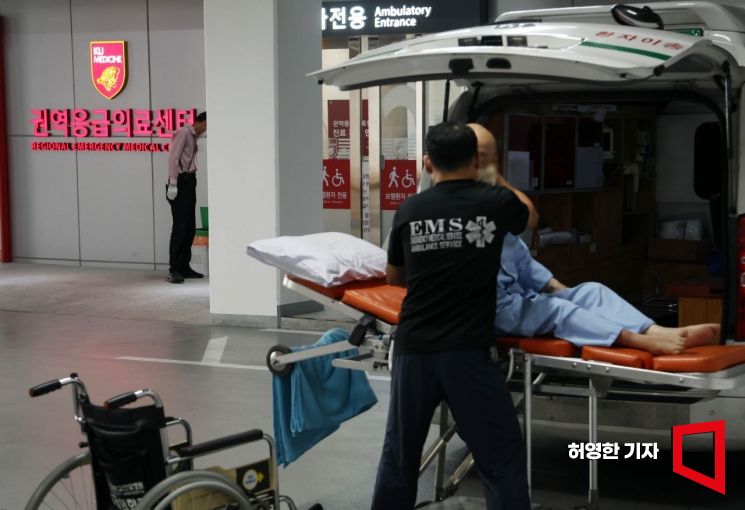 The photo is not related to the specific content of the article. A private paramedic is unloading a patient from an ambulance in front of the Regional Emergency Medical Center at Korea University Anam Hospital in Seoul.
In March last year, an accident occurred in Daegu where a 17-year-old girl, A, was presumed to have fallen from a 4th-floor building. The 119 ambulance team transported her to Daegu Fatima Hospital, a regional emergency medical center, but the emergency medicine resident did not properly perform severity classification and recommended transfer to another hospital, citing the need for treatment through the department of psychiatry. At the second hospital, Kyungpook National University Hospital, the emergency medicine resident instructed to first check with the regional trauma center without even seeing the patient. Subsequently, the ambulance crew called Daegu Catholic University Hospital’s emergency room, but the hospital refused treatment, citing the absence of neurosurgery staff. After other hospitals also consecutively refused to admit the patient, the ambulance team called Daegu Catholic University Hospital again, but the hospital repeated the same refusal, stating treatment was impossible.
Eventually, A suffered cardiac arrest while being transferred to another hospital and was later moved to Daegu Catholic University Hospital’s emergency medical center for treatment but died. The Ministry of Health and Welfare launched an investigation into the incident and issued corrective orders and a six-month suspension of subsidy payments to four hospitals: Daegu Fatima Hospital, Kyungpook National University Hospital, Keimyung University Dongsan Hospital, and Daegu Catholic University Hospital, citing “refusal to admit without justifiable reason.” In particular, Fatima Hospital and Kyungpook National University Hospital were additionally fined for violating the obligation of severity classification.
In response, Seonmok Academy of Daegu Catholic University Hospital filed a lawsuit seeking to cancel the corrective order and subsidy suspension.
During the lawsuit, the hospital argued, “We informed that all neurosurgery specialists were absent due to suspected traumatic brain injury in the patient and recommended other hospitals where neurosurgery and orthopedics were available, or stated that treatment in departments other than neurosurgery was possible,” asserting that “there was no refusal or avoidance of emergency medical care.” However, the court did not accept this claim.
Rather, the court stated, “The hospital did not directly face the suspected emergency patient or take appropriate measures but refused admission after deciding the necessary medical departments without even performing basic primary care,” concluding that Daegu Catholic University Hospital refused or avoided emergency medical care. The court further pointed out, “Despite having the facilities and manpower in the emergency room, the hospital repeatedly refused to admit the emergency patient, resulting in a serious outcome of death, which strongly condemns the refusal or avoidance of emergency medical care.”
The court also rejected the hospital’s claim that the Ministry of Health and Welfare’s six-month subsidy suspension exceeded discretionary authority, stating, “The suspension of financial support under the Emergency Medical Service Act during the corrective order implementation period does not comprehensively restrict hospital operations.”
© The Asia Business Daily(www.asiae.co.kr). All rights reserved.

















