Protest Text Against Intentional No-Show
"Will Hold Legally Responsible" Backlash
A story has been shared about a self-employed business owner who sent a text asking a customer who did not show up after making a restaurant reservation to cancel, only to be threatened with legal action.
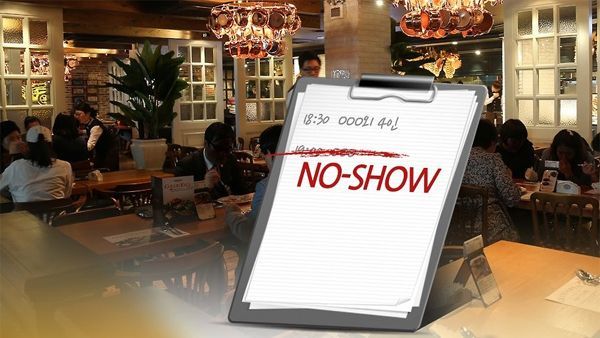
On the 21st, a post titled "Is this the right response after texting a no-show customer?" was uploaded on the self-employed online community 'Apeunikka Sajangida' (Because It Hurts, I'm the Boss). The author, Mr. A, said, "At first, I called after the reservation time passed, but the call was not answered and then hung up," adding, "Honestly, if they had just said 'I forgot' or 'I can't come today,' or even if they didn't answer the phone at all, it would have been less frustrating. But after several calls, it felt like they recognized it was our store and deliberately turned off the phone." He then shared the text messages exchanged with the customer. Mr. A admitted, "There were some emotional parts in my messages," but lamented, "There was not a single apology regarding the no-show, and they said they would take legal action."
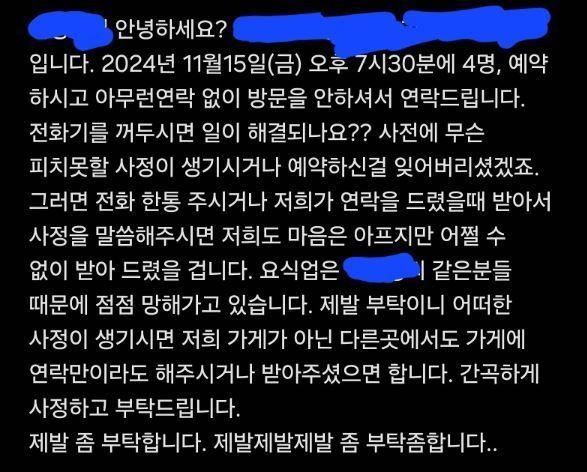 Self-employed person A's text message sent to a 'no-show' customer. Self-employed online community 'Apeunikka Sajangida'
In the disclosed text messages, Mr. A told the customer, "You made a reservation for four people and did not show up without any contact, so I am reaching out." He added, "Do you think turning off your phone will solve the issue? If so, please at least call us back or answer when we contact you and explain your situation. Although it would hurt, we would have accepted it." He continued, "The food service industry is gradually collapsing because of people like you," and pleaded, "Please, if something comes up, at least contact us or answer the phone. I am begging you."
Mr. A revealed that the reply came from a different number, not the one used for the reservation. The sender of the message stated, "Let me make it clear that sending such a message after business hours, and to your personal number, is illegal. It is itself a violation for a business owner to send personal texts to customers." They claimed, "If you want to ask for something, do it politely. People like you, who send abusive messages to customers, cause other self-employed business owners to be criticized." They added, "Your victim mentality is ridiculous; instead of blaming others, take responsibility for your own overstepping behavior," and warned, "If you contact me again in any way, I will hold you legally accountable."
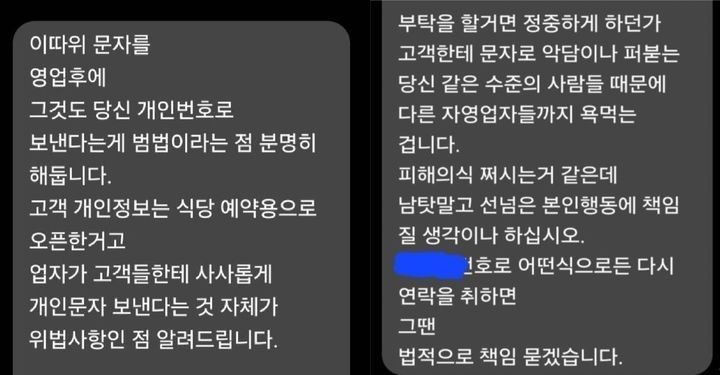 Self-employed person A sent a text message to a 'no-show' customer and received a reply from a different number. Self-employed online community "Apeunikka Sajangida"
Netizens who saw this reacted with comments such as, "For a moment, I was confused about who the perpetrator and who the victim was," "By this logic, delivery drivers sending texts would also be considered illegal collection of personal information," "The pot calling the kettle black," and "If that is illegal, then no-shows are business obstruction."
Recently, as the no-show tactic has become more sophisticated, the damage to self-employed business owners has increased. While they create and share self-help measures, they cannot help but worry about customer backlash if they implement systems like reservation deposits. Legally, no-shows constitute contract breaches and can lead to claims for damages, but practical issues such as difficulty in calculating the amount of damages arise. Some argue that intentional no-shows should be subject to charges of obstruction of business. Obstruction of business can result in imprisonment of up to five years or a fine of up to 15 million won.
© The Asia Business Daily(www.asiae.co.kr). All rights reserved.

![Clutching a Stolen Dior Bag, Saying "I Hate Being Poor but Real"... The Grotesque Con of a "Human Knockoff" [Slate]](https://cwcontent.asiae.co.kr/asiaresize/183/2026021902243444107_1771435474.jpg)

















