Taking a Nap in the Office After Working Overtime... Termination Notice
Court: "No Serious Damage Caused to the Company"
A story has emerged about a man in China who was fired after taking a nap for about an hour in the office the day after working late overtime. Having worked at the company for 20 years, he filed a lawsuit against the company claiming unfair dismissal and won.
On the 22nd, the Hong Kong South China Morning Post (SCMP) reported on a man named Jang who worked for 20 years at a chemical company in Taixing, Jiangsu Province, southeastern China. Earlier this year, after driving late at night for work-related duties, he briefly fell asleep at his office desk the next day. Jang’s nap was captured on the company’s closed-circuit television (CCTV).
Two weeks later, the company’s HR department issued a report stating, “Jang was caught sleeping at work due to fatigue.” Jang signed the document, and the company issued him an official dismissal notice. The notice stated, “Jang joined the company in 2004 under an indefinite employment contract. However, your act of sleeping at work seriously violates the company’s zero-tolerance policy.” The company added, “With the approval of the labor union, the company has decided to terminate your employment and end all labor relations between you and the company.”
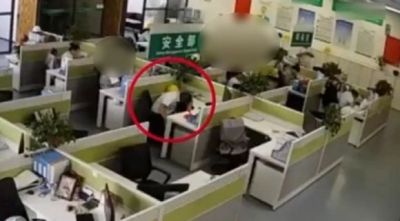 A Chinese man who was fired for taking a one-hour nap in the office after working overtime won a lawsuit and will receive compensation.
 [Image source=SCMP capture]
In response, Jang immediately filed a lawsuit against the company claiming unfair dismissal, and the court ruled in his favor, ordering the company to compensate him 350,000 yuan (approximately 67 million KRW). The court acknowledged that while an employer has the right to terminate a contract due to rule violations, certain conditions must be met, including that the violation causes significant damage to the company.
Judge Ju of the Taixing People’s Court explained, “Sleeping at work is an illegal act, but it did not cause serious harm to the company.” Furthermore, considering Jang’s outstanding performance during his 20 years at the company, the court deemed that dismissing him for a single violation was excessive.
Meanwhile, in China, rapid economic growth has intensified competition among companies, making long working hours a social issue. The term “996 work schedule” has emerged, referring to working from 9 a.m. to 9 p.m., six days a week.
In 2019, Chinese major home appliance company Haier sparked controversy when local media reported that it fired four employees for taking naps during working hours. The four employees working at Haier in Qingdao were caught by patrol staff taking naps in a teahouse instead of returning to work after lunch. The company dismissed them citing a “Level 1 rule violation.”
At the time, the company claimed the dismissal was justified as a “regulatory action.” However, following reports of the company’s strict disciplinary measures and employee testimonies that break times were only 30 minutes, online criticism surged with comments such as “treating people like machines” and “harsh employee management is no longer acceptable.”
© The Asia Business Daily(www.asiae.co.kr). All rights reserved.
![Clutching a Stolen Dior Bag, Saying "I Hate Being Poor but Real"... The Grotesque Con of a "Human Knockoff" [Slate]](https://cwcontent.asiae.co.kr/asiaresize/183/2026021902243444107_1771435474.jpg)
















