Increasing Importance of Joint Health Due to Rapid Aging
Advantages of Minimally Invasive Procedures: Maximum Effectiveness and Quick Return to Daily Life
In the aging era, joint diseases are a major factor threatening the health of the elderly.
In particular, knee osteoarthritis causes significant discomfort in daily life and lowers the quality of life. According to statistics from the Health Insurance Review and Assessment Service, the number of patients treated for degenerative arthritis increased from about 3.82 million in 2020 to about 4.33 million in 2023.
In this regard, artificial joint surgery is becoming widely performed, giving hope to arthritis patients. However, many people still have misunderstandings about artificial joint surgery. Incorrect information such as "postoperative pain is severe" and "the lifespan of artificial joints is short" persists.
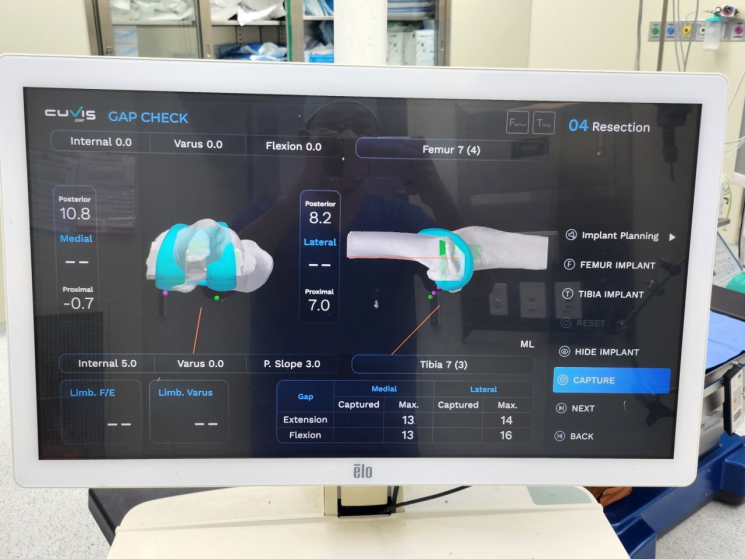
▲Artificial Joint Robot Surgery
Recently, with the advancement of cutting-edge medical technology, revolutionary changes are occurring in artificial joint surgery. This is the advent of robot surgery. Robot surgery combines the skilled techniques of specialized doctors with the precision of advanced robots, enabling safer and more accurate surgeries.
Dr. Lee Woon-sung, Director of the Orthopedic Joint Center at Centum General Hospital, explained, “Above all, we create a three-dimensional image of each patient's bones to establish an optimized surgical plan tailored to the individual's body, rather than a standardized surgery. Because the cutting is done with a steady movement accurate to 0.5 mm, bone resection is minimized and damage to surrounding ligament tissues is reduced.” He added, “Postoperative pain is less, recovery is faster, and patients can quickly return to daily life after rehabilitation.”
Centum General Hospital was the first in Korea to introduce the next-generation robotic surgical device ‘Robodoc’ and currently operates two artificial joint robotic surgery devices. Experienced and competent medical staff provide patient-customized artificial joint robot surgery. The following is a Q&A with Director Lee Woon-sung.
◆Misunderstandings and Truths about Artificial Joint Robot Surgery
▲Is it better to delay knee artificial joint surgery? Is the lifespan only 10 years?
“Factors affecting the lifespan of artificial joints include the appropriate selection of implants, surgical accuracy, rehabilitation, and proper postoperative care. Since the advent of robot surgery, surgical outcomes have improved, and it is now expected that artificial joints can last 20 to 30 years or more. In fact, delaying surgery too long can lead to poor outcomes, so surgery is recommended at ages 65 to 70.”
▲Does artificial joint surgery result in a stiff leg?
“In the past, some cases resulted in poor outcomes called ‘stiff leg’ because rehabilitation and management after surgery were inadequate, preventing sufficient flexion angles. However, recent improvements in surgical techniques and implant designs, especially with artificial joint robot surgery, have accelerated rehabilitation and recovery, allowing the joint to fully extend about two weeks after surgery.”
▲Is artificial joint surgery not possible if one is too old?
“As people age, the incidence of systemic diseases such as hypertension, diabetes, heart disease, cerebrovascular disease, and myocardial infarction naturally increases. Because of this, the risk of complications and functional recovery after surgery may be higher than in younger patients. However, the decision to perform artificial joint surgery depends not simply on chronological age but on the individual's overall health condition. Therefore, it is necessary to be evaluated by a specialist before surgery. With proper evaluation and management before and after surgery, most cases can safely undergo surgery.”
◆Improvement in Patients’ Quality of Life
Ms. Kim, a woman in her late 60s who had suffered from knee arthritis for a long time, regained her health and happiness after receiving artificial joint robot surgery. She said, “Before surgery, it was difficult even to walk, but now I am very happy to be able to freely take walks and travel with my friends.”
Dr. Park Jae-hong, Director of the Joint Center at Centum General Hospital, emphasized, “Artificial joint robot surgery goes beyond simply advancing surgical techniques; it greatly contributes to improving patients’ quality of life. Robot surgery enhances both accuracy and safety, reducing patients’ burdens and aiding rapid recovery. Additionally, we do our best to help patients maintain a healthy life through meticulous postoperative care.”
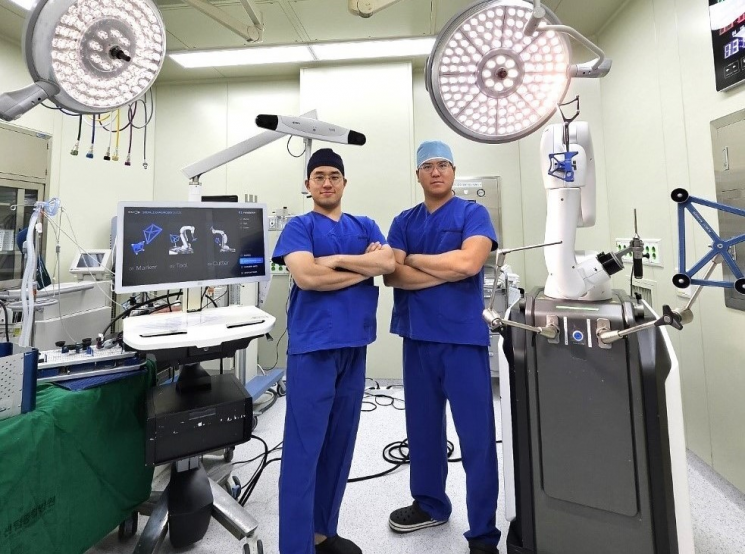 Lee Woon-sung (left), Head of the Orthopedic Joint Center at Centum General Hospital, and Jae-hong Park, Manager, are posing in front of the robotic equipment for artificial joint surgery. Photo by Centum General Hospital
© The Asia Business Daily(www.asiae.co.kr). All rights reserved.
!["I'd Rather Live as a Glamorous Fake Than as a Poor Real Me"...A Grotesque Success Story Shaking the Korean Psyche [Slate]](https://cwcontent.asiae.co.kr/asiaresize/183/2026021902243444107_1771435474.jpg)

















