First Place in Regulatory Impact Analysis and Post-Evaluation
Stakeholder Participation Ranks 3rd by Legal Standards
This year, South Korea ranked first in multiple categories in the Organisation for Economic Co-operation and Development (OECD) Regulatory Policy Evaluation. Having previously remained in the upper ranks, it secured the top position for the first time this year. The government praised the significance of this achievement, noting that other countries are seeking to learn from Korea's administrative system. The government’s plan is to enhance its influence in the international community as an advanced regulatory country.
On the 24th, the government announced that South Korea achieved first place in two categories (Regulatory Impact Analysis and Ex-post Evaluation) in the '2024 OECD Regulatory Policy Evaluation,' conducted among 38 OECD member countries. For the first time this year, South Korea also ranked first in the transparency index covering three categories publicly released by the OECD.
Since 2015, the OECD Regulatory Policy Committee has evaluated member countries’ regulatory policies every three years by dividing them into three categories: ▲Regulatory Impact Analysis (review of new and strengthened regulations, etc.) ▲Ex-post Evaluation (review of the appropriateness of existing regulations, etc.) ▲Stakeholder Participation (collecting public opinions during regulation introduction·implementation·and evaluation) and then publishes the results.
This year, South Korea ranked first in both laws and subordinate statutes (enforcement decrees and enforcement rules) in Regulatory Impact Analysis. Previously ranked between 2nd and 4th, it achieved first place for the first time this year. The Regulatory Reform Committee’s expansion of in-depth review targets, thoroughly examining the necessity and appropriateness of new and strengthened regulations, influenced this outcome.
In Ex-post Evaluation, South Korea also ranked first among 38 member countries in both laws and subordinate statutes. Compared to 2021, laws rose from 5th to 1st place, and subordinate statutes from 7th to 1st. This result came from periodic reviews to check whether side effects, which were difficult to foresee before regulation enforcement, did not occur after enforcement and whether the initial regulatory objectives were achieved.
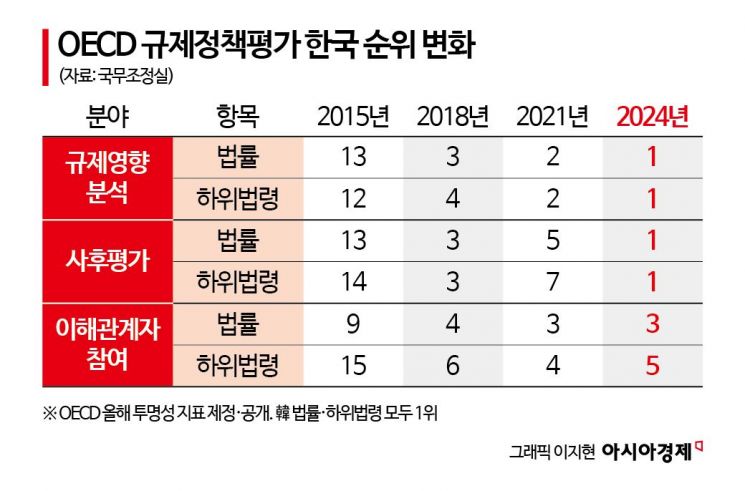
In Stakeholder Participation, South Korea ranked 3rd in laws and 5th in subordinate statutes. The ranking for laws remained the same as in 2021, while subordinate statutes dropped one place from 4th to 5th. Although this is a less satisfactory result compared to other categories, the government explained that the absolute scores increased compared to 2021.
Nam Hyung-gi, Deputy Minister of the Office for Government Policy Coordination, said, "This evaluation relatively assessed procedures that provide feedback to stakeholders during administrative processes. Some countries’ scores increased, so while the ranking for laws remained the same, the ranking for subordinate statutes dropped."
In the transparency ranking, which the OECD publicly released for the first time this year covering the three categories, South Korea ranked first in both laws and subordinate statutes. This result reflects the government’s efforts to disclose regulatory information online and to publish new and strengthened regulations at the Government Legislation Support Center.
Deputy Minister Nam said, "Foreign countries are showing keen interest in and learning from Korea’s administrative system," adding, "We take pride in ranking first among major OECD members." He also described this achievement as an "administrative Korean Wave."
Since May 2022, the government has improved over 2,900 regulations. It expects an economic effect of approximately 148 trillion won through investment creation and sales expansion. Going forward, the government plans to expand cooperation with international organizations to fulfill its role as an advanced regulatory country in the international community.
Deputy Minister Nam stated, "There are cases where regulatory improvement outcomes that should have been effective through legal amendments have not materialized in practice due to incomplete legislation. We will work with the National Assembly to ensure these amendments are enacted."
This year’s OECD Regulatory Policy Evaluation covered the regulatory policies and systems of 38 member countries from 2021 to last year. In May last year, the OECD Regulatory Policy Committee surveyed member countries on regulatory impact analysis, ex-post evaluation, stakeholder participation, and general regulatory policies, and the Office for Government Policy Coordination submitted responses and supporting documents.
The OECD has individually informed each country of this year’s evaluation results. In May next year, the OECD plans to publish the '2024 Regulatory Policy Outlook' on its website, which will include detailed content of this year’s evaluation, an overview of member countries’ regulatory policies, and best practices.
© The Asia Business Daily(www.asiae.co.kr). All rights reserved.

















