Alternative for Local Golf Courses Facing Robot Labor Shortage
Utilizing Cleaning Robots, Serving Robots, Guide Robots, Delivery Robots
24-Hour Operation, Smooth Employment, Labor Cost Reduction
Can robots be an alternative to the ‘labor shortage’ at golf courses?
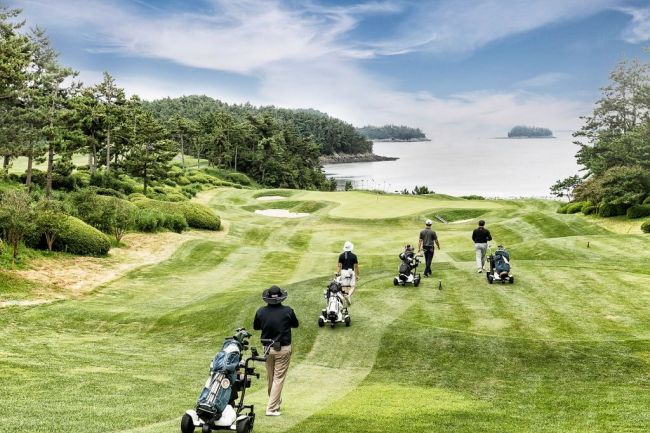 Robots are emerging as a solution to the labor shortage at local golf courses. Weekend golfers are enjoying rounds with robot caddies at Pine Beach Golf Links. Photo by Pine Beach Golf Links
The representative of Golf Course A in Chungbuk expressed difficulties in recruiting staff. "It is not easy to find people. There is a tendency to avoid hard and difficult work," he said, adding, "Even when we hire, many quit after just one year. It is really a concern for golf course management." He also mentioned, "Recently, we purchased three serving robots. Customers still feel awkward about being served by robots."
Domestic golf courses enjoyed a COVID-19 boom starting in 2020. Golf courses nationwide experienced a boom. However, difficulties began as the pandemic ended. In the metropolitan area, there are no major operational difficulties. It is still not easy to make reservations. But the situation is different in the provinces. It is so tough that there are times with no customers and empty slots. On top of that, frequent employee resignations add to the worries.
In provincial golf courses, robots are increasingly taking on human roles. Robots are emerging as problem solvers. They are using cleaning robots, guide robots, delivery robots, and serving robots. The price range of robots varies. A cleaning robot can be purchased for around 50 million KRW, and a serving robot for about 20 million KRW.
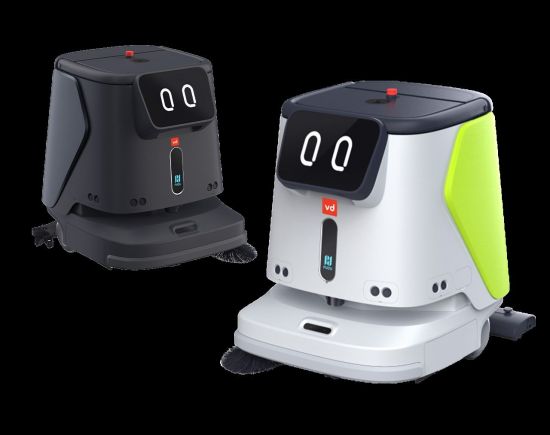 Cleaning robots are relatively expensive to purchase, but they are economical in the long run. Photo by VD Company
Using robots can reduce labor costs. For example, hiring a staff member to clean the clubhouse requires a minimum annual salary of 32 million KRW. On the other hand, although the initial purchase cost of a cleaning robot is high, it is quite competitive.
The strength of cleaning robots lies in their economic efficiency. The golf industry evaluates that "one robot performs the work of 0.5 people." It perfectly cleans an average area of about 500 pyeong (approximately 1,650 square meters) in two hours daily. Over five years, it can save up to 200 million KRW in cumulative labor costs. It maintains cleanliness, leaving a good impression on customers. It has four cleaning functions: wet and dry cleaning, sweeping, and mopping. With autonomous driving technology, it can operate on various floor materials.
Cleaning robots autonomously detect dirty areas and create a pleasant environment. Besides the golf course clubhouse, they can also care for restaurants and lodging facilities. They perfectly remove soil and dust left by customers after rounds. They avoid obstacles and people automatically. Robots handle tasks that people tend to avoid.
Unlike humans, robots can operate 24 hours outside of working hours. When charging is needed, they move to the charging station by themselves. They can be remotely controlled via a dedicated app. Cleaning effectiveness can also be monitored. Even during breakdowns or maintenance, the robot’s status and location can be tracked.
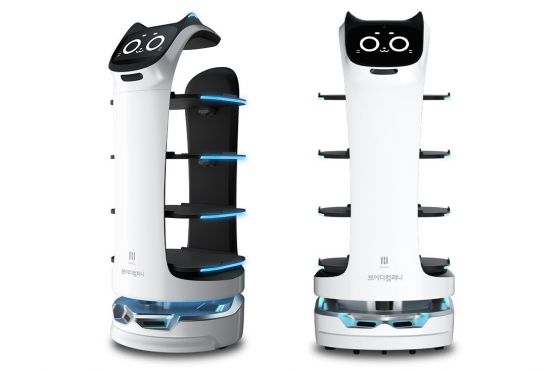
Many golf courses are focusing on AI as preparation for the future. From reservations to check-in, everything is handled through apps and kiosks, enabling contactless service. Drones are used for course management to spray pesticides. They also scan the course to identify overall issues and assist in repairing problem areas. Additionally, robots necessary for golf courses have appeared. They are used at places such as Jayu CC, Sagewood Hongcheon, Gochang CC, Lotte Skyhill, Pine Beach, and All Day Tejeve CC.
Jayu CC is a representative golf course that uses many robots. It first introduced them in January 2022. This is the stabilization period for robot use. Currently, it operates a total of six robots: two cleaning robots, one delivery robot, two serving robots, and one caddie bag transport robot.
Kim Heegon, Operations Team Manager at Jayu CC, said, "We are greatly benefiting from the help of robots," adding, "It did not start with the intention to reduce human staff; the roles of robots and humans are clearly distinguished." He continued, "The workload and performance at the golf course have definitely improved. The remaining staff can be reassigned elsewhere, which is good. I also feel that work concentration has increased. We are not increasing the workforce anymore."
Golf course robots are still in their early stages. More technological advancement is needed. Caddie robots are also gradually being introduced. However, domestic golf courses are located in mountainous terrain. Product development that considers safety during operation is necessary. Manager Kim said, "For cleaning robots that are not the latest version, human assistance is needed to open automatic doors and ride elevators," and predicted, "In the next 5 to 10 years, robots will be fully established at golf courses."
© The Asia Business Daily(www.asiae.co.kr). All rights reserved.



















