End of Stalemate... Increased Possibility of Ruling and Opposition Agreement
Disagreements Remain on Alternative Bills Following the Abolition of the Dantong Act
The "Basic Act on the Development of Artificial Intelligence and the Establishment of Trust" (AI Basic Act), which has been discussed since the 21st National Assembly, is increasingly likely to pass through the National Assembly this year. The "Device Distribution Act (Dantong Act)," criticized for reducing consumer subsidy benefits, is also undergoing abolition procedures after 10 years. Both bills are being promoted through bipartisan agreement as they have been demanded not only by the science and technology sectors but also by the general public.
The National Assembly's Science, Technology, Information and Broadcasting and Communications Committee (STIBC) Subcommittee on Bill Review passed the AI Basic Act and the abolition bill of the Dantong Act on the afternoon of the 21st. Once passed by the full STIBC meeting and the plenary session, the legislative process will be completed. The AI Basic Act, proposed in December 2022, gained momentum following the EU's passage of the Artificial Intelligence (AI) Act in 2023. Although there was speculation about a possible agreement at the end of the 21st National Assembly in May, it was ultimately discarded. Discussions continued into the 22nd National Assembly, and on the 13th, the policy chiefs of both ruling and opposition parties agreed on the AI Basic Act.
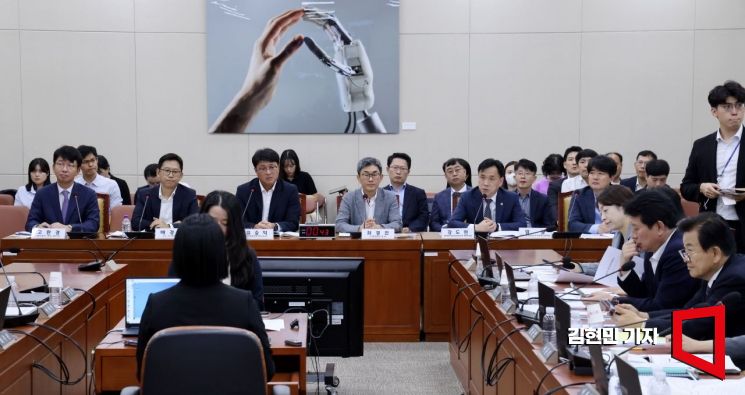 Kang Dohyun, Vice Minister of the Ministry of Science and ICT, is answering questions at a public hearing on artificial intelligence and digital inclusion-related bills held by the National Assembly's Science, Technology, Information and Broadcasting and Communications Committee on September 24. Photo by Kim Hyunmin
The AI Basic Act, which passed the STIBC subcommittee this time, was approved by merging 19 bills. It establishes the legal basis for setting up a National AI Committee, introduces grounds for AI-related research and development, and includes industrial promotion measures such as support for AI-related R&D. The industry’s concern over excessive regulation led to the exclusion of the "Prohibited AI" provisions. However, a new responsibility for operators regarding "High-impact AI" was introduced. This means AI technologies that pose risks such as personal information leakage are classified as high-impact and regulated accordingly.
The STIBC subcommittee also passed the abolition bill of the Dantong Act by bipartisan agreement. The abolition bill was directly mentioned by Lee Jae-myung, leader of the Democratic Party, and both the government and the People Power Party have expressed their intention to promote it. The Dantong Act was introduced in 2014 under the pretext of improving the device distribution structure, but it has been criticized for leveling down consumer subsidy benefits and increasing illegal subsidy payments.
As an alternative to the abolition of the Dantong Act, the "Partial Amendment to the Act on Promotion of Information and Communications Network Utilization and Information Protection, etc." (Amendment Bill) was also passed. The amendment includes provisions such as mandatory submission of data by manufacturers and prohibition of discriminatory subsidy payments. However, ruling party lawmakers oppose the amendment. People Power Party lawmaker Park Chung-kwon criticized, "When we said to abolish regulations, they created even stronger regulations."
© The Asia Business Daily(www.asiae.co.kr). All rights reserved.

















