As the war in Ukraine intensifies, European natural gas prices have soared to their highest level in a year. International oil prices also rose.
On the 21st (local time), natural gas December futures on the Netherlands TTF gas futures exchange closed at 48.640 euros (about 71,395 won) per megawatt-hour (㎿h), up 3.94% from the previous session. This is the first time in a year since November last year that natural gas futures prices have exceeded 48 euros.
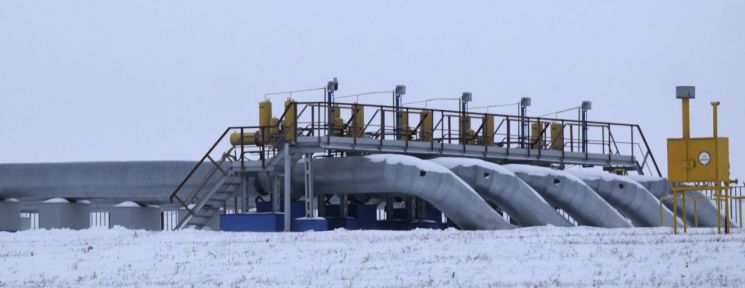
Earlier, European natural gas prices surged to around 300 euros (about 440,000 won) in August 2022, right after the outbreak of the war in Ukraine, but had fallen to the low 20-dollar range by last February. However, since then, the situation has escalated daily due to Ukraine's invasion of Kursk in Russia, the recent deployment of North Korean troops, and the U.S. lifting restrictions on the use of ATACMS missiles.
Concerns over the escalation surrounding Ukraine heightened further on this day as the Ukrainian military announced that Russia had launched an intercontinental ballistic missile (ICBM). Shortly after, Russian President Vladimir Putin confirmed that the weapon used in the attack was not an ICBM but a new type of hypersonic intermediate-range ballistic missile (IRBM) without a nuclear warhead, but fears of escalation have not easily subsided.
News also emerged that Gazprombank, the financial subsidiary of Russia's state-owned energy company Gazprom, was added to the U.S. sanctions list that afternoon, fueling concerns over gas supply. Gazprombank has mediated natural gas transactions between Russia and Europe by receiving euros, converting them to rubles according to the Russian government's ruble payment policy since the outbreak of the war, and then paying Gazprom. Florence Schmidt, an energy strategist at Rabobank, explained, "This could lead to some transactions being halted and result in supply delays and reductions."
Since the outbreak of the war in Ukraine, Europe has steadily reduced its dependence on Russian natural gas by increasing energy imports from the U.S., Norway, and other countries. However, some Central and Eastern European countries such as Austria, Hungary, and Slovakia still import Russian gas, failing to completely sever the connection. TASS news agency reported, based on Eurostat and its own data, that in September, the EU's imports of Russian pipeline gas reached 840 million euros (about 1.2 trillion won), the highest since February last year.
International oil prices also showed an upward trend due to rising geopolitical tensions. On this day, West Texas Intermediate (WTI) crude oil for January delivery on the New York Mercantile Exchange closed at $70.10 per barrel, up $1.35 (1.96%) from the previous session. This is the first time since the 8th that WTI has closed above $70 per barrel. Brent crude, the global oil price benchmark, also closed at $74.35 per barrel, up $1.54 (2.12%) from the previous session, marking the highest closing price since the 7th of this month.
© The Asia Business Daily(www.asiae.co.kr). All rights reserved.

















