'After Deduction Inheritance' Changed to 'Inheritance After Deduction' After 30 Years
Partial Remand of Children Not Eligible for Survivor Pension Rights
The Supreme Court plenary session has ruled that when deducting survivor's pensions from the compensation claims equivalent to lost retirement pensions inherited by the heirs of a deceased testator, the deduction should only be made from the compensation claims inherited by the heir who actually receives the survivor's pension.
This ruling adopts the so-called 'deduction after inheritance' method, where to prevent overlapping compensation for damages after inheritance shares are distributed, only the compensation claims inherited by the heir receiving separate benefits such as pensions are deducted. This marks a change in Supreme Court precedent after 30 years.
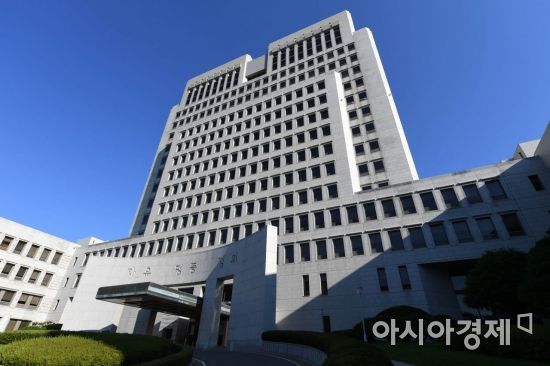
In this case, the spouse of a university professor who died in a traffic accident was a beneficiary receiving a survivor's pension under the Private School Teachers' Pension Act. Instead of first deducting the survivor's pension from the compensation claims (lost retirement pensions) that the heirs?the spouse and children?would claim from the perpetrator and then dividing the remainder among the three heirs, the entire compensation claim was inherited by the three heirs according to their respective shares, and only the spouse, as the survivor's pension beneficiary, was required to deduct the survivor's pension amount from the compensation claim they inherited.
Previously, in 1995, the Supreme Court adopted the 'deduction before inheritance' method in a case involving the Private School Teachers' Pension, where to prevent double payment, survivor's pensions were deducted from the entire compensation claim equivalent to lost retirement pensions under the Government Employees Pension Act, which the Private School Teachers' Pension Act applies mutatis mutandis, and the remainder was jointly inherited. The Supreme Court plenary session has now overturned this precedent.
On the 21st, the Supreme Court plenary session unanimously overturned the appellate court's ruling that calculated damages using the 'deduction before inheritance' method in a compensation claim lawsuit filed by the wife Hong and children A and B of the deceased KAIST professor Shin against the National Taxi Transport Business Association, and remanded the case to the Seoul Central District Court.
The court annulled the appellate court's ruling regarding the lump-sum lost retirement pension portion for A and B, dismissed Hong's appeal, and rejected the remaining appeals of A and B.
The court pointed out, "The appellate court should not have concluded that there was nothing left to inherit after deducting the occupational survivor's pension from the entire compensation claim equivalent to the deceased's lost retirement pension lump sum. Instead, it should have recognized that the compensation claim equivalent to the lost retirement pension lump sum is jointly inherited by the heirs according to their respective shares, and only deducted the occupational survivor's pension from the compensation claim inherited by the beneficiary."
It added, "The appellate court erred in its legal reasoning regarding the order and personal scope of deductions of occupational survivor's pensions from the compensation claim equivalent to lost retirement pensions, which affected the judgment, thus warranting reversal and remand."
Furthermore, the court stated, "Upon remand, the appellate court needs to carefully examine who the beneficiary of the occupational survivor's pension is before making deductions, and determine the scope and target of the deduction accordingly."
Regarding the appeal on the negligence ratio, the court said, "We accept the appellate court's assessment that the deceased's negligence ratio was 20%, limiting the perpetrator vehicle's liability to 80%. There is no error in the negligence assessment that affected the judgment."
This case concerns the order and personal scope of deducting occupational survivor's pensions from compensation claims equivalent to lost retirement pensions.
Regarding this, the Supreme Court stated, "The compensation claim equivalent to the lost retirement pension arising from the death of a person who could have received a retirement pension due to an occupational injury caused by another's illegal act is jointly inherited by the heirs according to their respective shares, and thereafter, the occupational survivor's pension received by the beneficiary is deducted only from the compensation claim equivalent to the lost retirement pension inherited by that beneficiary (deduction after inheritance method)."
It added, "We overturn the previous Supreme Court precedent that held the 'deduction before inheritance' method, where survivor's pensions are first deducted from the entire compensation claim equivalent to lost retirement pensions, and the remainder is jointly inherited by the heirs according to their shares."
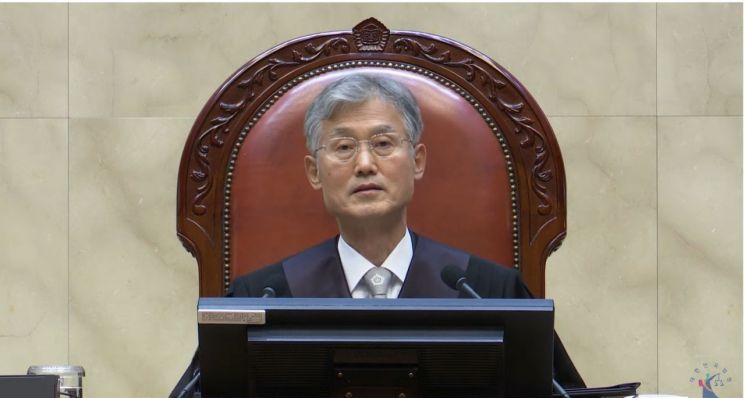 Chief Justice Cho Hee-dae is delivering the Supreme Court plenary session ruling on the 21st at the Supreme Court courtroom in Seocho-gu, Seoul. Photo by the Supreme Court
On September 30, 2016, Shin was riding a motorcycle in the first lane of a two-lane road in Danyang-gun, Chungbuk, when a taxi suddenly crossed the center line from the second lane to make a U-turn and collided with the front of the motorcycle, resulting in Shin's death at the scene.
Shin's wife Hong and their two children filed a lawsuit against the National Taxi Transport Business Association, the insurer under the automobile mutual aid contract for the offending vehicle, claiming damages of approximately KRW 758 million (Hong) and KRW 736 million (A and B).
The first-instance court applied the 'deduction after inheritance' method and ordered the association to pay Hong about KRW 187 million, and A and B about KRW 336 million each plus interest. After the lost retirement pension that Shin could no longer receive due to death was inherited by Hong and the two children, only Hong, as the first-priority beneficiary under the Private School Teachers' Pension Act, had the survivor's pension special additional payment of about KRW 46 million and survivor's pension of about KRW 149 million, which she had already received from the pension fund, deducted.
Under this method, Hong received no retirement pension, while the two children each received about KRW 43 million in retirement pension. The total amount including consolation money was recognized by the court as damages.
The defendant association argued that since deducting the survivor's pension and special additional payment from Shin's lump-sum retirement pension left no remaining lost retirement pension lump sum, not only Hong but also A and B could not inherit it, but this was rejected.
On the other hand, the appellate court applied the 'deduction before inheritance' method adopted by the Supreme Court in 1994 in a case involving a member of the Busan Municipal Symphony Orchestra who died in a traffic accident, overturned the first-instance ruling ordering payment of about KRW 300 million to A and B, and dismissed the plaintiffs' claims.
The court reasoned that since the Private School Teachers' Pension Act applies the Government Employees Pension Act mutatis mutandis, that precedent should also apply to Shin's case.
However, the Supreme Court's judgment differed.
The court stated, "If the beneficiary of the occupational survivor's pension also inherits the compensation claim equivalent to the lost retirement pension, they would receive double benefits with the same purpose, such as retirement pensions aimed at stabilizing the beneficiary's livelihood and welfare. Therefore, it is equitable to deduct the occupational survivor's pension only from the compensation claim equivalent to the lost retirement pension inherited by the beneficiary."
It continued, "However, heirs who are not beneficiaries cannot be considered to receive double benefits even if they receive the compensation claim equivalent to the lost retirement pension they inherited. Therefore, occupational survivor's pensions should not be deducted from the compensation claims inherited by heirs who are not beneficiaries."
In this case, only the spouse Hong actually receives the survivor's pension, so it is unfair to deduct the survivor's pension first from the compensation claims equivalent to the lost retirement pension jointly inherited by heirs who do not receive survivor's pensions, such as lineal descendants.
The court explained, "The compensation claims inherited by heirs who are not beneficiaries and the occupational survivor's pension rights belong to different subjects and cannot be considered complementary. Therefore, the payment of occupational survivor's pensions does not constitute compensation for the compensation claims inherited by other heirs who are not beneficiaries. If such deductions were made, all or part of the compensation claims would be deprived."
It added, "If the scope of deduction of occupational survivor's pensions from compensation claims equivalent to lost retirement pensions is broadly recognized as in the 'deduction before inheritance' method emphasizing overlapping compensation, it would result in exempting the perpetrator's liability using social security funds and undermine the purpose and intent of social security laws aimed at stabilizing the beneficiary's livelihood and welfare."
For these reasons, the court concluded that when a testator who could have received a retirement pension dies due to another's illegal act, the compensation claim equivalent to the lost retirement pension is first jointly inherited by the heirs, and only the heir receiving the survivor's pension should deduct the survivor's pension they received (the 'deduction after inheritance' method).
Finally, the court stated that it overturns the previous Supreme Court precedent that adopted the 'deduction before inheritance' method in cases involving the Government Employees Pension Act.
The court explained, "Since the Private School Teachers' Pension Act applies the Government Employees Pension Act and the Government Employee Accident Compensation Act mutatis mutandis regarding the types, reasons, amounts, and limitations of benefits, it is difficult to interpret them differently. The Supreme Court's fundamental and final interpretation of the applicable provisions is consistent with the coherence of the legal order."
It added, "The Supreme Court rulings such as 93Da57346, which held that survivor's pensions are deducted first from the entire compensation claim equivalent to lost retirement pensions under the Government Employees Pension Act applied mutatis mutandis by the Private School Teachers' Pension Act, and the remainder is jointly inherited ('deduction before inheritance' method), are changed to the extent they conflict with this ruling's view ('deduction after inheritance' method)."
© The Asia Business Daily(www.asiae.co.kr). All rights reserved.


















